 Popular
Demographics of Cody, WY
Affluence Level in Cody, WY
A middle-class area roughly in line with national averages across income, home values, education, and employment.
People of Cody, WY
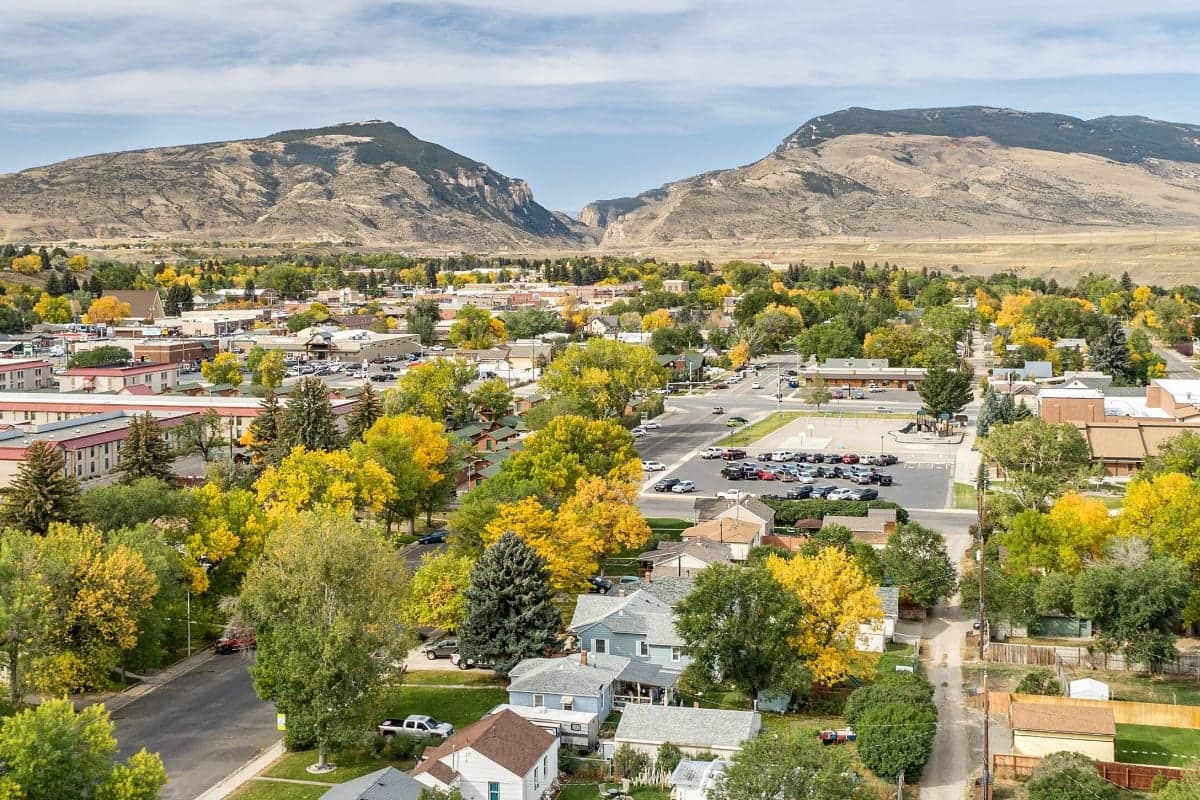
The people of Cody, Wyoming, today number 10,121 and form a notably homogeneous community shaped by a century of steady, predominantly domestic migration. The city is overwhelmingly white (91.0%) with a small Hispanic population (4.7%) and a foreign-born share of just 1.2%, reflecting its character as a culturally stable, family-oriented gateway to Yellowstone. Distinctive identity markers include a strong Western ranching and tourism economy, a politically conservative tilt, and a population that values outdoor recreation and community self-reliance.
How the city was settled and grew
Cody was founded in 1896 by Colonel William F. "Buffalo Bill" Cody as the hub of his irrigation and land-development scheme in the Bighorn Basin. The original population was drawn by the promise of irrigated farmland and the construction of the Chicago, Burlington & Quincy Railroad, which reached Cody in 1901. Early settlers were overwhelmingly native-born white homesteaders from the Midwest and Great Plains, along with a small number of European immigrants (primarily German and Scandinavian) who worked the land and built the town's first infrastructure. The historic Downtown Cody district, centered on Sheridan Avenue, was the commercial and social heart built by these early ranchers and merchants. The South Fork area, along the South Fork of the Shoshone River, became the primary agricultural settlement zone, where homesteaders established ranches and irrigated fields. A second wave arrived during the 1920s and 1930s, driven by the completion of the Buffalo Bill Dam (1910) and the subsequent expansion of irrigated agriculture, which attracted more Midwestern farm families. The West Side neighborhood, west of the downtown core, grew during this period as a residential area for dam workers and railroad employees. The city's population remained overwhelmingly white and native-born through the mid-20th century, with no significant immigrant or minority enclaves forming.
Modern era (post-1965)
After the 1965 Immigration and Nationality Act, Cody experienced virtually no shift in its racial or ethnic composition. The foreign-born share remained below 2%, and the city did not attract the post-1965 immigrant waves that transformed many other Western towns. Instead, domestic in-migration became the dominant demographic force, driven by two main factors: the expansion of tourism (Yellowstone National Park draws millions of visitors annually) and the growth of the energy sector (oil and gas development in the Bighorn Basin). The Skyline neighborhood, on the city's eastern edge, was developed in the 1970s and 1980s as a suburban-style subdivision for middle-class families employed in tourism, energy, and local government. The Mountain View area, south of the downtown core, absorbed a mix of retirees and second-home buyers drawn by the area's scenery and low crime. The Hispanic population grew modestly from near-zero in 1970 to 4.7% by 2020, concentrated primarily in service-sector jobs in hospitality and construction, but no distinct Hispanic neighborhood emerged. The Asian population (0.4%) and Black population (0.3%) remain negligible, with most Asian residents working in professional roles at the local hospital or schools. The Indian-subcontinent population is effectively zero (0.0%). The city's racial homogeneity has been reinforced by the high cost of housing (median home value above $400,000) and the limited availability of rental units, which screens out lower-income and immigrant populations.
The future
Cody's population is projected to grow slowly, reaching roughly 11,000–11,500 by 2040, driven primarily by domestic in-migration of retirees and remote workers seeking a low-tax, high-amenity lifestyle. The population is not becoming more diverse in any meaningful sense. The Hispanic share may inch upward to 6–7% as service-sector jobs continue to attract some migrant labor, but the foreign-born share is expected to remain below 3%. The North Cody area, near the Yellowstone Regional Airport, is the primary zone for new residential development, with several subdivisions planned for single-family homes targeting families and retirees. The East Entrance Road corridor is seeing growth in vacation rentals and short-term lodging, which is shifting the housing stock away from permanent residents. The cultural identity of Cody is likely to remain strongly Western, conservative, and recreation-oriented, with no significant pressure toward multiculturalism. For someone moving in now, Cody offers a stable, safe, and culturally predictable environment, but one with very limited racial or ethnic diversity and a population that skews older and wealthier than the national average.
In summary, Cody is becoming a slightly older, slightly wealthier, and still overwhelmingly white community, with growth concentrated in suburban-style subdivisions on the northern and eastern edges. The city's cultural evolution is one of continuity rather than transformation, making it a good fit for those seeking a traditional Western small-town lifestyle with strong community ties and low crime, but a poor fit for those seeking racial or ethnic diversity or a rapidly changing social landscape.

* Values derived from national, state, county, city and local statistics and may differ in a specific area. Last updated: 2026-10-02T20:49:12.000Z
Narrative content on this page is AI-generated and may contain mistakes. Verify any details that matter before acting on them.
ReloMaps may earn a commission from affiliate links at no extra cost to you.

