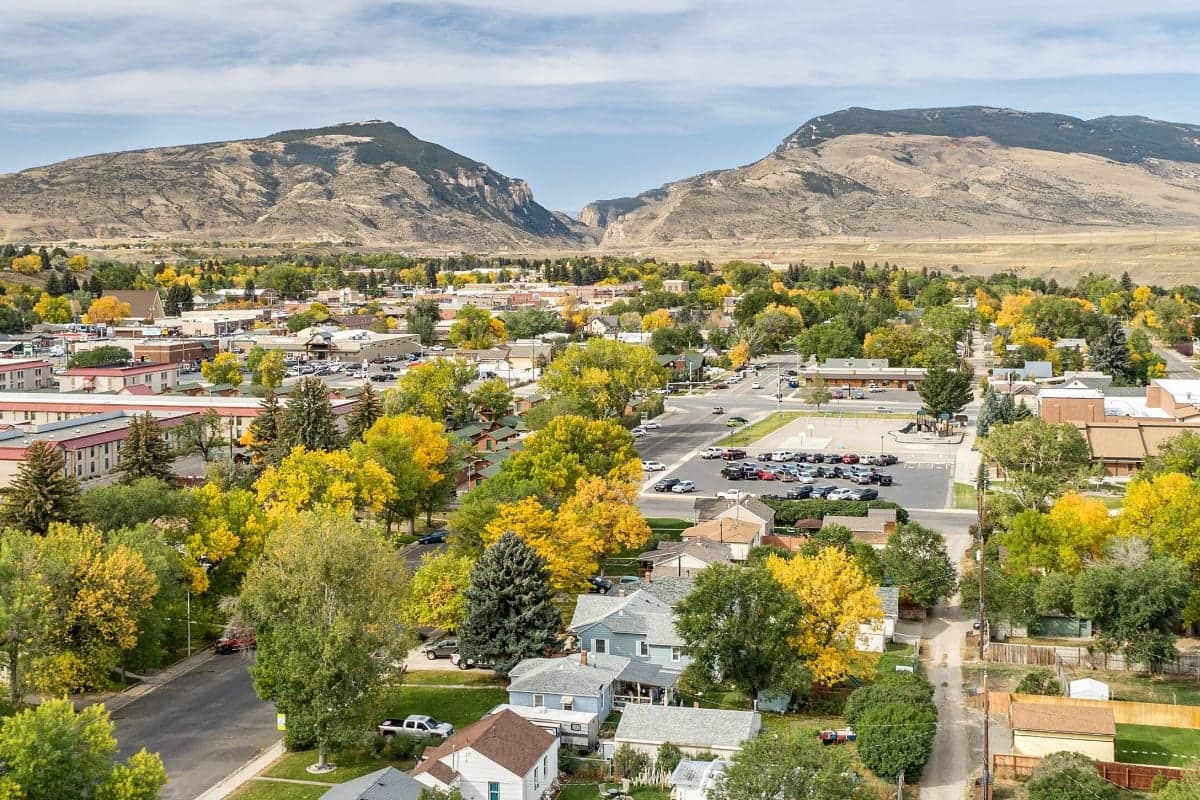
 Popular
Political ClimatePolitical Climate in Cody, WY
District shown is the primary district for this city’s centroid. Cities may span multiple districts.
Inherited from parent state — no local data available.
Local Political AnalysisPolitical Analysis of Cody, WY
Cody, Wyoming, is about as reliably conservative as a place gets, with local elections often decided in the Republican primary and Democrats rarely fielding candidates for county offices. The town sits in Park County, which voted over 75% for Donald Trump in 2020 and 2024, a margin that has actually widened slightly in recent cycles. While the state of Wyoming as a whole is the most Republican-leaning state in the nation by partisan voting index, Cody’s politics are notably more culturally and socially conservative than even the state average, driven by a strong ranching, tourism, and energy extraction economy.
How it compares
Compared to the rest of Wyoming, Cody feels distinctly more "Old West" in its political culture. The state’s largest city, Cheyenne, and the college town of Laramie both have visible Democratic minorities and occasional progressive activism, especially around the University of Wyoming. In Cody, you’d be hard-pressed to find a single elected official who isn’t a Republican, and the local discourse is heavily shaped by Second Amendment advocacy, federal land use debates, and opposition to environmental regulations. The nearby town of Powell, just 20 miles east, is similarly conservative but has a slightly more agricultural, less tourist-driven flavor. The contrast is sharpest with Jackson Hole, about 90 miles south, where a mix of wealthy transplants and seasonal workers has created a more politically mixed, occasionally liberal-leaning enclave—though even Teton County is purple, not blue.
What this means for residents
For conservative residents, Cody is a place where their values are the default: gun rights are rarely challenged, property taxes are low, and local government is small and hands-off. The school board and city council meetings rarely feature the culture-war fights seen elsewhere, because there’s broad consensus on most issues. For liberal or moderate residents, the reality is more isolating. There is no organized Democratic Party presence in Park County, and progressive viewpoints are often met with polite dismissal or open hostility. Socially, it can be tough for newcomers who don’t share the dominant political outlook—many find their social circles limited to fellow transplants or the few moderate Republicans who keep their heads down. That said, the town’s strong sense of community and neighborliness means that political differences rarely interfere with daily life in practical ways, like helping a neighbor with a snowblower or volunteering at the rodeo.
Culturally, Cody’s politics are deeply tied to its identity as the "Rodeo Capital of the World" and the gateway to Yellowstone’s East Entrance. The annual Cody Stampede and the Buffalo Bill Center of the West reinforce a frontier self-reliance that translates into skepticism of federal land management and a preference for local control. Policy-wise, this means the town has resisted zoning regulations that might limit development, and it strongly supports the energy industry—coal, oil, and natural gas—even as those sectors decline nationally. Looking ahead, the trajectory is toward even deeper conservatism, as younger residents who stay tend to be those who embrace the lifestyle, while more moderate or liberal-leaning locals often move to larger cities for work or education. If you’re considering a move here, understand that the political climate isn’t just a backdrop—it’s woven into the fabric of daily life, from the bumper stickers on trucks to the conversations at the coffee shop.

State Political ClimatePolitical Climate in Wyoming
State Political AnalysisPolitical Environment in the State
Wyoming is one of the most reliably Republican states in the nation, with a partisan lean that has only deepened over the past two decades. In the 2024 presidential election, Donald Trump carried the state by a margin of roughly 46 points, a slight increase from his 43-point win in 2020 and a significant jump from the 25-point margin George W. Bush enjoyed in 2004. The dominant coalition is a blend of rural ranchers, energy-sector workers, and a growing number of conservative transplants from blue states, all united by a fierce commitment to limited government, gun rights, and energy independence. While Democrats once held a foothold in union-heavy mining towns and the state capital, that presence has eroded to the point where no Democrat holds statewide elected office, and the party’s registration hovers around 15%.
Urban vs. rural divide
The political map of Wyoming is defined by a stark urban-rural split, though even the "urban" areas are small by national standards. Cheyenne, the state capital and largest city (pop. ~65,000), is the most politically moderate area, with Laramie County occasionally electing a Democratic state senator or representative. Casper, the second-largest city, leans conservative but has a more pragmatic, energy-industry-driven Republicanism. The real engine of the state’s deep-red tilt is the vast rural expanse: counties like Sublette, Lincoln, and Park routinely vote 80%+ Republican. Teton County, home to Jackson Hole and Yellowstone tourism, is the glaring exception — it’s the only county that consistently votes Democratic, driven by wealthy second-home owners and a service-industry workforce. In 2024, Teton County went for Kamala Harris by about 15 points, while every other county backed Trump by at least 30 points. The divide is less about ideology and more about density: the few towns with a critical mass of government workers or tourism dollars tilt left, while the rest of the state is uniformly conservative.
Policy environment
Wyoming’s policy environment is a textbook example of small-government conservatism. There is no state income tax, and the sales tax is a low 4% (local options can push it to 6%). Property taxes are among the lowest in the nation, with no tax on retirement income. The regulatory posture is aggressively pro-business, especially for the energy sector — oil, gas, and coal extraction are lightly regulated, and the state has fought federal environmental rules in court repeatedly. Education policy is locally controlled, with school choice limited to charter schools (no vouchers or education savings accounts as of 2026). Healthcare is a mixed bag: the state did not expand Medicaid under the ACA, leaving a coverage gap for low-income adults, but telehealth and rural clinics are expanding. Election laws are straightforward: voter ID is required, same-day registration is not available, and mail-in voting is allowed with an excuse. The state has a closed primary system, meaning only registered Republicans can vote in the dominant GOP primary, which effectively decides most general elections.
Recent policy direction
Over the past five years, Wyoming has moved decisively toward a more libertarian-leaning conservative posture. In 2021, the state passed a constitutional carry law (House Bill 81), allowing concealed carry of firearms without a permit — a move that solidified its status as one of the most gun-friendly states. On education, the 2022 "Parents’ Bill of Rights" (SF 117) requires schools to notify parents of any curriculum involving sexuality or gender identity and to obtain consent before students can change their names or pronouns. Medical freedom took a sharp turn with the 2023 ban on gender-affirming care for minors (SF 99), which also prohibits Medicaid coverage for such treatments. On privacy, the state passed a data privacy law in 2024 (the Wyoming Data Protection Act) that gives residents control over how companies use their personal data, though enforcement is weak. Property rights were strengthened with the 2023 "Private Property Protection Act," which limits eminent domain for economic development. Voting access tightened slightly with a 2022 law requiring a driver’s license or state ID to vote, but no major voter suppression controversies have emerged. The overall direction is toward maximizing individual liberty in areas like guns and property, while restricting it in areas like medical care for minors and ballot access.
Civil unrest & political movements
Wyoming is not a hotbed of civil unrest, but it has its share of organized political movements. The most visible is the "Freedom Caucus" wing of the state legislature, which has pushed for nullification of federal gun laws and a state-level "Second Amendment Preservation Act" (passed in 2022) that declares federal firearms restrictions unenforceable in Wyoming. Immigration politics are relatively quiet — the state has a small foreign-born population (about 3%), and there are no sanctuary cities. However, in 2024, the legislature considered a bill to allow local law enforcement to enforce federal immigration law, though it stalled. Secession rhetoric surfaces occasionally, usually tied to federal land management disputes — the state is about 48% federally owned, and there’s a long-running movement to transfer those lands to state control. Election integrity controversies are minimal; the state uses paper ballots and has robust audits, and no major fraud allegations have gained traction. The most visible flashpoint for a new resident would be the "Yellowstone" license plate debate — a 2023 law replaced the iconic bison plate with a new design, sparking a surprisingly heated culture war over state identity.
Projection
Over the next 5-10 years, Wyoming is likely to become even more conservative, but with a libertarian twist. In-migration is accelerating, driven by remote workers and retirees fleeing high-tax states like California and Colorado. These newcomers tend to be conservative but less culturally attached to the old energy economy — they’re more focused on gun rights, low taxes, and outdoor recreation. This could shift the political center of gravity from Cheyenne and Casper toward Laramie and Sheridan, where the new arrivals are clustering. The Democratic presence in Teton County will remain an island, but statewide, the GOP will likely move further right on cultural issues while maintaining its pro-business, anti-tax stance. The biggest wildcard is the energy transition: if coal continues to decline, the state may face a fiscal crisis that forces a reconsideration of its tax structure (possibly a sales tax expansion or a modest income tax). A new resident moving in now should expect a decade of continued Republican dominance, with occasional fights over federal land control and education funding, but little chance of a political realignment.
For a new resident, the bottom line is straightforward: if you value low taxes, minimal regulation, and a culture of self-reliance, Wyoming will feel like home. If you’re on the left, you’ll find a small but resilient community in Jackson and parts of Laramie, but you’ll be a clear minority in most of the state. The political climate is stable, predictable, and unlikely to surprise you — which is exactly what most people moving here are looking for.
* Values derived from national, state, county, city and local statistics and may differ in a specific area. Last updated: 2026-10-02T20:49:12.000Z
Narrative content on this page is AI-generated and may contain mistakes. Verify any details that matter before acting on them.
ReloMaps may earn a commission from affiliate links at no extra cost to you.

