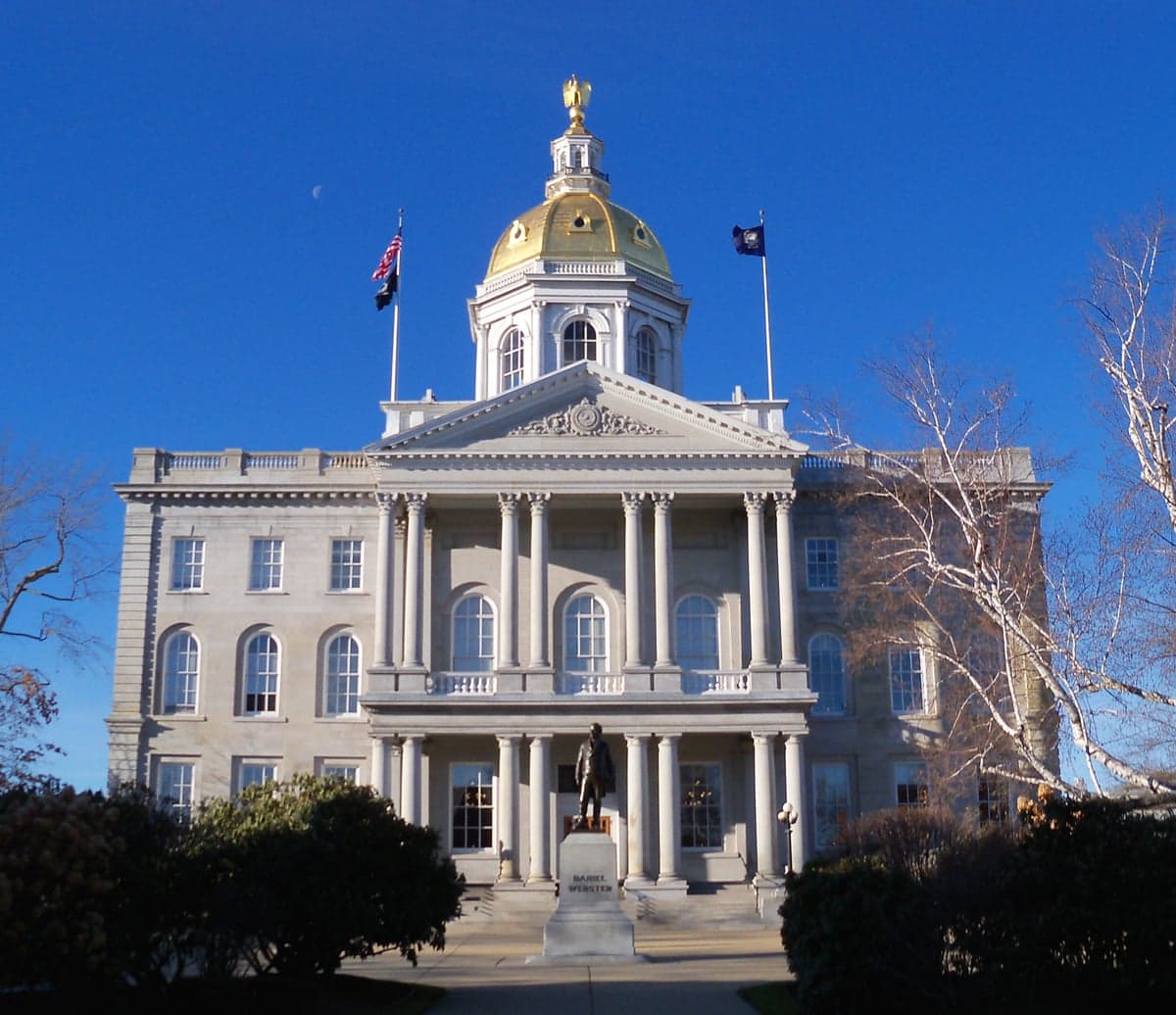
Photo: Wikipedia
Personal Sovereignty in Concord, NH
Viable for self-reliance. Generally workable, though some barriers may limit total independence.
What does Personal Sovereignty tell us?
Personal Sovereignty measures your capacity for self-reliance and independence with minimal government friction. Higher scores mean fewer barriers between you and the way you want to live... but it assumes you have the space you need and good neighbors.
What does this tell us?
Personal Sovereignty measures your capacity for self-reliance and independence with minimal government friction. Higher scores mean fewer barriers between you and the way you want to live... but it assumes you have the space you need and good neighbors.
State Policy
Energy independence: Importer (10% of energy produced in-state)
Personal Liberty
Homesteading

Personal Liberty Analysis
Concord, New Hampshire, offers a notably high degree of personal sovereignty compared to much of the Northeast, anchored by a state culture that prizes local control and individual responsibility. The city itself, as the state capital, is a political hub, but its governance is tempered by New Hampshire’s famously libertarian-leaning ethos—embodied in the state motto “Live Free or Die.” For a conservative audience concerned with government overreach, Concord represents a strategic compromise: access to state-level services and infrastructure without the heavy-handed regulatory environment found in neighboring Massachusetts or Vermont. The key question for a survivalist or prepper is whether this autonomy is real and durable, or merely a veneer over creeping statism.
Tax burden and regulatory posture: How New Hampshire’s model protects your wallet and choices
New Hampshire’s tax structure is a major draw for those seeking to minimize government intrusion into personal finances. The state has no broad-based personal income tax and no general sales tax, meaning Concord residents keep more of what they earn. Property taxes are the primary revenue source, and while they are higher than the national average—around 2.2% of assessed value in Merrimack County—they fund local services directly, giving residents more leverage through town meetings and school board elections. The regulatory environment is similarly light. New Hampshire is a “right-to-work” state, and Concord does not impose the kind of onerous business licensing or zoning overlays seen in blue-state cities. For a prepper, this means fewer hurdles for home-based businesses, private contracting, or even small-scale manufacturing. The state’s limited government philosophy extends to land use, with no state-level building code enforcement in unincorporated areas, though Concord itself has municipal codes. Overall, the tax and regulatory posture here is among the most favorable in New England for someone prioritizing financial and operational autonomy.
Self-defense and gun law specifics: What the Second Sanctuary status means for your rights
New Hampshire is a constitutional carry state, and Concord sits squarely within that framework. No permit is required to openly carry or conceal a firearm for any law-abiding adult over 18. The state has no magazine capacity restrictions, no “assault weapon” bans, and no firearm registration requirements. Concord itself has not enacted any local ordinances that infringe on these rights, and the city’s police department generally respects the state’s preemption law, which prohibits municipalities from passing stricter gun rules than the state. In 2021, New Hampshire became a “Second Amendment Sanctuary” state via a resolution, though this is symbolic rather than legally binding. For a prepper, the practical reality is clear: you can arm yourself as you see fit, train on private land, and store ammunition without bureaucratic interference. The state’s stand-your-ground law and castle doctrine provide strong legal protection for self-defense in the home or in public. The only notable restriction is that carrying on school property (K-12) is prohibited without a special permit, but this is standard nationwide. For those prioritizing the right to self-defense, Concord offers one of the most permissive environments east of the Mississippi.
Self-reliance and homesteading viability: Lot sizes, zoning, and off-grid feasibility in Concord
Concord’s zoning is a mixed bag for serious homesteading. Within the city limits, most residential lots are under an acre, and suburban-style subdivisions dominate. However, the city’s agricultural and rural zoning districts allow for larger parcels—typically 2 to 5 acres minimum—where raising chickens, goats, or even a small vegetable operation is feasible. The real opportunity lies in the unincorporated areas of Merrimack County just outside Concord, where lot sizes can be 10 acres or more with minimal county oversight. Off-grid living is legally possible but requires navigating state building codes for septic and well systems. New Hampshire has no state law prohibiting rainwater collection, and solar panels are widely used. The state’s net metering policy is favorable, allowing you to sell excess power back to the grid. For a prepper, the key limitation is that Concord’s municipal water and sewer are standard, so going fully off-grid within city limits would require special permits and likely neighbor pushback. The better play is to buy land in nearby towns like Bow, Hopkinton, or Canterbury, where zoning is looser and you can build a self-sufficient compound with a well, septic, and backup power. The state’s right-to-farm law protects agricultural activities from nuisance lawsuits, a critical safeguard for anyone raising livestock or running a small farm.
Personal liberties: Parental rights, medical autonomy, speech, and property protections
New Hampshire has a strong track record on parental rights. The state’s “parental bill of rights” law (HB 1431), passed in 2023, requires schools to notify parents of any medical or mental health services offered to their children and prohibits instruction on sexual orientation or gender identity in grades K-3. This is a significant win for conservatives concerned about government overreach into family matters. Medical autonomy is also relatively robust: New Hampshire has no state-level vaccine mandate for adults, and while COVID-era mandates were enforced in healthcare settings, they have since been rescinded. The state’s right-to-try law allows terminally ill patients access to experimental treatments without FDA interference. On speech, New Hampshire has no hate speech laws that criminalize protected expression, and the state’s public forums are generally open. Property rights are well-protected under the state constitution, which explicitly prohibits “taking” without just compensation. Eminent domain abuse is rare, and Concord’s city council has not engaged in the kind of aggressive redevelopment seen in larger cities. For a prepper, this means your property—whether a suburban home or a rural acreage—is secure from arbitrary seizure or regulatory takings. The state’s lowest-in-the-nation rate of civil asset forfeiture (requiring a criminal conviction before property can be permanently seized) is another strong point for personal sovereignty.
In the broader landscape of American personal sovereignty, Concord, NH, stands out as a relative stronghold in the Northeast. While it cannot match the outright libertarian environments of rural Idaho or Montana—where federal land dominance is less pronounced—it offers a rare combination of low taxes, strong gun rights, and legal protections for family and property autonomy. The trade-off is that Concord is a state capital with a permanent political class, meaning vigilance is required to prevent the kind of regulatory creep seen in blue states. For a survivalist or prepper who values community resilience and legal self-defense, Concord provides a solid foundation—but the smart move is to secure land in the surrounding county, where the “Live Free or Die” spirit is less diluted by city bureaucracy. The overall sovereignty score here is high for the region, but it demands active participation in local governance to keep it that way.

* Values derived from national, state, county, city and local statistics and may differ in a specific area. Last updated: 2026-04-23T07:26:41.000Z
Narrative content on this page is AI-generated and may contain mistakes. Verify any details that matter before acting on them.
ReloMaps may earn a commission from affiliate links at no extra cost to you.

