Photo: Wikipedia
Demographics of Conway, AR
Affluence Level in Conway, AR
A middle-class area roughly in line with national averages across income, home values, education, and employment.
People of Conway, AR
The people of Conway, Arkansas, today number roughly 66,300, forming a notably well-educated and family-oriented community where 41.1% of adults hold a bachelor’s degree or higher. The city’s character is shaped by a white majority (68.7%) alongside a significant Black population (18.1%) and a growing Hispanic community (7.2%), with a very small foreign-born share of just 2.9%. Conway’s identity is distinctly that of a college town and suburban hub, anchored by three universities and a strong sense of local pride that blends traditional Southern values with a youthful, professional energy.
How the city was settled and grew
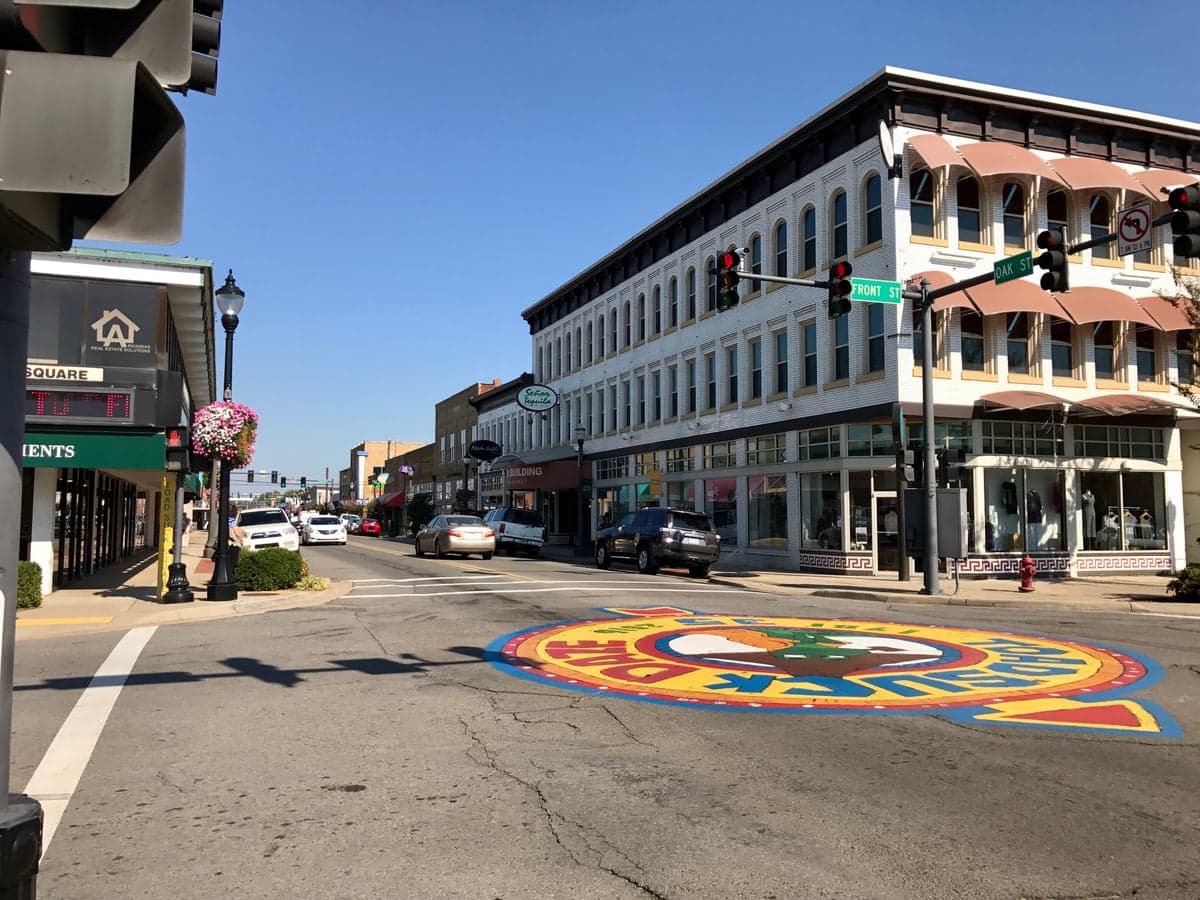
Conway’s founding population was overwhelmingly white and of Scots-Irish and English descent, drawn by the promise of fertile farmland and the railroad. The city was incorporated in 1875 as a stop on the Cairo and Fulton Railroad, which made it a regional shipping point for cotton and timber. The original settlers clustered around the railroad depot in what is now Downtown Conway, building wood-frame homes and small businesses along Front Street. By the early 1900s, the arrival of Hendrix College (then Central Institute) and later the Arkansas State Teachers College (now the University of Central Arkansas) began attracting a new class of residents: educators, ministers, and their families. These academic and religious migrants settled in the Hendrix Village area and the historic district around Robinson Avenue, where many of the city’s oldest homes still stand. The Black population, which grew slowly during Reconstruction, concentrated in the Pine Street and East Conway neighborhoods, where churches and small businesses formed the backbone of community life. Through the mid-20th century, Conway remained a relatively small, segregated Southern town, with its population hovering around 10,000 as late as 1960.
Modern era (post-1965)
The post-1965 era brought profound change. The Immigration and Nationality Act of 1965 had a muted direct effect on Conway—the foreign-born population remains very low at 2.9%—but the city’s growth exploded through domestic in-migration. From 1970 to 2020, Conway’s population surged from roughly 15,000 to over 66,000, driven by the expansion of the University of Central Arkansas and the rise of major employers like Acxiom and the Conway Regional Health System. This wave of newcomers—overwhelmingly white professionals from other parts of Arkansas and the Midwest—settled in master-planned subdivisions that ring the city. Mayflower Estates and Village at Hendrix became popular with college-educated families seeking good schools and new construction. The Black population, which had historically been concentrated in East Conway, began to suburbanize within the city limits, moving into neighborhoods like South Conway and Greenbrier Road corridor. The Hispanic community, though small (7.2%), grew steadily after 1990, primarily through migration from Texas and Mexico, and established a visible presence around Oak Street and in the Dave Ward Drive area, where several Hispanic-owned restaurants and markets now operate. The East/Southeast Asian population (1.3%) and Indian-subcontinent population (0.4%) are tiny but present, largely composed of faculty and graduate students at the three universities, and are scattered rather than concentrated in any single neighborhood.
The future
Conway’s population is trending toward continued growth, but with a notable homogenization of its racial and ethnic structure. The white majority is slowly declining as a share (from over 80% in 1990 to 68.7% today), while the Hispanic and Black shares are rising modestly. The foreign-born population, however, remains exceptionally low for a city of its size—2.9% compared to the national average of 13.7%—and shows no signs of a rapid increase. The city’s growth is overwhelmingly driven by domestic migration: young families from California, Texas, and other parts of Arkansas seeking lower costs, good schools, and a conservative social environment. New subdivisions like Cadron Creek and Lake Conway Estates are filling with these arrivals, reinforcing the city’s suburban, family-oriented character. The immigrant communities that do exist—Hispanic, East/Southeast Asian, and Indian—are small and assimilating quickly, with little evidence of ethnic enclave formation. Over the next 10–20 years, Conway is likely to become slightly more diverse in absolute numbers but will remain a predominantly white, native-born, and college-educated city, with a stable Black minority and a growing but still modest Hispanic presence.
For someone moving in now, Conway is becoming a place where traditional Southern community values meet modern professional aspirations. The population is growing, well-educated, and largely native-born, with a social fabric that remains cohesive rather than fragmented into distinct ethnic enclaves. New residents will find a city that is welcoming to families and professionals, but one where the demographic story is one of gradual, organic change rather than rapid transformation.

* Values derived from national, state, county, city and local statistics and may differ in a specific area. Last updated: 2026-04-23T16:31:40.000Z
Narrative content on this page is AI-generated and may contain mistakes. Verify any details that matter before acting on them.
ReloMaps may earn a commission from affiliate links at no extra cost to you.

