
Photo: Wikipedia
Personal Sovereignty in Conway, AR
Viable for self-reliance. Generally workable, though some barriers may limit total independence.
What does Personal Sovereignty tell us?
Personal Sovereignty measures your capacity for self-reliance and independence with minimal government friction. Higher scores mean fewer barriers between you and the way you want to live... but it assumes you have the space you need and good neighbors.
What does this tell us?
Personal Sovereignty measures your capacity for self-reliance and independence with minimal government friction. Higher scores mean fewer barriers between you and the way you want to live... but it assumes you have the space you need and good neighbors.
State Policy
Energy independence: Importer (35% of energy produced in-state)
Personal Liberty
Homesteading

Personal Liberty Analysis
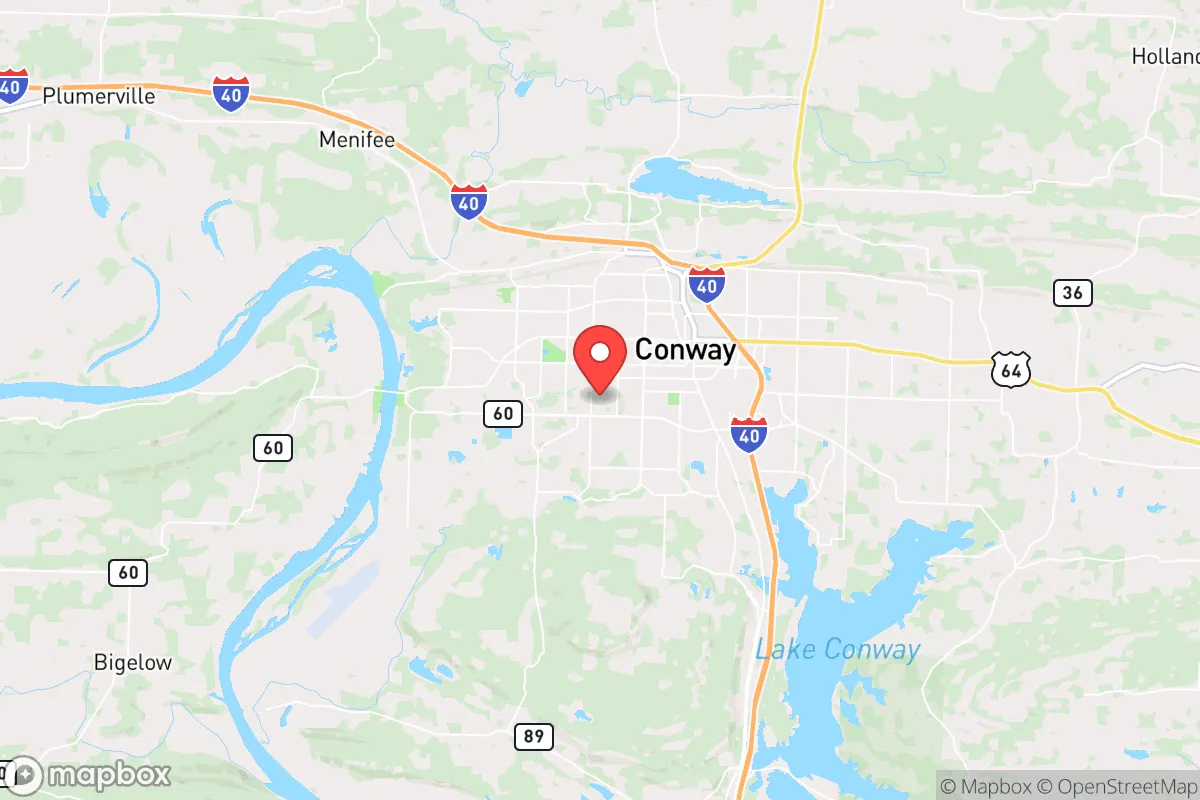
Conway, Arkansas offers a notably high degree of personal sovereignty compared to much of the coastal and Midwestern United States, making it a serious consideration for those prioritizing autonomy, self-reliance, and minimal government intrusion. The city sits within a state that has deliberately constructed a legal and regulatory environment favoring individual decision-making over state control, from tax policy to self-defense rights. For the prepper or survivalist-minded individual, Conway provides a strategic balance—close enough to a mid-sized city for employment and infrastructure, yet embedded in a county (Faulkner) with a rural character that still respects property rights and personal liberty. The overall autonomy environment here is one where the government is more of a background presence than an active manager of daily life, a contrast that is increasingly rare in 2026.
Tax burden and regulatory posture: how Arkansas compares to high-tax states
Arkansas has been on a multi-year trajectory of reducing its tax burden, and Conway residents benefit directly. The state's individual income tax rate has been flattened to a single rate of 4.4% as of 2025, down from a top marginal rate of nearly 7% just a few years prior. There is no state-level estate or inheritance tax, meaning wealth transfers to the next generation are not subject to a second layer of government confiscation. Property taxes in Faulkner County are moderate, with an effective rate around 0.6% of assessed home value—roughly half the national average. For a prepper mindset, this lower tax burden translates directly into more disposable income for supplies, land, and defensive investments. The regulatory posture in Conway is business-friendly and light-touch. There is no city-level rent control, no burdensome energy mandates, and no aggressive environmental regulations that would restrict building a workshop, storing fuel, or keeping livestock on residential property. The state's right-to-work laws and limited occupational licensing requirements further reduce government entanglement in how you earn a living or run a side business. Compared to states like California, New York, or Illinois, Conway represents a deliberate retreat from the regulatory state.
Self-defense and gun law specifics: what Conway offers for armed preparedness
Arkansas is a constitutional carry state, meaning no permit is required to carry a concealed firearm for anyone legally allowed to possess one. Conway, as a city, does not impose its own additional restrictions beyond state law—there are no local assault weapon bans, magazine capacity limits, or waiting periods. The state preempts local firearm ordinances, so Faulkner County and Conway cannot create a patchwork of conflicting rules. Stand Your Ground laws are fully in effect, with no duty to retreat in any place where you are lawfully present. Castle Doctrine protections extend to your vehicle and place of business, not just your home. For the survivalist, this means your defensive capabilities are not subject to the whims of a city council. Additionally, Arkansas has a strong firearm preemption statute that has been tested in court, so there is little risk of Conway suddenly adopting restrictive measures. The state also allows for the open carry of handguns and long guns without a permit, giving you flexibility in how you choose to present yourself. For those building a comprehensive preparedness plan, the legal environment here supports stockpiling ammunition, storing firearms, and training without government interference. The only notable limitation is that private sales between individuals do not require a background check, which is a positive for those who value privacy in transactions.
Self-reliance and homesteading viability: lot sizes, zoning, and off-grid feasibility
Conway's zoning code is more permissive than many similarly sized cities, particularly in the unincorporated areas of Faulkner County that are a short drive from downtown. Inside city limits, standard residential lots in newer subdivisions are typically one-quarter to one-half acre, which is sufficient for a substantial garden, a small chicken coop, and rainwater collection. However, for serious homesteading—think larger livestock, a root cellar, or a detached workshop for reloading ammunition—you will want to look at properties just outside Conway's extraterritorial jurisdiction. In unincorporated Faulkner County, lot sizes of one to five acres are common and affordable, with many parcels under $10,000 per acre as of 2026. Zoning in these areas is minimal; there are no restrictions on keeping goats, pigs, or horses, and no prohibitions on constructing outbuildings for storage or workshop use. Off-grid feasibility is high. Arkansas has no state-level prohibition on rainwater harvesting, and many rural properties have existing wells or the potential to drill one. Solar panel installation is straightforward, with no punitive net metering policies or HOA restrictions in unincorporated areas. The county does not require building permits for structures under 200 square feet, which is useful for a small shed or a secure storage container. For the prepper, the key takeaway is that Conway offers a realistic path to semi-self-sufficiency without needing to move to a remote mountain cabin—you can be 15 minutes from a Walmart and still have a functioning homestead.
Personal liberties: parental rights, medical autonomy, speech, and property
Parental rights in Arkansas are among the strongest in the nation. The state has enacted laws that affirm parents' fundamental right to direct the upbringing, education, and healthcare of their children. This means no mandatory vaccine requirements for school attendance beyond the standard schedule, and no state-level mandates for social-emotional learning curricula that bypass parental consent. Conway's school district, while generally well-regarded, operates under state law that requires parental notification for any health services provided at school. Medical autonomy is similarly respected. Arkansas has not adopted any broad vaccine mandates for adults, and there are no state-level restrictions on purchasing supplements, herbal remedies, or medical equipment without a prescription. The state's medical marijuana program is operational, though Conway itself has opted out of allowing dispensaries within city limits—a reflection of local community values rather than state overreach. Free speech protections are robust, with no hate speech laws that criminalize political or religious expression. Property rights are defended through Arkansas's strong eminent domain protections, which limit the government's ability to seize land for private development. For the survivalist, this means your property is less likely to be taken for a bike path or a corporate park. The overall legal climate in Conway and Faulkner County is one where the default assumption is that you are free to act unless a specific law prohibits it—a stark contrast to jurisdictions where every activity requires a permit or government approval.
In the broader context of American personal sovereignty, Conway ranks favorably against nearly any urban area in the Northeast, West Coast, or Upper Midwest. The combination of constitutional carry, low taxes, permissive zoning, strong parental rights, and minimal regulatory overhead creates an environment where an individual can live largely unbothered by government. For the prepper or survivalist weighing relocation options, Conway offers a pragmatic middle ground: it is not a remote libertarian enclave, but it is a functioning city within a state that has deliberately chosen to prioritize individual freedom over collective management. Compared to Texas, which is often the default recommendation for sovereignty-minded people, Arkansas offers lower property taxes and a less crowded landscape. Compared to Missouri or Oklahoma, Conway provides better infrastructure and a more stable local economy. The bottom line is that if your goal is to maximize personal autonomy while still having access to a hospital, a grocery store, and a Home Depot, Conway is a strong candidate that deserves serious consideration.

* Values derived from national, state, county, city and local statistics and may differ in a specific area. Last updated: 2026-04-23T16:31:40.000Z
Narrative content on this page is AI-generated and may contain mistakes. Verify any details that matter before acting on them.
ReloMaps may earn a commission from affiliate links at no extra cost to you.

