
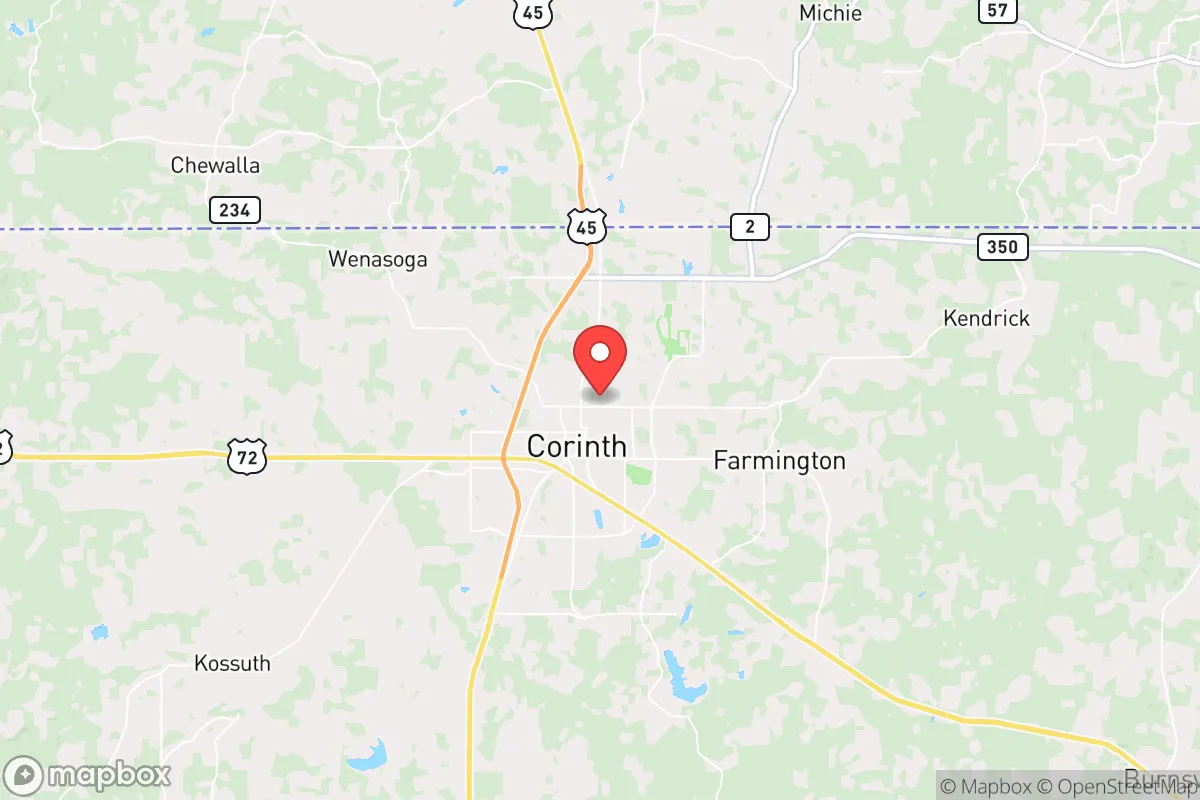
Photo: Wikipedia
Demographics of Corinth, MS
Affluence Level in Corinth, MS
A low-income area with significant economic hardship. Household wealth and educational attainment are well below national averages.
People of Corinth, MS
The people of Corinth, Mississippi, today form a predominantly native-born, racially binary community of roughly 14,450 residents, characterized by a strong sense of local heritage and a slower pace of life. The city is 71.4% White and 19.2% Black, with a very small Hispanic population of 5.2% and virtually no foreign-born presence (1.0%). This demographic profile reflects a community that has seen limited new immigration for decades, resulting in a population that is both stable and aging, with a college attainment rate of 25.9% that aligns with regional averages.
How the city was settled and grew
Corinth’s founding and early growth were driven entirely by its strategic position as a railroad junction. Incorporated in 1856 at the crossing of the Memphis & Charleston and the Mobile & Ohio railroads, the city’s first major population wave consisted of railroad workers, merchants, and tradesmen, mostly of Anglo-American stock from the surrounding rural counties. The city’s early residential pattern was defined by the Downtown Historic District, where the original commercial and professional class built homes within walking distance of the depots. A second, distinct wave came during and immediately after the Civil War, when Corinth became a key supply and hospital center, drawing a significant population of freedmen and Black laborers who settled in what became the Shiloh Road and Washington Street neighborhoods. These areas remain predominantly Black to this day. By the early 20th century, the city’s economy diversified into light manufacturing (textiles, furniture), but the population base remained overwhelmingly native-born White and Black, with no significant European immigrant enclaves forming. The North Corinth area, developed in the 1920s and 1930s, became a middle-class White neighborhood, while the South Parkway corridor saw post-WWII growth of modest single-family homes for both White and Black families, though in segregated sections.
Modern era (post-1965)
The post-1965 era in Corinth was not marked by the arrival of new immigrant groups, as the city’s foreign-born share remained negligible. Instead, the major demographic shift was suburbanization and the slow, steady out-migration of younger adults seeking jobs in larger metro areas. The Cross Creek and Lake Hills subdivisions, developed from the 1970s through the 1990s, became the primary destinations for upwardly mobile White families moving from older in-town neighborhoods. Meanwhile, the Black population remained concentrated in the historic Shiloh Road and Washington Street areas, with some expansion into the East Corinth area near the Alcorn County line. The Hispanic population, though small at 5.2%, began to appear in the 2000s, largely drawn by agricultural and construction work, and is now most visible in the West Corinth area near Highway 72. However, this growth has been modest and has not fundamentally altered the city’s racial binary. The Asian and Indian populations remain at 0.0%, reflecting the city’s lack of the professional or tech-sector employment that typically attracts these groups.
The future
Corinth’s population trajectory points toward continued slow decline or stagnation, with gradual aging and a potential slight increase in Hispanic share. The city is not homogenizing into a single identity; rather, it is likely to remain a racially binary community with distinct, stable neighborhoods. The White population is aging in place in the Cross Creek and North Corinth areas, while younger White families are often leaving for larger cities. The Black population is also aging, with younger generations moving to Memphis or Tupelo for better job opportunities. The Hispanic community, while small, is the only segment showing any growth, and it is likely to slowly expand through natural increase and limited new arrivals, but it will not reach a scale that changes the city’s character. The foreign-born share will likely remain below 2% for the foreseeable future. The city’s future is one of demographic stability, not transformation.
For someone moving to Corinth now, the city offers a deeply rooted, traditional Southern community where neighborhoods have clear historical identities and where the population is stable and predictable. The lack of significant immigration or rapid growth means that newcomers will find a place where social networks are established and change is gradual. The city is becoming a quieter, older version of itself, with a strong sense of local history and a pace of life that appeals to those seeking a low-cost, low-stress environment away from the demographic churn of larger metros.

* Values derived from national, state, county, city and local statistics and may differ in a specific area. Last updated: 2026-05-01T13:28:01.000Z
Narrative content on this page is AI-generated and may contain mistakes. Verify any details that matter before acting on them.
ReloMaps may earn a commission from affiliate links at no extra cost to you.

