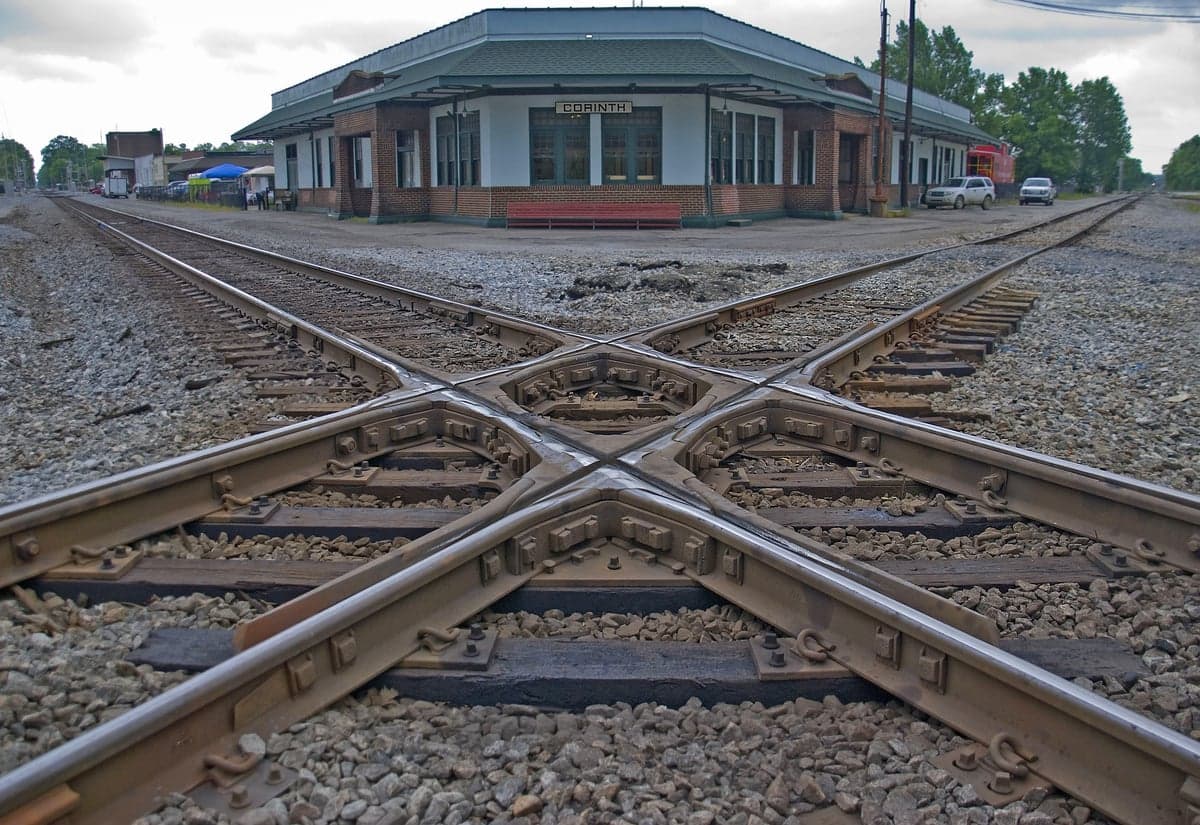
Photo: Wikipedia
Strategic Assessment of Corinth, MS
Workable tactical position. Some exposure to population density or targets, but generally defensible in a crisis.
What does the Strategic Assessment tell us?
Our Strategic Assessment grades tactical survivability of an area. Major population centers, military targets, fallout zones, natural disasters, and border exposure all drive risk — lower exposure means a more defensible position in a crisis.
This is heavily inspired by Joel Skousen's Strategic Relocation book. Highly recommended you checkout the book ($)What does this tell us?
Our Strategic Assessment grades tactical survivability of an area. Major population centers, military targets, fallout zones, natural disasters, and border exposure all drive risk — lower exposure means a more defensible position in a crisis.
This is heavily inspired by Joel Skousen's Strategic Relocation book. Highly recommended you checkout the book ($)Strategic Pillars

Key Distances
Regional Safe Places
Below is our recommended "safe zones" in Mississippi and the surrounding area based on our strategic heuristics. For most people, it's unrealistic to live in a “safe zone” full-time due to work, family or other personal reasons. They tend to be more rural. However, many of these areas are perfect for second homes and retreat properties that double as a vacation home or even a short-term rental.
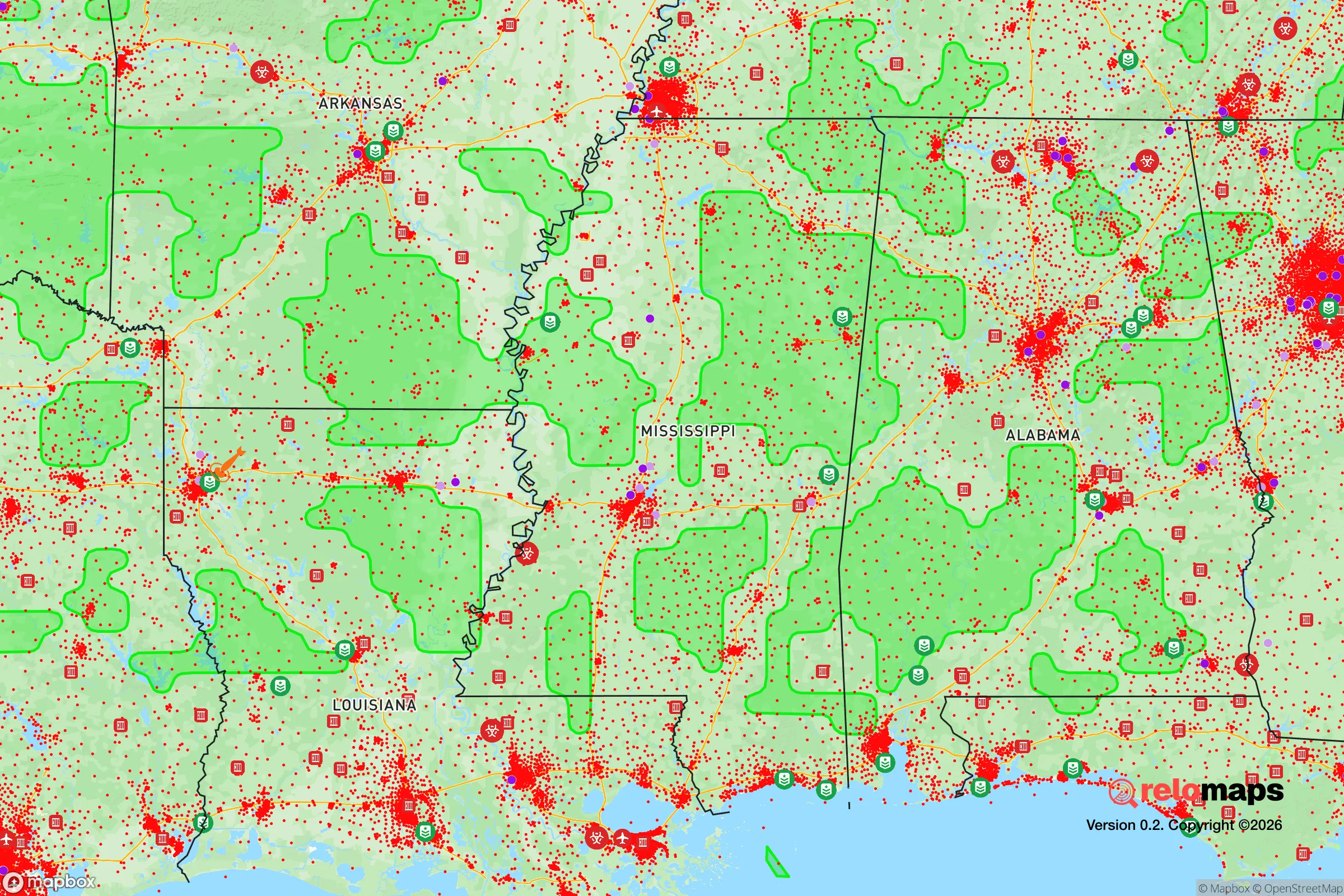
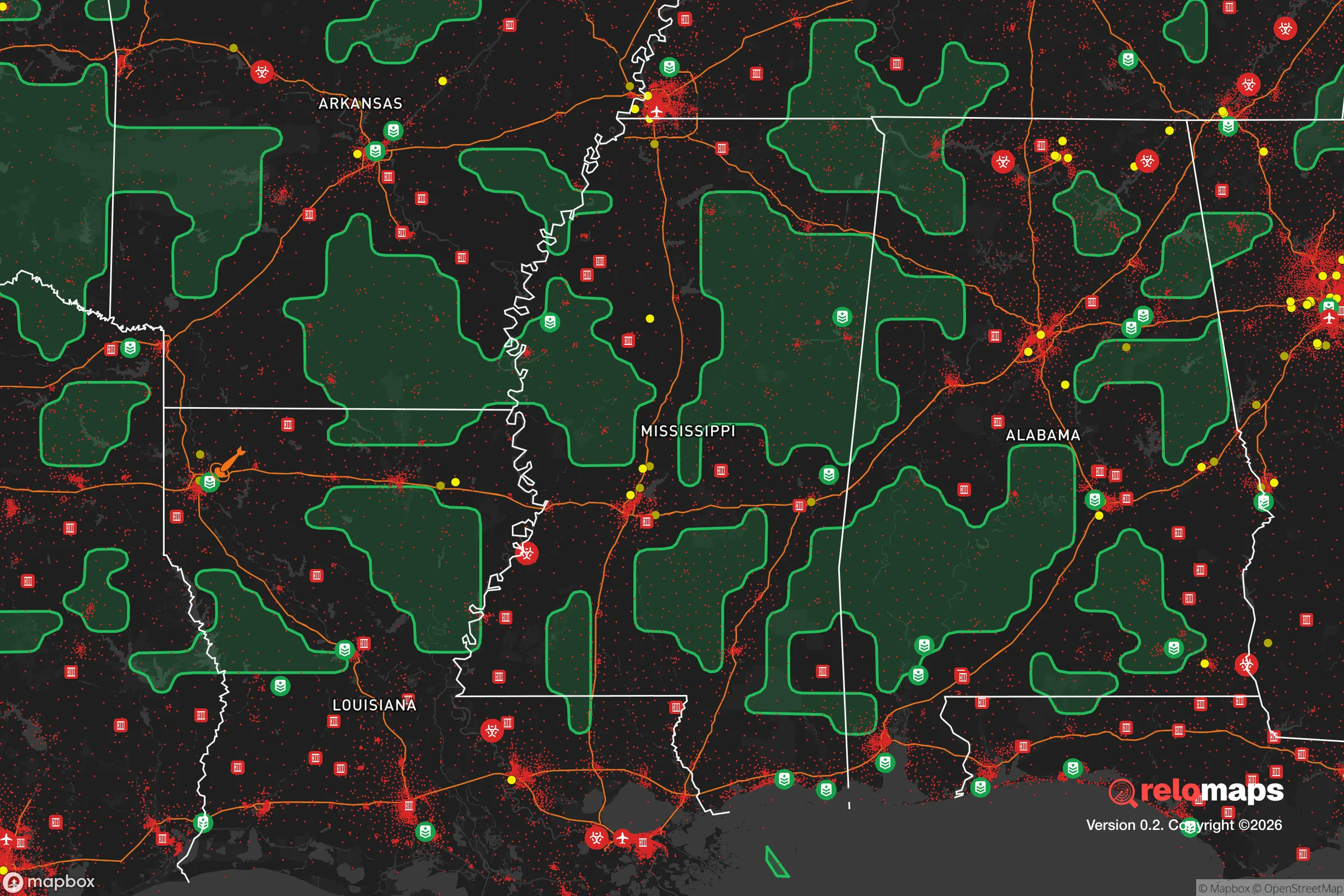


Important Note: For informational purposes only. This does not mean nothing bad ever happens in the green zones. Please use common sense. This is based on public data and modeled with AI. We tried to take a conservative approach but mistakes happen. We update this regularly as new information becomes available.
Solar Generator Recommendations
Backup power matters more here than in safer locations. We've picked three solar generators across budgets and capacity tiers — start with the budget unit if you only need a few essentials, or step up if you want to run a fridge and HVAC for days at a time.

Jackery Portable Power Station Explorer 300
Budget OptionPower on the Go: Weighing only 11 lbs, it's convenient to set up and store with book-sized foldable solar panels

BLUETTI Portable Power Station AC180
Designed for both indoor and outdoor scenarios, AC180 is highly capable as it has a robost capacity and continuous output power.

EF ECOFLOW DELTA Pro Ultra Power Station
Upgraded PickEcoFlow DELTA Pro Ultra is a whole-home energy system designed to grow with your family. Integrated with the Smart Home Panel 2, it scales to meet your evolving energy needs — keeping your home powered, intelligent, and secure through every stage of life.
We earn a commission, at no additional cost to you.
Strategic Assessment Analysis
Corinth, Mississippi, offers a compelling strategic position for those prioritizing resilience and self-sufficiency, sitting in the far northeastern corner of the state where it borders Tennessee and Alabama. Its location places it roughly 90 miles east of Memphis and 100 miles west of Huntsville, but the area itself feels distinctly removed from the urban pressures of either city. For a relocator with a survivalist or prepper mindset, Corinth’s combination of small-town infrastructure, agricultural land, and relative isolation from major population centers makes it a viable base for long-term preparedness, though it is not without its own vulnerabilities.
Geographic position and natural advantages for long-term security
Corinth’s geography is defined by the rolling hills and hardwood forests of the Tennessee River Valley, providing natural cover and defensible terrain compared to flat, open farmland elsewhere in the Delta. The city sits on the edge of the Pickwick Lake region, part of the Tennessee-Tombigbee Waterway, which offers a reliable freshwater source and potential for off-grid water access. The area’s moderate climate means fewer extreme weather events than the Gulf Coast or Tornado Alley proper, though severe thunderstorms and occasional tornadoes do occur. The surrounding rural landscape is dotted with small farms, timberland, and creeks, giving relocators options for private land with good water tables and soil for gardening. The presence of the Natchez Trace Parkway and numerous state wildlife management areas provides buffer zones and public land for hunting and foraging, which is a tangible advantage for food security in a grid-down scenario. The region’s low population density—Alcorn County has roughly 37,000 residents—means fewer people competing for resources in a crisis, and the lack of major interstate highways running directly through town reduces the risk of refugee flow from larger cities.
Risks, exposures, and proximity to fallout-relevant landmarks
No location is without risk, and Corinth’s strategic picture includes several exposures that a serious prepper must account for. The most significant is its proximity to Memphis, just over an hour’s drive west. Memphis is a major transportation hub with a large population, high crime rates, and potential for civil unrest that could spill into surrounding areas during a societal breakdown. While Corinth is far enough to avoid direct fallout from urban riots or infrastructure collapse, it sits along U.S. Highway 72, a primary east-west corridor that could become a route for evacuees fleeing Memphis or Nashville. The city itself is also within 30 miles of the Tennessee Valley Authority’s Browns Ferry Nuclear Plant near Athens, Alabama, and roughly 60 miles from the Sequoyah Nuclear Plant near Chattanooga. A catastrophic event at either facility would place Corinth in a moderate fallout zone, depending on wind patterns. Additionally, the region’s reliance on a single major employer—the Corinth-Alcorn County Industrial Park, which includes defense contractor and manufacturing facilities—means that a localized economic collapse or targeted disruption could ripple through the community. The area’s infrastructure is aging, with limited redundancy in power grids and water treatment, making it vulnerable to prolonged outages from ice storms or cyberattacks.
Practical resilience for a relocator: food, water, energy, and defensibility
For a relocator focused on practical self-sufficiency, Corinth offers a mix of strengths and weaknesses. The local water supply is drawn from groundwater aquifers and the Tennessee River, and many rural properties have access to private wells, which is a critical advantage over urban areas dependent on municipal systems. The soil in the region is generally fertile, with a growing season long enough for multiple crop cycles, and the abundance of oak and hickory forests provides mast for game like deer and turkey. Hunting and fishing are viable year-round, with Pickwick Lake and the Hatchie River offering consistent protein sources. Energy resilience is more challenging: the local grid is served by the Tennessee Valley Authority, which has a decent reliability record but is a single point of failure for the region. Solar potential is moderate—the area gets about 210 sunny days per year, below the national average—but battery storage and backup generators are advisable. Natural gas is available in town, but rural properties may rely on propane or wood heat. Defensibility is a mixed bag: the terrain offers good cover and chokepoints along rural roads, but the town itself is relatively open, with a historic downtown that lacks natural barriers. A better strategy is to secure land outside city limits, particularly in the hills east of town toward the Tennessee line, where property is still affordable and neighbors are sparse. The local law enforcement presence is small—Alcorn County has about 40 deputies—so community self-defense networks and situational awareness are essential.
The overall strategic picture for Corinth is one of moderate resilience with clear trade-offs. It avoids the worst risks of major metropolitan areas while retaining access to regional resources and transportation routes, but it is not a remote bunker location. For a conservative-leaning individual or family who values community ties, agricultural potential, and a lower cost of living—median home prices hover around $150,000—Corinth provides a workable base for a prepared lifestyle. The key is to treat it as a hub for regional self-sufficiency rather than a fortress, leveraging its natural advantages while actively mitigating its exposure to Memphis-driven instability and nuclear infrastructure risks. Those willing to invest in off-grid water, energy backup, and a rural property outside the city limits will find Corinth a solid, if not perfect, option for weathering the storms ahead.

* Values derived from national, state, county, city and local statistics and may differ in a specific area. Last updated: 2026-05-01T13:28:01.000Z
Narrative content on this page is AI-generated and may contain mistakes. Verify any details that matter before acting on them.
ReloMaps may earn a commission from affiliate links at no extra cost to you.

