
Photo: Wikipedia
Political ClimatePolitical Climate in Corinth, MS
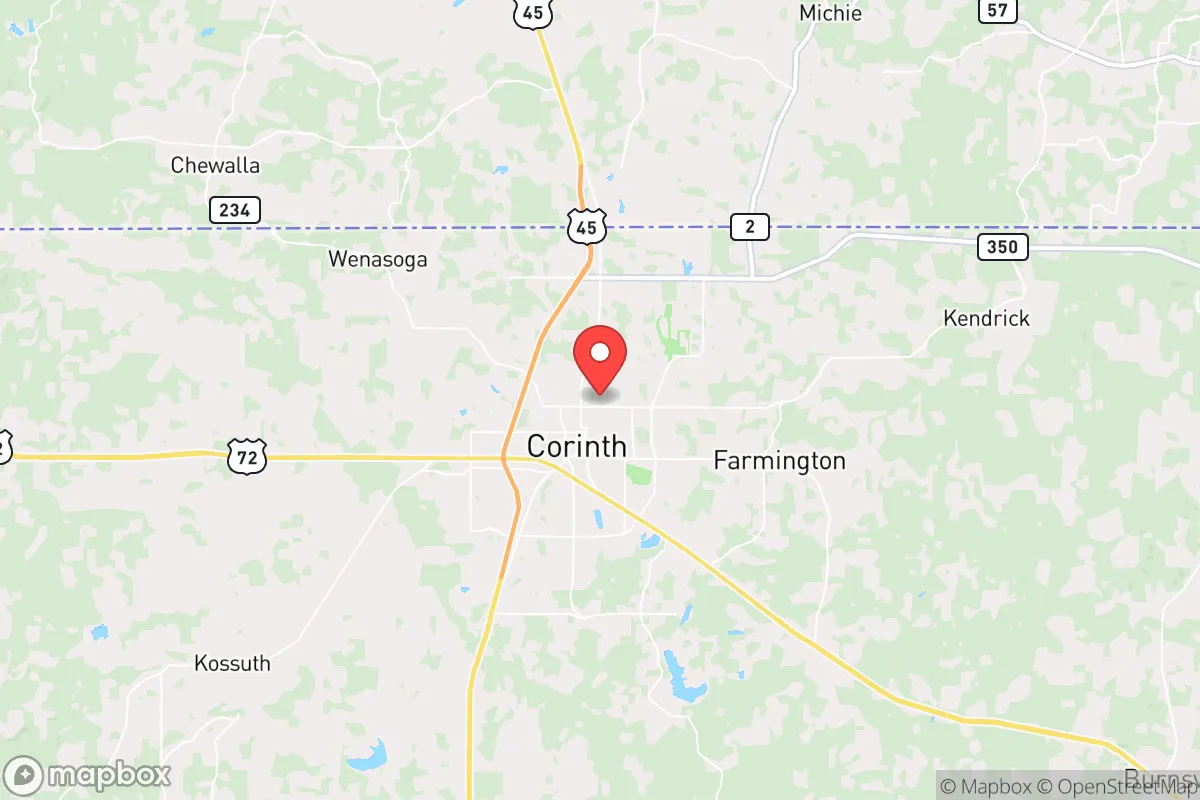
District shown is the primary district for this city’s centroid. Cities may span multiple districts.
Local Political AnalysisPolitical Analysis of Corinth, MS
Corinth, Mississippi, sits deep in the heart of the state’s northeastern corner, and its politics reflect that. The area’s Cook PVI of R+18 tells you the basics—this is solid, reliable Republican territory where conservative values aren’t just a preference, they’re the baseline. But if you’ve lived here a while, you know it’s more than just a number. The political lean here isn’t a recent shift; it’s a long-standing tradition rooted in a way of life that values personal responsibility, limited government, and the freedom to live without a bureaucrat looking over your shoulder. You don’t see the wild swings you get in some places—Corinth votes red, and it votes red consistently, with local races often decided in the primary.
How it compares
Drive an hour south to Tupelo, and you’ll find a similar conservative bent, though it’s a bit more tempered by a larger, more diverse economy. Head west into the Memphis suburbs like Olive Branch or Southaven, and you start to feel the pull of a bigger metro area—still red, but with a few more purple streaks as folks commute into a blue city for work. The real contrast, though, is just across the state line into Tennessee. Places like Selmer or Savannah are cut from the same cloth, but drive a little further north to Jackson, TN, and you’ll see a place that’s starting to flirt with some of the progressive ideas creeping in from Nashville. Corinth hasn’t gone down that road, and most folks here aim to keep it that way. The surrounding rural counties—Alcorn, Tishomingo, Prentiss—are even more deeply red, creating a buffer that helps Corinth hold its ground against any outside pressure to shift left.
What this means for residents
For the people who call Corinth home, this political climate translates into a daily life that’s largely free from the kind of government overreach you hear about in other parts of the country. You’re not dealing with heavy-handed zoning rules that tell you what you can do with your own property, and the tax burden is light enough that you keep more of what you earn. The local schools and law enforcement are run by people who answer to the community, not to some distant state or federal mandate. That said, there’s a quiet concern among long-time residents about the slow creep of progressive ideology—whether it’s through federal funding strings attached to local projects or the occasional push from outside groups to change how things are done. The general feeling is that as long as Corinth stays engaged and keeps voting for leaders who prioritize local control and individual liberty, the town will stay on the right track. But it’s something you keep an eye on, because once those freedoms start to slip, they’re hard to get back.
Culturally, Corinth is a place where the Second Amendment isn’t debated—it’s assumed. Church attendance is high, and community events like the annual Slugburger Festival are a bigger deal than any political rally. There’s a strong sense of self-reliance here, and that extends to policy: people want the government to stay out of their healthcare decisions, their children’s education, and their businesses. The biggest policy distinction you’ll notice is a deep skepticism of any new regulation, whether it’s from Jackson or Washington. The attitude is simple: if it isn’t broken, don’t fix it, and if it is broken, let the people closest to the problem handle it. That’s the Corinth way, and it’s not changing anytime soon.

State Political ClimatePolitical Climate in Mississippi
State Political AnalysisPolitical Environment in the State
Mississippi is one of the most reliably conservative states in the nation, with a Republican lean that has only deepened over the past two decades. The state has not voted for a Democratic presidential candidate since 1976, and in 2024, Donald Trump carried it by roughly 17 points. The dominant coalition is a blend of rural white evangelicals, suburban families in the Jackson metro exurbs, and Gulf Coast retirees, all united around low taxes, gun rights, and traditional values. Over the last 10-20 years, the shift has been dramatic: Democrats once held a majority in the state legislature as recently as 2010, but today Republicans hold supermajorities in both chambers, and every statewide elected office is held by the GOP.
Urban vs. rural divide
The political map of Mississippi is starkly divided between a handful of Democratic-leaning urban islands and a vast, deeply red rural and suburban landscape. The city of Jackson (Hinds County) is the state’s most reliably Democratic stronghold, consistently voting 80%+ for Democratic candidates, driven by a majority-Black population and a strong union and public-sector workforce. However, the surrounding suburbs of Madison and Ridgeland in Madison County are among the most conservative in the South, often voting 70%+ Republican. On the Gulf Coast, Biloxi and Gulfport lean Republican but are more competitive, with a mix of military families, casino workers, and retirees. The northeastern corner around Tupelo is solidly red, anchored by manufacturing and agriculture. The Mississippi Delta, including towns like Greenville and Clarksdale, remains Democratic due to high poverty and a large Black population, but turnout there is low and shrinking. The real story is the exurban growth: counties like DeSoto (just south of Memphis), Lamar (near Hattiesburg), and Rankin (east of Jackson) are growing fast and voting increasingly Republican, cementing the state’s conservative trajectory.
Policy environment
Mississippi’s policy environment is among the most conservative in the country, with a strong emphasis on limited government and traditional values. The state has no income tax on Social Security benefits and a flat income tax rate of 4% that is being phased down to 0% by 2026 under the Taxpayer Pay Raise Act of 2022. Property taxes are low, with no state-level property tax and local rates averaging around 0.8% of assessed value. The regulatory posture is business-friendly: Mississippi is a right-to-work state with no state-level minimum wage above the federal $7.25, and it has some of the weakest environmental regulations in the nation. On education, the state has a robust school choice program, including the Mississippi Education Scholarship Account (ESA) for special needs students and a growing charter school sector, though most districts remain traditional public. Healthcare policy is limited: Mississippi did not expand Medicaid under the ACA, leaving a coverage gap for about 100,000 low-income adults, but the state has some of the lowest per-capita healthcare costs in the nation. Election laws are strict: voter ID is required, early voting is limited to in-person absentee with an excuse, and no-excuse mail voting is not permitted. The state also passed a 2023 law banning ranked-choice voting and requiring all ballots to be counted by election night.
Trajectory & freedom
Mississippi is moving decisively toward more personal freedom in the areas that matter most to conservatives, but with some concerning caveats. On gun rights, the state is a constitutional carry state since 2016, with no permit required to carry a concealed firearm, and in 2024, the legislature passed a law prohibiting local governments from enforcing any federal gun restrictions. On parental rights, the 2023 "Parents’ Bill of Rights" (HB 1310) requires schools to notify parents of any medical or mental health services offered to their child and prohibits instruction on sexual orientation or gender identity in K-3 classrooms. Medical autonomy saw a major win with the 2024 "Medical Freedom Act," which prohibits vaccine mandates by private employers and government entities, though it stopped short of banning all mandates. On property rights, the state has strong eminent domain protections, and a 2023 law prohibits local governments from imposing rent control. The concerning trend is on taxation: while the income tax is being eliminated, the state has increased the gas tax (by 9 cents per gallon in 2022) and allowed local sales taxes to creep up, particularly in Jackson and the Gulf Coast. Overall, the trajectory is toward more freedom in the traditional sense, but the state’s heavy reliance on federal funding (about 40% of the state budget) creates a long-term vulnerability to federal overreach.
Civil unrest & political movements
Mississippi has a relatively low level of visible civil unrest compared to other Southern states, but there are flashpoints. The most significant recent protest activity occurred in 2020 after the death of George Floyd, with demonstrations in Jackson, Oxford (home to Ole Miss), and Hattiesburg. These were largely peaceful but led to a backlash that energized conservative turnout in the 2020 and 2022 elections. On the right, the most active movements are the "Mississippi Freedom Caucus" in the state legislature, which has pushed for stricter election integrity laws and anti-critical race theory legislation. Immigration politics are muted because Mississippi has a very small foreign-born population (about 2.5%), but there is strong support for border security, and the state passed a 2024 law requiring local law enforcement to cooperate with ICE. There is no sanctuary city movement; in fact, the state preempts any local sanctuary policies. Election integrity controversies have been minimal, though the 2023 law banning ballot drop boxes and requiring all ballots to be counted by election night was a response to concerns from the 2020 election. The most visible flashpoint for a new resident would be the ongoing water crisis in Jackson, which has become a political battleground between the Democratic city government and the Republican state government, with the state taking over the water system in 2023. This has fueled a narrative of urban mismanagement versus rural competence.
Projection
Over the next 5-10 years, Mississippi will likely become even more conservative, driven by two demographic trends: the continued exodus of Black residents from the Delta and Jackson to other states (Mississippi lost about 30,000 Black residents between 2020 and 2024), and the in-migration of white retirees and remote workers to the Gulf Coast and the "Golden Triangle" (Columbus, Starkville, West Point). The state’s population is projected to remain flat or decline slightly, but the political composition will shift rightward as the remaining population becomes older, whiter, and more rural. The biggest wild card is the potential for a major economic development project, like the planned "Mega Site" in Lowndes County for a large manufacturing plant, which could bring in new residents from more liberal states. However, the state’s strong cultural conservatism and low cost of living are likely to attract people who are already aligned with the dominant political culture. The most realistic projection is that Mississippi will remain a solidly red state, with the Democratic Party becoming increasingly confined to Jackson and a few Delta counties, and the Republican supermajority in the legislature growing even larger.
For a new resident, the bottom line is that Mississippi offers a high degree of personal freedom in the areas that matter most: low taxes, strong gun rights, parental control over education, and minimal government interference in daily life. The trade-offs are a weak social safety net, limited healthcare access in rural areas, and a political environment that can feel insular. If you value traditional freedoms and are willing to accept a slower pace of life and fewer amenities, Mississippi is a safe bet. Just be prepared for the heat, the mosquitoes, and the fact that everyone you meet will probably ask you what church you go to.
* Values derived from national, state, county, city and local statistics and may differ in a specific area. Last updated: 2026-05-01T13:28:01.000Z
Narrative content on this page is AI-generated and may contain mistakes. Verify any details that matter before acting on them.
ReloMaps may earn a commission from affiliate links at no extra cost to you.

