Photo: Wikipedia
Demographics of Covington, KY
Affluence Level in Covington, KY
A middle-class area roughly in line with national averages across income, home values, education, and employment.
People of Covington, KY
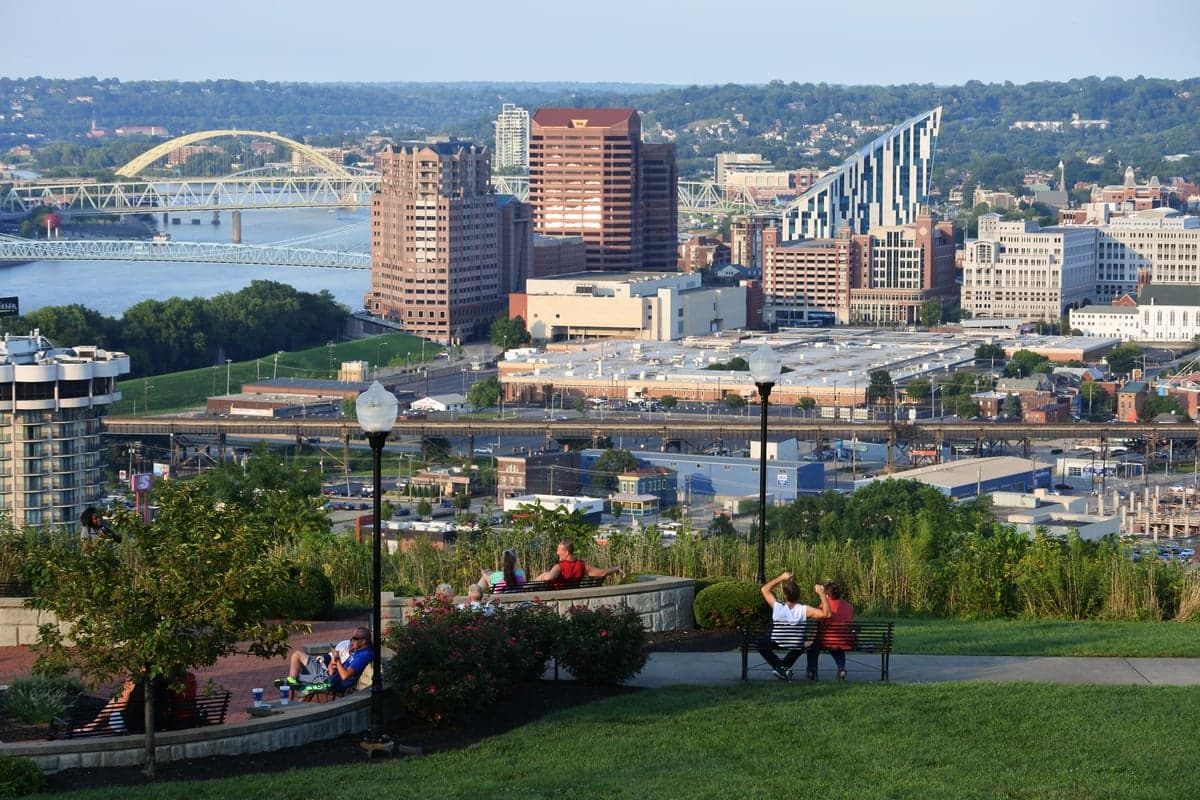
Covington, Kentucky, is a dense, historic river city of 40,902 residents, defined by its 19th-century row houses, steep hillside neighborhoods, and a population that is 74.8% white, 9.4% Black, and 9.1% Hispanic. Its people are a mix of long-standing German Catholic families, Appalachian transplants from the mid-20th century, and a growing Hispanic community, creating a working-to-middle-class character with a distinct urban edge. The city feels older and more settled than its Northern Kentucky suburbs, with a strong sense of neighborhood identity and a population that has stabilized after decades of decline.
How the city was settled and grew
Covington was founded in 1815 at the confluence of the Ohio and Licking Rivers, directly across from Cincinnati, and its early growth was driven by German and Irish immigrants who arrived in the 1830s–1860s. These groups built the city’s iconic architecture—the brick townhouses and churches of MainStrasse Village (a historic German district) and the working-class rowhomes of Licking Riverside. Germans dominated the brewing, carpentry, and Catholic parish life, while the Irish worked the riverfront and railroads. By 1900, Covington was a booming industrial and commercial hub, with a population exceeding 60,000. A smaller wave of Black migrants from the rural South arrived during the Great Migration (1910–1940), settling primarily in the Westside neighborhood, which became the historic center of the city’s Black community. The city’s growth peaked around 1930 and then plateaued, as suburbanization and the decline of river-based industry began to pull residents outward.
Modern era (post-1965)
After the 1965 Hart-Cellar Act, Covington saw only modest foreign-born growth—today just 3.9% of residents are foreign-born—but domestic migration reshaped the city significantly. The most dramatic shift was the arrival of Appalachian whites from Eastern Kentucky and West Virginia between 1950 and 1980, drawn by manufacturing jobs at plants like the nearby General Motors assembly plant and the Cincinnati/Northern Kentucky International Airport. These families settled in the Latonia and Peaselburg neighborhoods, giving those areas a distinctly Appalachian character that persists in local speech patterns, churches, and family networks. Meanwhile, the city’s Black population, which peaked at around 15% in the 1970s, has declined to 9.4% today, as many middle-class Black families moved to suburban Boone and Kenton counties. The Hispanic population, now 9.1%, began growing in the 1990s, driven by Mexican and Central American immigrants working in construction, landscaping, and the restaurant industry. They have concentrated in Latonia and parts of South Covington, where a small but visible cluster of tiendas and taquerias has emerged. The East/Southeast Asian population remains tiny at 0.9%, and the Indian-subcontinent population is effectively zero (0.0%).
The future
Covington’s population is stabilizing after a long decline from 60,000 in 1930 to 40,902 today, and the city is likely to remain a predominantly white, working-to-middle-class community with a growing Hispanic minority. The Hispanic share is the fastest-growing demographic, projected to reach 12–15% by 2040, driven by both immigration and higher birth rates, and this growth is concentrated in Latonia and South Covington. The white population is aging and slowly declining, though the city is attracting a small number of younger, college-educated professionals (32.0% college-educated) to neighborhoods like MainStrasse Village and Licking Riverside, drawn by historic housing stock and proximity to Cincinnati. The Black population is likely to remain stable or decline slightly, as out-migration to suburbs continues. Covington is not tribalizing into stark enclaves—neighborhoods remain mixed by class and ethnicity—but the Hispanic community is becoming more visible and institutionally organized, with Spanish-language Catholic masses and small businesses. The city’s future is one of slow, modest diversification rather than rapid change.
For someone moving in now, Covington offers a dense, walkable urban experience with a strong sense of neighborhood history, but it is not a melting pot in the traditional sense. It is a city where German and Appalachian roots still dominate the culture, while a growing Hispanic community adds new layers. The population is stable and aging, but the city’s affordability and location across from Cincinnati are drawing a slow trickle of new residents. It is becoming a slightly more diverse, slightly more educated version of its former self, but the core identity—working-class, Catholic, and river-oriented—remains intact.

* Values derived from national, state, county, city and local statistics and may differ in a specific area. Last updated: 2026-04-21T10:25:27.000Z
Narrative content on this page is AI-generated and may contain mistakes. Verify any details that matter before acting on them.
ReloMaps may earn a commission from affiliate links at no extra cost to you.

