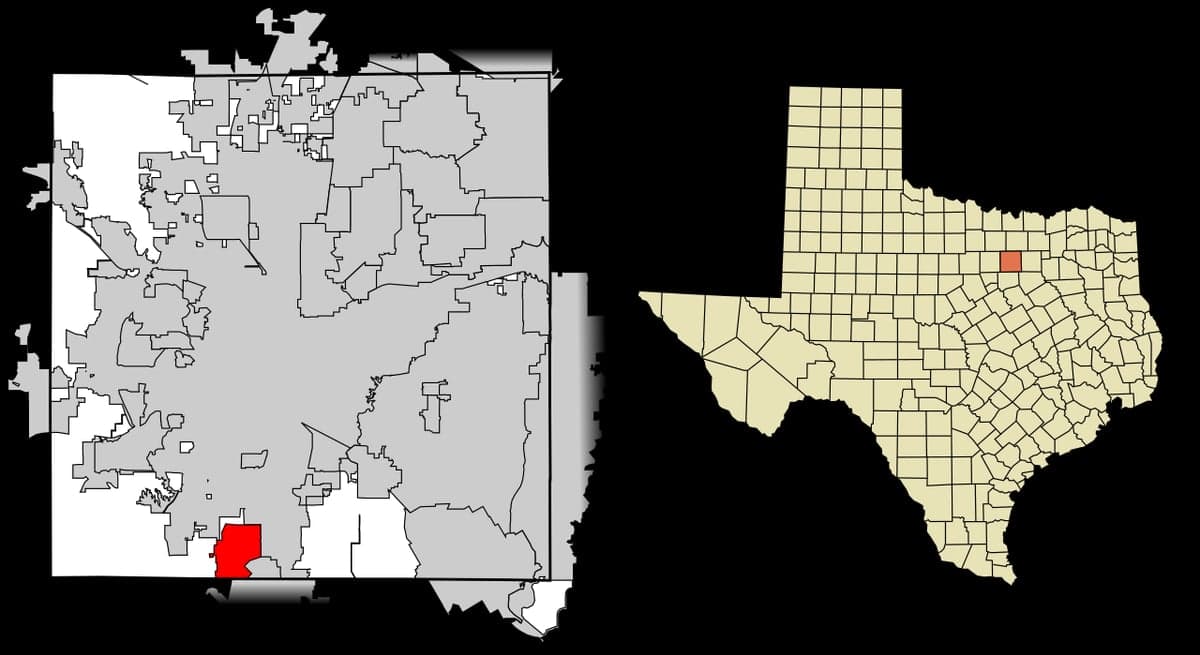
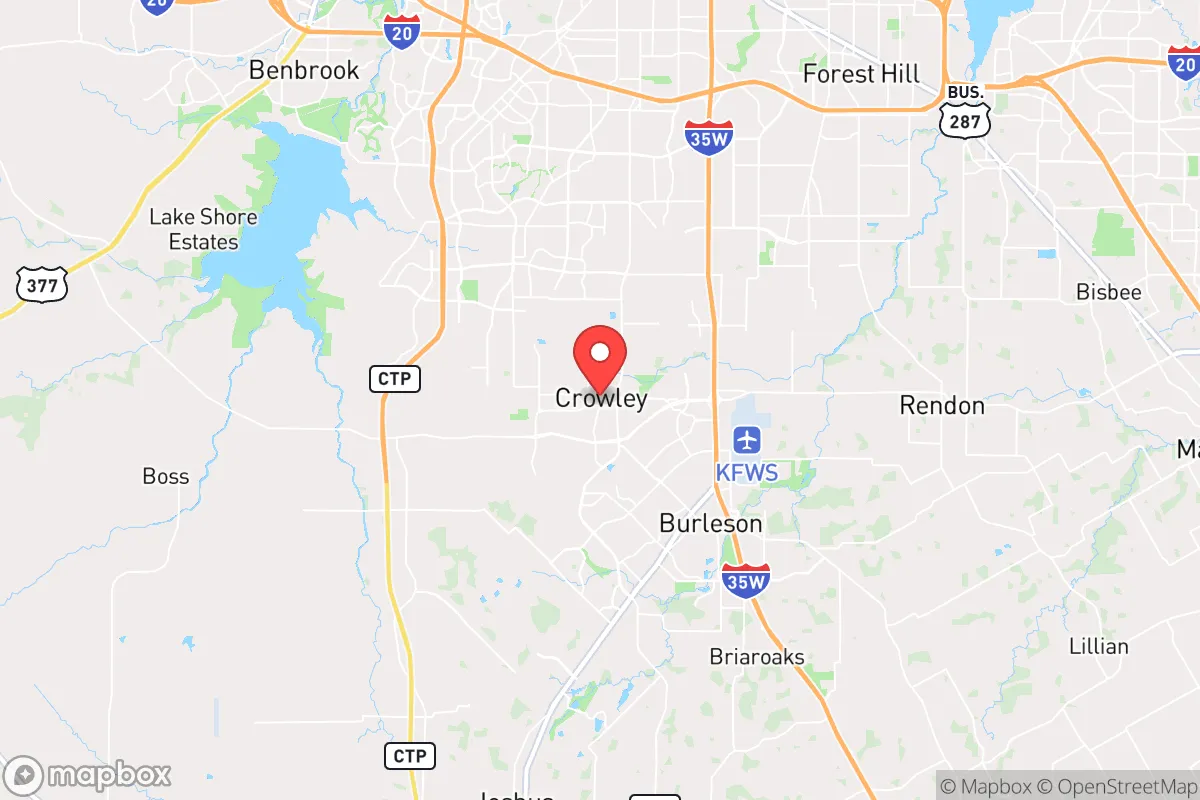
Photo: Wikipedia
Demographics of Crowley, TX
Affluence Level in Crowley, TX
A middle-class area roughly in line with national averages across income, home values, education, and employment.
People of Crowley, TX
The people of Crowley, Texas, today form a notably diverse, family-oriented community of roughly 19,000 residents, characterized by a near-even tripartite split among White (44.4%), Hispanic (31.0%), and Black (21.4%) populations. This demographic profile, combined with a modest foreign-born share of 3.9% and a college-educated rate of 26.7%, marks Crowley as a working-to-middle-class suburb where racial and ethnic groups live in close proximity rather than isolated enclaves. The city’s identity is shaped by its rapid transformation from a small farming depot into a bedroom community of Fort Worth, with a population that has more than doubled since 2000, attracting families seeking affordable housing and a small-town feel within commuting distance of the Metroplex.
How the city was settled and grew
Crowley’s original population was drawn by the railroad and agriculture in the late 19th century. Founded in 1886 as a stop on the Texas & Pacific Railway, the town was named after railroad official S.H. Crowley. The earliest settlers were Anglo-American farmers and ranchers who established homesteads along the rail line, with the Old Town Crowley district—centered around Main Street and the depot—serving as the commercial and social hub. A small number of Black families also arrived during this period, working as sharecroppers and laborers on cotton farms, and they settled in what became the South Crowley area, near the railroad tracks. The population remained under 500 through the 1930s, with growth stalling during the Great Depression and Dust Bowl, as the agricultural economy contracted and young people left for cities.
Modern era (post-1965)
The post-1965 era brought profound demographic change, driven by suburbanization and the expansion of the Dallas-Fort Worth metroplex. The 1965 Hart-Cellar Act had a limited direct effect on Crowley—foreign-born residents remain low at 3.9%—but the broader domestic migration of White and Black families from Fort Worth and rural Texas reshaped the city. The construction of Interstate 35W in the 1970s made Crowley accessible, and developers began building subdivisions on former farmland. The Bent Creek neighborhood, developed in the 1980s and 1990s, attracted White middle-class families seeking larger lots and newer homes. Meanwhile, Mistletoe Estates and Deer Creek became destinations for Black families moving south from Fort Worth’s historic Stop Six and Como neighborhoods, drawn by lower home prices and newer schools. Hispanic families began arriving in significant numbers during the 1990s and 2000s, many from rural Texas and Mexico, settling in the Willow Creek and Summer Creek subdivisions, where affordable starter homes and rental properties were concentrated. By 2010, Crowley’s population had reached 12,838, and the White share had dropped below 50% for the first time, as Hispanic and Black growth accelerated.
The future
Crowley’s population is projected to continue growing, likely reaching 25,000–30,000 by 2040, driven by ongoing residential development and the expansion of the Chisholm Trail Parkway, which reduces commute times to Fort Worth and downtown Dallas. The city is not homogenizing into a single demographic bloc but rather tribalizing into distinct neighborhoods by income and race, though with significant overlap. The Bent Creek area remains predominantly White and higher-income, while South Crowley and Willow Creek are increasingly Hispanic and Black, with a growing number of mixed-race families. The East/Southeast Asian community (1.7%) and Indian subcontinent community (0.6%) are small but growing, concentrated in newer subdivisions like Hidden Creek, where tech and healthcare workers from Fort Worth have settled. The foreign-born share is expected to rise slowly, as Crowley lacks the industrial or service-sector jobs that attract large immigrant flows, but the Hispanic population will likely approach 40% by 2040 through natural increase and continued domestic migration. The college-educated rate, currently 26.7%, is below the national average, but new housing developments targeting commuters may gradually raise it as more professionals seek affordable alternatives to Fort Worth’s inner suburbs.
For someone moving in now, Crowley is becoming a more diverse, family-oriented suburb where racial and ethnic groups coexist in overlapping neighborhoods rather than rigid enclaves. The city’s affordable housing stock, low crime relative to Fort Worth, and improving infrastructure make it attractive to first-time homebuyers and young families, but its schools and services are still catching up to rapid growth. The next decade will likely see continued demographic diversification, with the White share declining further and Hispanic and Black populations solidifying their presence, while the small Asian and Indian communities grow slowly. Crowley is not a melting pot but a patchwork of distinct communities sharing a common small-town identity—a place where newcomers can find their niche without being absorbed into a single cultural norm.

* Values derived from national, state, county, city and local statistics and may differ in a specific area. Last updated: 2026-05-11T21:59:45.000Z
Narrative content on this page is AI-generated and may contain mistakes. Verify any details that matter before acting on them.
ReloMaps may earn a commission from affiliate links at no extra cost to you.

