
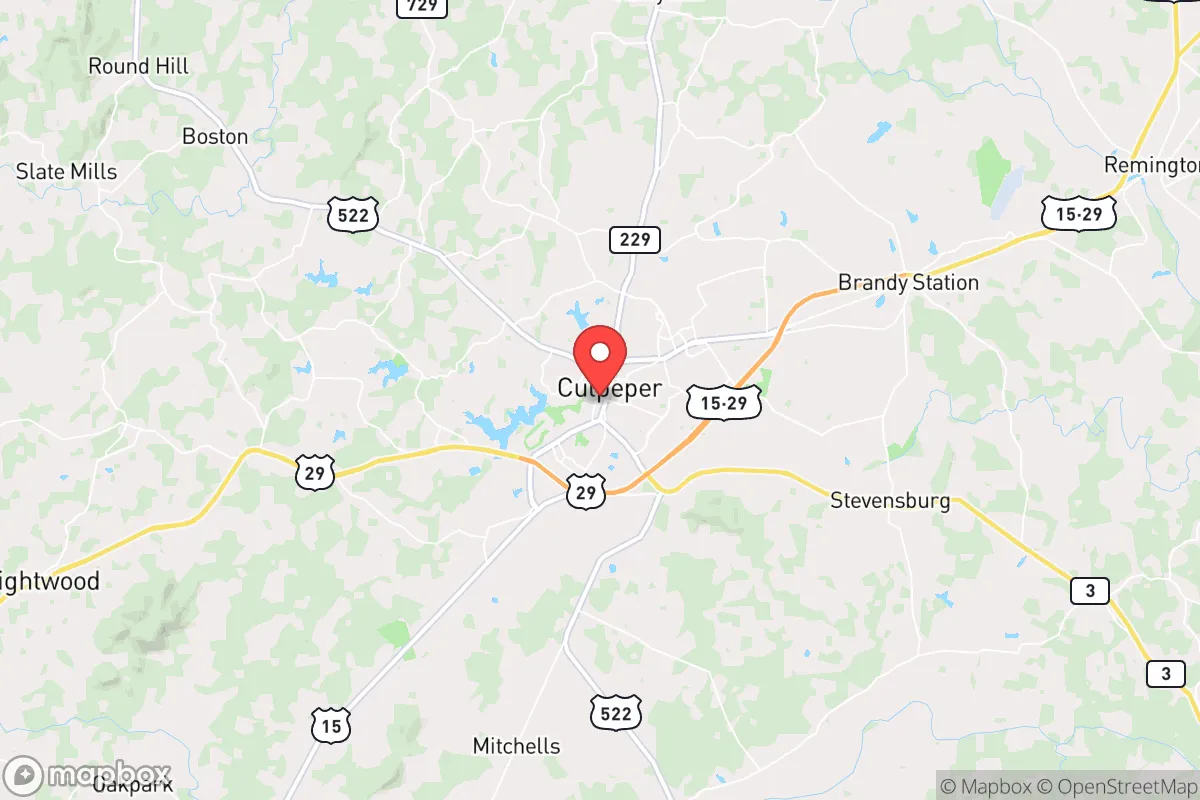
Photo: Wikipedia
Personal Sovereignty in Culpeper, VA
Viable for self-reliance. Generally workable, though some barriers may limit total independence.
What does Personal Sovereignty tell us?
Personal Sovereignty measures your capacity for self-reliance and independence with minimal government friction. Higher scores mean fewer barriers between you and the way you want to live... but it assumes you have the space you need and good neighbors.
What does this tell us?
Personal Sovereignty measures your capacity for self-reliance and independence with minimal government friction. Higher scores mean fewer barriers between you and the way you want to live... but it assumes you have the space you need and good neighbors.
State Policy
Energy independence: Importer (20% of energy produced in-state)
Personal Liberty
Homesteading

Personal Liberty Analysis
Culpeper, Virginia, offers a notably high degree of personal sovereignty compared to many other parts of the Mid-Atlantic, particularly for those who prioritize minimal government interference in daily life, self-defense, and family autonomy. The town itself, while growing, retains a rural character that supports a live-and-let-live ethos, and the surrounding county’s political leanings—consistently Republican in presidential elections, with Donald Trump winning 62% of the vote in 2020—reflect a community that values individual liberty over collective mandates. For a single individual or parent concerned with preserving personal freedoms against perceived government overreach, Culpeper presents a strategic balance of accessibility to urban resources and a legal environment that largely respects the right to be left alone.
Tax burden and regulatory posture in Culpeper County
Virginia is a moderately tax-friendly state, but Culpeper’s specific posture leans toward fiscal restraint. The state income tax is a flat 5.75%, which is higher than no-income-tax states like Florida or Texas, but Virginia does not tax Social Security benefits and offers a modest deduction for other retirement income—a plus for older preppers. Property taxes in Culpeper County are relatively low, with a real estate tax rate of $0.54 per $100 of assessed value as of 2025, well below the national average and significantly lower than neighboring Northern Virginia counties like Fairfax ($1.11) or Prince William ($1.12). This lower tax burden directly supports self-reliance by leaving more capital in private hands for land, supplies, and infrastructure. The regulatory environment is similarly restrained: Culpeper County has no county-wide building permit requirement for agricultural structures under 200 square feet, and zoning is generally permissive for accessory structures like sheds, greenhouses, and workshops. However, the town of Culpeper itself has stricter ordinances, so those seeking maximum autonomy should prioritize properties in the county’s unincorporated areas. The state’s business climate is also favorable—Virginia is a right-to-work state, and Culpeper’s local government has resisted adopting overly burdensome licensing requirements for home-based businesses, which is critical for anyone looking to generate income off-grid or through trade.
Self-defense and gun law specifics in Culpeper
Virginia’s gun laws have become a battleground in recent years, but Culpeper remains a stronghold for Second Amendment rights. The state requires a background check for all firearm purchases (including private sales, via the state police system), but Virginia is a shall-issue state for concealed carry permits, meaning the sheriff’s office in Culpeper County must issue a permit to any qualified applicant—no discretion, no subjective “good cause” requirement. The county sheriff, Scott H. Jenkins, has publicly stated his office will not enforce any “unconstitutional” gun control measures, a stance that resonates with the local prepper community. Open carry is legal without a permit for anyone 18 or older who can legally possess a firearm, and there is no state-level ban on standard-capacity magazines or so-called “assault weapons.” Culpeper County also has no local ordinances restricting firearm possession on private property or in vehicles. For those concerned about self-defense in the home, Virginia’s Castle Doctrine is strong: there is no duty to retreat before using deadly force if you are in a place you have a right to be, and the law presumes a reasonable fear of death or great bodily harm if an intruder unlawfully enters your dwelling. Stand Your Ground laws apply outside the home as well, though the legal landscape has seen some court challenges. For a prepper, the key takeaway is that Culpeper offers a legal environment where you can train, carry, and defend yourself without fear of local prosecution for exercising a constitutional right.
Self-reliance and homesteading viability in Culpeper
Culpeper County is one of the more viable locations in Virginia for serious homesteading and off-grid living, thanks to its rural zoning and relatively affordable land. Minimum lot sizes in the county’s Agricultural (A-1) district are 3 acres, and many parcels of 5 to 20 acres are available for under $15,000 per acre—far cheaper than Loudoun or Fauquier counties to the north. Zoning allows for keeping livestock, including chickens, goats, sheep, and cattle, as a matter of right on parcels of 3 acres or more, with no special permit required. Beekeeping is also permitted without a county license. For those seeking energy independence, Culpeper County has no restrictions on solar panel installation for residential use, and net metering is available through Rappahannock Electric Cooperative, though the utility’s interconnection process can be bureaucratic. Rainwater collection is legal and unregulated at the state level, and the county does not impose additional restrictions. Wells and septic systems are permitted for new construction, though a health department permit is required for the septic. The biggest hurdle for full off-grid living is the county’s building code: while agricultural structures are exempt, a primary dwelling must meet Virginia’s Uniform Statewide Building Code, which can be a barrier for those wanting to build with unconventional materials or methods. Still, for a prepper looking to establish a semi-autonomous homestead with gardens, livestock, and backup power, Culpeper County offers a regulatory environment that is permissive by East Coast standards.
Personal liberties in Culpeper: parental rights, medical autonomy, and property
Virginia’s state-level policies on parental rights and medical autonomy are mixed, but Culpeper’s local culture and school board lean strongly toward traditional values. The Culpeper County School Board has resisted implementing controversial curriculum elements seen in more progressive districts, and parental notification policies for health services are robust, with the school system requiring written consent for most non-emergency medical care. The state does not have a religious or philosophical exemption to vaccine mandates for school entry (only medical), which is a concern for some families, but local enforcement is reportedly lax, and homeschool laws are among the most favorable in the nation: parents need only file a notice of intent and provide a curriculum description, with no standardized testing requirement for most families. Medical autonomy is further supported by Virginia’s lack of a state-level prescription drug monitoring program that restricts patient access to controlled substances, though federal laws still apply. Property rights are strong in Culpeper County: there is no county-wide rent control, no short-term rental ban (though the town of Culpeper has some restrictions), and the county has not adopted any form of “inclusionary zoning” that would force property owners to set aside units for below-market rent. Eminent domain abuse is rare, and the county’s comprehensive plan explicitly prioritizes private property rights. For speech, Virginia is a First Amendment-friendly state, and Culpeper’s local government has not attempted to restrict political expression or assembly, even during the 2020 protests.
Overall, Culpeper ranks as one of the stronger locations for personal sovereignty in the Mid-Atlantic, especially when compared to nearby jurisdictions like Northern Virginia or Maryland. The combination of low property taxes, permissive gun laws, viable homesteading land, and a local culture that respects parental and property rights creates an environment where a prepper or liberty-minded individual can operate with minimal friction. The main trade-offs are Virginia’s state income tax and the building code requirements for primary dwellings, but these are manageable for those willing to work within the system. For a single person or family looking to build a life with maximum personal autonomy, Culpeper County represents a solid strategic choice—not a libertarian utopia, but a practical, defensible position in a region where such freedoms are increasingly rare.

* Values derived from national, state, county, city and local statistics and may differ in a specific area. Last updated: 2026-05-01T16:12:37.000Z
Narrative content on this page is AI-generated and may contain mistakes. Verify any details that matter before acting on them.
ReloMaps may earn a commission from affiliate links at no extra cost to you.

