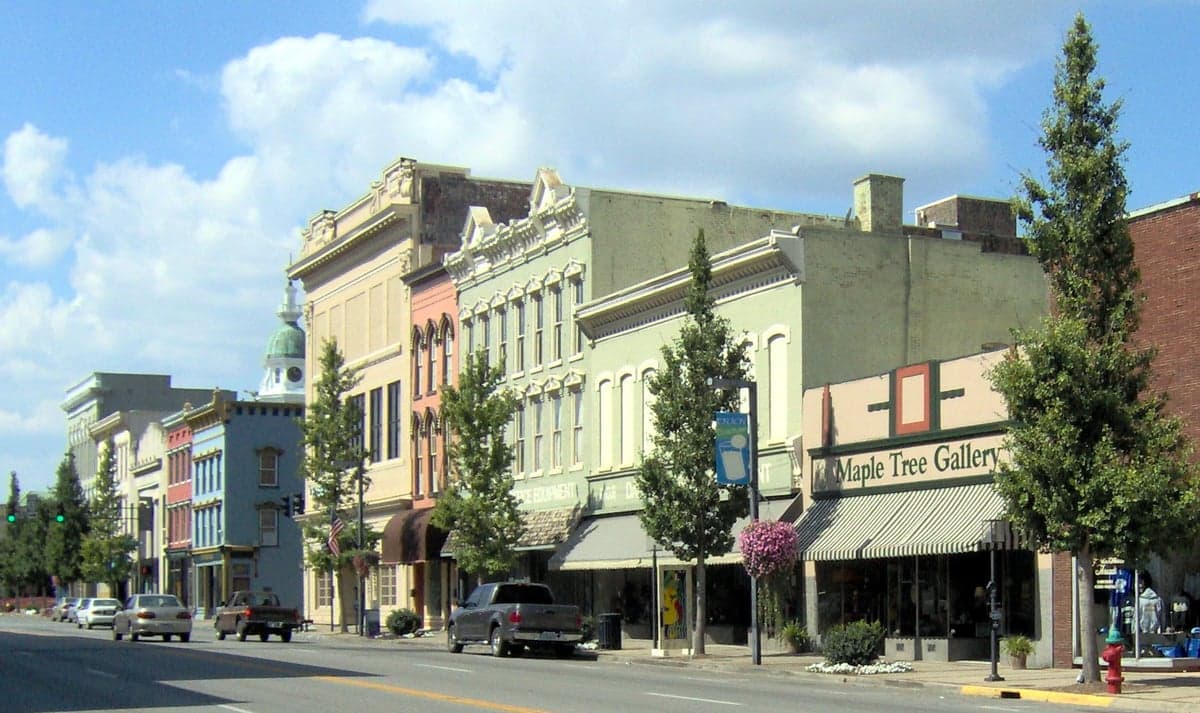
Photo: Wikipedia
Personal Sovereignty in Danville, KY
Viable for self-reliance. Generally workable, though some barriers may limit total independence.
What does Personal Sovereignty tell us?
Personal Sovereignty measures your capacity for self-reliance and independence with minimal government friction. Higher scores mean fewer barriers between you and the way you want to live... but it assumes you have the space you need and good neighbors.
What does this tell us?
Personal Sovereignty measures your capacity for self-reliance and independence with minimal government friction. Higher scores mean fewer barriers between you and the way you want to live... but it assumes you have the space you need and good neighbors.
State Policy
Energy independence: Importer (60% of energy produced in-state)
Personal Liberty
Homesteading

Personal Liberty Analysis
For the liberty-minded individual or family evaluating Danville, Kentucky as a relocation target, the personal sovereignty environment is a mixed bag of strong constitutional protections and creeping state-level overreach. Kentucky’s legal framework generally respects the right to keep and bear arms, offers some of the lowest property tax burdens in the nation, and has not yet adopted the most aggressive public health mandates seen in blue states. However, the state’s regulatory posture on land use, occupational licensing, and emergency powers leaves room for concern. Danville itself, as a smaller city in a rural-leaning county (Boyle County), benefits from a lower density of enforcement and a community culture that still values self-reliance, but it is not a libertarian utopia. The key for a prepper or survivalist is understanding where Kentucky’s constitutional shield ends and where local ordinances or state-level bureaucracy begin to infringe on autonomy.
Tax burden and regulatory posture for self-reliant individuals
Kentucky’s tax structure is generally favorable for those seeking to minimize government extraction from their income and property. The state imposes a flat individual income tax rate of 4.5% (as of 2026), down from 5% in 2023, with a scheduled phase-down to 4% by 2028 if revenue targets are met. This is a meaningful improvement over high-tax states like California or New York, but it is not a zero-income-tax state like Tennessee or Florida. Property taxes are a standout positive: the effective property tax rate in Boyle County is roughly 0.85% of assessed value, well below the national average of 1.1%. For a $200,000 home, that’s about $1,700 annually — a fraction of what you’d pay in the Northeast or Midwest. Sales tax is 6%, with no local add-ons, and groceries are exempt. The regulatory posture is mixed. Kentucky is a “right-to-work” state, which limits union power, and occupational licensing requirements are less burdensome than in many states, but they still exist for trades like electrical and plumbing work. For a homesteader or small-scale producer, the state’s cottage food laws allow sales of certain low-risk foods (baked goods, jams) without a license, but selling meat, eggs, or dairy requires a permit and inspection. The bigger regulatory concern is land use: Boyle County has no county-wide zoning, but the city of Danville does enforce zoning within its limits, including minimum lot sizes (typically 0.25 to 0.5 acres in residential zones) and restrictions on livestock and outbuildings. For true self-reliance, you’ll want to look at unincorporated areas of the county, where you can keep chickens, goats, or even a small orchard without municipal interference.
Self-defense and gun law specifics for preppers
Kentucky is a strong Second Amendment state, and Danville sits in a region where gun ownership is the norm, not the exception. The state has permitless carry (constitutional carry) for anyone 21 or older who is legally allowed to possess a firearm — no license, no training, no permit required. This went into effect in 2019 and has not been rolled back. Open carry is also legal without a permit. For those who want reciprocity when traveling, a Kentucky concealed carry license (CCL) is available and recognized by 37 states. The state preempts local gun ordinances, meaning Danville city council cannot pass its own bans on magazine capacity, assault weapons, or carry in parks — a critical protection against the kind of patchwork restrictions seen in states like Colorado or Washington. Stand-your-ground laws are in effect: there is no duty to retreat in any place you have a legal right to be. Castle doctrine applies to your home, vehicle, and occupied structure. The state also has a “red flag” law? No — Kentucky does not have an Extreme Risk Protection Order (ERPO) law, which is a major plus for those concerned about due process and confiscation orders. However, federal law still applies: felons and those with domestic violence convictions are prohibited from possession, and NFA items (suppressors, short-barreled rifles) are legal with a federal tax stamp. For a prepper, the legal environment is permissive enough to build a serious armory without worrying about state-level overreach, but you should still be aware that local law enforcement in Danville is generally pro-2A and unlikely to harass legal gun owners.
Self-reliance and homesteading viability in Boyle County
For those serious about food security, water independence, and off-grid living, Boyle County offers real opportunities but also practical constraints. The county is part of Kentucky’s Bluegrass region, with fertile limestone soil and a growing season of roughly 180 days (April to October). Average annual rainfall is 45 inches, so water catchment is viable, but the state does not have a formal rainwater harvesting law — it is generally allowed, but there are no explicit protections against local restrictions. Well water is common in rural areas, and drilling a well typically costs $5,000–$10,000 depending on depth. Septic systems are required for properties without sewer access, and permits are issued by the county health department. Zoning is the biggest variable: unincorporated Boyle County has no zoning, which means you can build a workshop, keep livestock, or set up a greenhouse without a permit from the county planning office. However, the state building code applies to new construction, and you will need permits for electrical and plumbing work. Minimum lot sizes in unincorporated areas are generally 1 acre for a single-family home with a septic system, but you can find parcels as small as 0.5 acres if you’re on public sewer. For off-grid solar, Kentucky has net metering for grid-tied systems, but there is no state mandate for utilities to allow off-grid disconnection — you can go fully off-grid, but you must still comply with building codes for the structure itself. The local culture is supportive of self-reliance: farmers’ markets, livestock auctions, and co-ops are common, and the Amish and Mennonite communities in nearby Casey County are a resource for tools, feed, and traditional skills. For a prepper, the key is to buy land outside city limits — inside Danville, you’ll face restrictions on everything from chicken coops to RV parking.
Personal liberties: parental rights, medical autonomy, speech, and property
Kentucky’s record on personal liberties is a study in contrasts. On parental rights, the state is generally strong: there is no universal vaccine mandate for schoolchildren (though individual school districts can require certain vaccines for attendance, with medical and religious exemptions available). The state passed a “Parents’ Bill of Rights” in 2022 that requires schools to notify parents of any medical services offered to students and to obtain parental consent for most health care. This is a significant protection against the kind of school-based medical autonomy erosion seen in states like California. On medical autonomy, Kentucky has not enacted any broad health mandates since the COVID-19 emergency ended, and the state legislature has passed laws prohibiting vaccine passports and mask mandates in public schools. However, the state does have a strict abortion law (trigger ban with no exceptions for rape or incest, only to save the mother’s life), which aligns with conservative values but also represents a government restriction on bodily autonomy — a tension that liberty-minded individuals should acknowledge. Free speech is protected under the Kentucky Constitution, and there are no state-level hate speech laws that criminalize political expression. Property rights are strong: Kentucky is a “pure” eminent domain state, meaning the government can only take land for a public use (not for private economic development, as in the Kelo case). The state also has a “right to farm” law that protects agricultural operations from nuisance lawsuits, which is useful for homesteaders. The biggest liberty concern is the state’s emergency powers: the governor has broad authority to issue executive orders during a declared emergency, including the power to restrict gatherings and close businesses. The legislature has attempted to rein in these powers since 2020, but the governor still retains significant unilateral authority. For a prepper, this means you should be prepared for potential state-level overreach during a future crisis, even if the local environment in Danville is more permissive.
Overall, Danville and Boyle County offer a solid foundation for personal sovereignty relative to most of the country, but they are not a refuge from all government overreach. The absence of a red flag law, the constitutional carry framework, and the lack of county zoning are major wins for the liberty-minded. The flat income tax and low property taxes reduce the financial burden of government. However, the state’s emergency powers, occupational licensing requirements, and municipal zoning inside Danville are reminders that no location is entirely free. Compared to states like Idaho or Montana, Kentucky is more moderate — less regulatory than the West Coast or Northeast, but not as libertarian as New Hampshire or Alaska. For a prepper or survivalist who wants a low-cost, gun-friendly, and community-oriented environment with decent soil and water, Danville is a strong contender. Just make sure you buy outside city limits, keep your paperwork in order, and stay engaged with local politics to protect the freedoms you have.

* Values derived from national, state, county, city and local statistics and may differ in a specific area. Last updated: 2026-04-21T09:44:24.000Z
Narrative content on this page is AI-generated and may contain mistakes. Verify any details that matter before acting on them.
ReloMaps may earn a commission from affiliate links at no extra cost to you.

