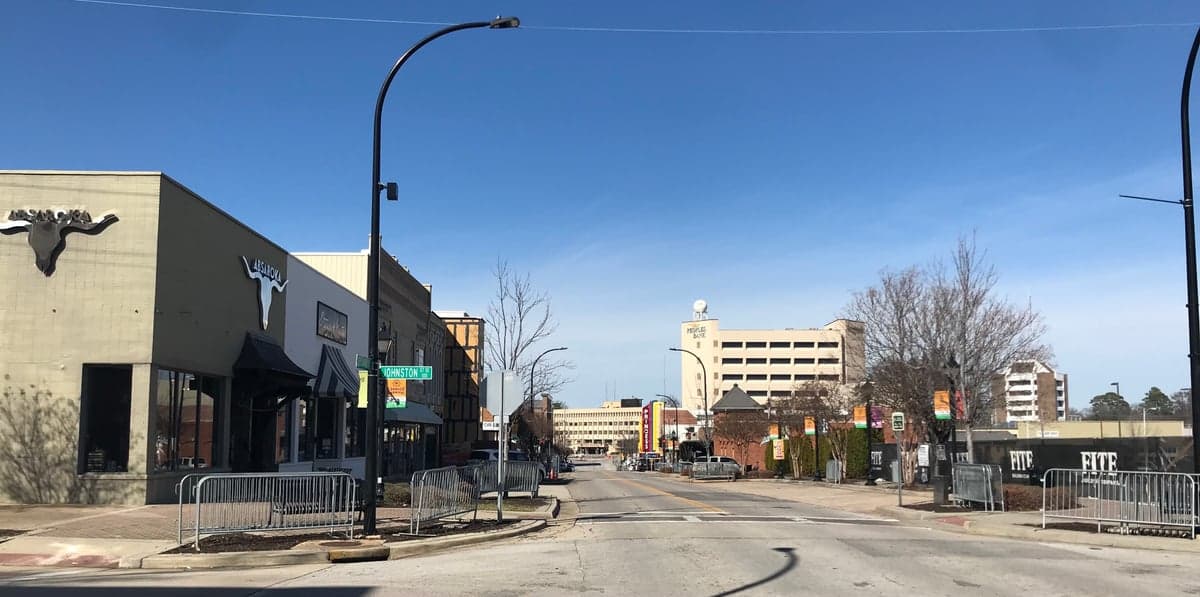
Photo: Wikipedia
Personal Sovereignty in Decatur, AL
Viable for self-reliance. Generally workable, though some barriers may limit total independence.
What does Personal Sovereignty tell us?
Personal Sovereignty measures your capacity for self-reliance and independence with minimal government friction. Higher scores mean fewer barriers between you and the way you want to live... but it assumes you have the space you need and good neighbors.
What does this tell us?
Personal Sovereignty measures your capacity for self-reliance and independence with minimal government friction. Higher scores mean fewer barriers between you and the way you want to live... but it assumes you have the space you need and good neighbors.
State Policy
Energy independence: Importer (45% of energy produced in-state)
Personal Liberty
Homesteading

Personal Liberty Analysis
Decatur, Alabama, offers a notably high degree of personal sovereignty compared to many regions of the country, particularly for those who prioritize minimal government interference in daily life. The city sits in a state that has consistently pushed back against federal overreach, with a legal and cultural environment that favors individual autonomy, self-defense rights, and local control. For the survivalist or prepper mindset, Decatur represents a practical middle ground—close enough to infrastructure and employment to be viable, yet embedded in a state whose political and legal framework actively resists the kind of top-down mandates that erode personal freedom. The key question is whether the specific local conditions in Decatur align with the priorities of someone seeking to maximize self-reliance and minimize government intrusion.
Tax burden and regulatory posture: How Alabama's low-tax structure supports autonomy
Alabama's tax and regulatory environment is among the most favorable in the nation for those seeking to keep more of their own resources and operate with fewer bureaucratic hurdles. The state has no tax on Social Security benefits, no estate tax, and a flat state income tax rate of 5% on taxable income over $3,000—meaning the state takes a fixed, predictable slice rather than a progressive bite. Property taxes are exceptionally low, with the average effective rate in Morgan County hovering around 0.4% of assessed value, which is roughly half the national average. For a prepper or homesteader, this translates directly into more capital for land, supplies, and infrastructure rather than feeding government coffers. The regulatory posture in Decatur is similarly light: the city does not impose its own income tax, and zoning ordinances are relatively permissive compared to metro Atlanta or Nashville. Business licensing is straightforward, and there are no onerous local mandates like paid sick leave or rent control that would signal a creeping expansion of government power. This low-tax, low-regulation environment is a deliberate state policy, not an accident—Alabama's constitution and legislative history reflect a deep skepticism of centralized authority, which provides a structural buffer against the kind of regulatory creep seen in blue states.
Self-defense and gun law specifics: What the Second Sanctuary status means for residents
Alabama is a constitutional carry state, meaning no permit is required to carry a concealed firearm for anyone legally allowed to possess one. This is not a recent concession but a settled legal reality that has been in place since 2022, and Decatur residents enjoy the full force of that law without local interference. Morgan County has been designated a Second Amendment Sanctuary, a formal resolution that directs local law enforcement not to enforce any federal gun control measures deemed unconstitutional. In practical terms, this means no waiting periods, no gun registration, no magazine capacity restrictions, and no "red flag" laws that allow confiscation without due process. Stand-your-ground laws are fully in effect, with no duty to retreat in any place where a person has a legal right to be. For the survivalist, this legal framework is critical: it means that self-defense decisions are not second-guessed by prosecutors or subject to the whims of a state legislature that might shift leftward. The local sheriff's office in Morgan County has a track record of opposing federal overreach on firearms, and the culture among law enforcement is one of deference to the individual's right to keep and bear arms. This is not a theoretical protection—it is a lived reality that allows residents to stockpile, train, and carry without fear of sudden legal changes.
Self-reliance and homesteading viability: Lot sizes, zoning, and off-grid feasibility in Decatur
Decatur's zoning and land-use policies offer genuine opportunities for self-reliance, though the degree of feasibility depends heavily on whether you are inside city limits or in the unincorporated county. Within Decatur proper, standard residential lots range from one-quarter to one-half acre, which is sufficient for a substantial garden, small livestock like chickens or rabbits, and rainwater catchment systems. The city's zoning code does not prohibit backyard chickens, and there are no HOA-style restrictions in most neighborhoods that would prevent a vegetable garden or a small workshop. However, for those seeking true off-grid capability—solar panels, a well, septic, and the ability to keep larger livestock like goats or a cow—the unincorporated areas of Morgan County are far more accommodating. Outside city limits, minimum lot sizes are typically one to five acres, with no building permit requirements for agricultural structures under 200 square feet. The county does not enforce building codes in rural areas, meaning a resident can construct a barn, a root cellar, or a workshop without government inspection. Off-grid solar is legal and common, and there are no state-level restrictions on rainwater harvesting or composting toilets. The Tennessee River provides a reliable water source for those with property frontage, and the local soil is fertile for gardening. For the prepper, the sweet spot is a property just outside the Decatur city limits—close enough to access jobs and supply runs, but far enough to operate under county jurisdiction where zoning is minimal and self-sufficiency is the norm.
Personal liberties: Parental rights, medical autonomy, speech, and property protections
Alabama has been at the forefront of protecting parental rights, with state law explicitly affirming that parents have the fundamental right to direct the upbringing, education, and healthcare of their children. This is not merely rhetorical—the state has passed legislation requiring parental consent for any medical procedure on a minor, including vaccinations, and has resisted federal mandates that would override parental authority in schools. In Decatur, the local school board has maintained a policy of transparency with parents regarding curriculum and health decisions, and there is no local push for critical race theory or gender ideology instruction that would bypass parental input. Medical autonomy for adults is similarly robust: Alabama has no state-level vaccine passport system, no mask mandates in effect, and no restrictions on the purchase of over-the-counter medications or supplements. The state's strong property rights protections include a constitutional amendment that prohibits the taking of private property for economic development, a safeguard against the kind of eminent domain abuse seen in other states. Free speech is protected by both state law and local culture—Decatur is not a city where public expression of conservative or religious views is met with social or legal retaliation. The city council has not passed any ordinances restricting political speech, and the public square remains open for assembly and protest. For the individual concerned about government overreach into personal decisions, Decatur offers a legal environment where the default assumption is that the citizen, not the state, holds the authority over their own life.
In the broader context of personal sovereignty across the United States, Decatur ranks favorably alongside other strongholds in the Southeast like rural Tennessee or the Florida Panhandle, but with the added advantage of being within a state that has not yet experienced the demographic shifts that threaten those areas. The combination of constitutional carry, low taxes, minimal zoning in the county, strong parental rights, and a culture of self-reliance creates a foundation that is difficult to find in most of the country. For the survivalist or prepper evaluating relocation options, Decatur represents a place where the legal and cultural infrastructure supports individual autonomy rather than undermining it—a rare and increasingly valuable quality in a nation trending toward centralized control.

* Values derived from national, state, county, city and local statistics and may differ in a specific area. Last updated: 2026-04-19T18:47:38.000Z
Narrative content on this page is AI-generated and may contain mistakes. Verify any details that matter before acting on them.
ReloMaps may earn a commission from affiliate links at no extra cost to you.

