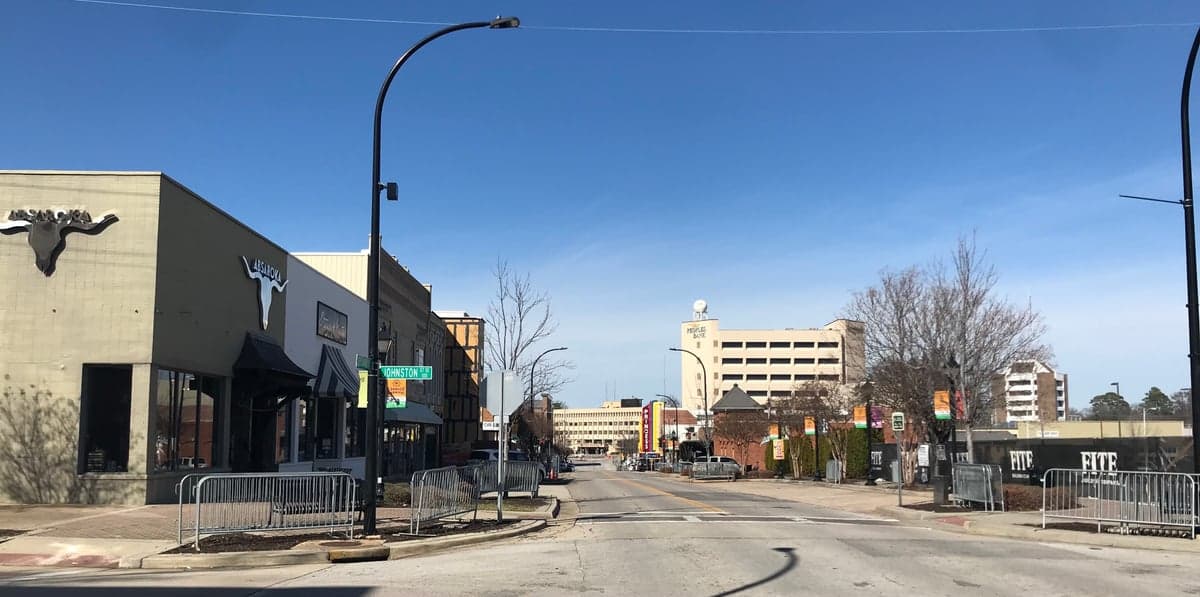
Photo: Wikipedia
Political ClimatePolitical Climate in Decatur, AL
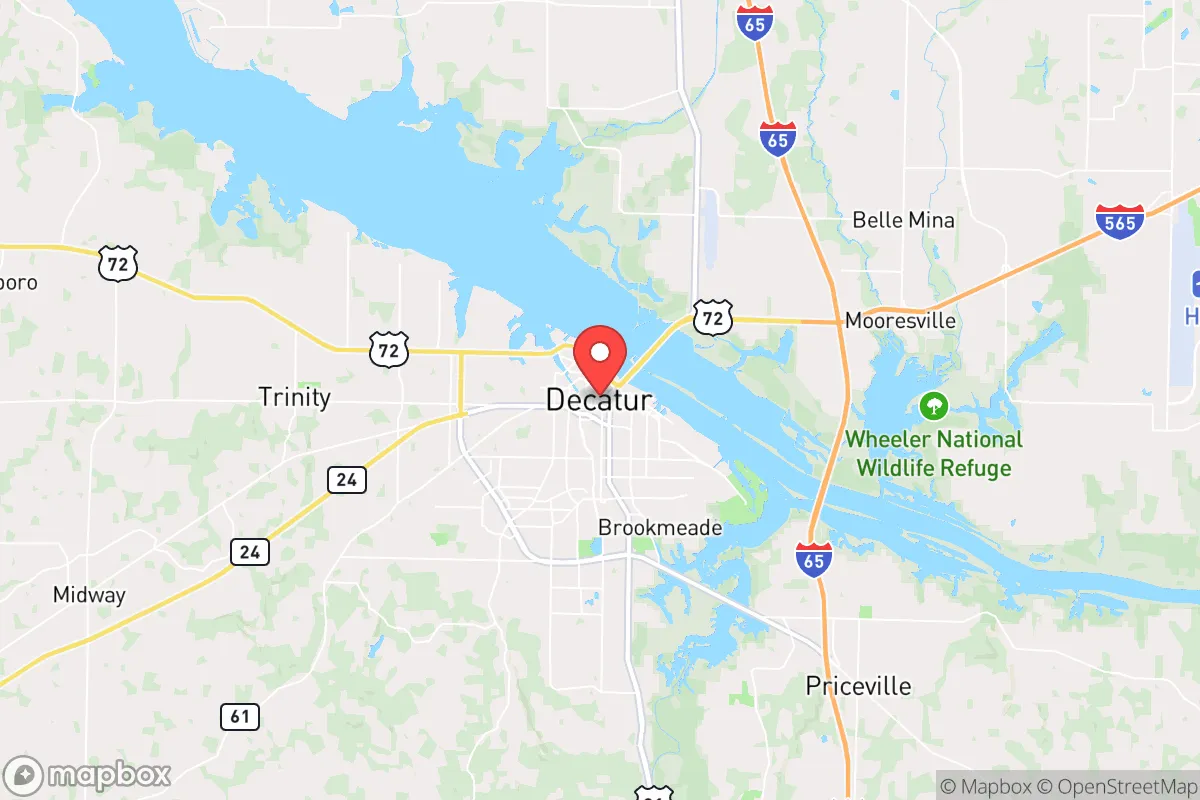
District shown is the primary district for this city’s centroid. Cities may span multiple districts.
Local Political AnalysisPolitical Analysis of Decatur, AL
Decatur, Alabama, sits solidly in the red, with a Cook PVI of R+15 that reflects a deep-rooted conservative tradition. This isn't a recent shift; it's the political baseline here, and for folks who've been around a while, it's a point of pride. The area leans Republican by a comfortable margin, and while national trends have nudged things slightly, the core values of limited government, personal responsibility, and local control remain the default setting for most folks in Morgan County and the Tennessee Valley.
How it compares
Drive 30 minutes south to Huntsville, and you'll feel the difference. Huntsville's booming tech and aerospace sectors have brought in a wave of newcomers, making it more politically mixed—still conservative overall, but with a noticeable progressive undercurrent, especially in city politics. Decatur, by contrast, feels more like the surrounding rural counties—Lawrence, Limestone, and Morgan itself. Towns like Hartselle and Moulton lean even further right, with a "don't tread on me" vibe that's hard to miss. Decatur's industrial base—think 3M, United Launch Alliance, and the Tennessee River's shipping traffic—keeps it grounded in blue-collar pragmatism, not coastal idealism. The contrast is stark: Huntsville might debate bike lanes and density zoning; Decatur debates property taxes and school board oversight. That R+15 rating isn't just a number—it's a reflection of a community that values stability and isn't eager to import the political experiments you see in Birmingham or Atlanta.
What this means for residents
For the average Decatur resident, this political climate translates into a government that, for now, mostly stays out of your business. Property taxes remain low compared to national averages, and there's a general resistance to overreach—whether it's mask mandates, business closures, or zoning rules that tell you what you can do with your own land. The local school board and city council elections tend to be low-key affairs, dominated by familiar names and local issues, not national culture wars. That said, there's a growing concern among longtime residents about creeping progressive influence, especially as Huntsville's growth spills over. You see it in debates over housing regulations and the occasional push for "equity" initiatives in schools. The worry is that these small shifts, if left unchecked, could erode the personal freedoms that make Decatur a good place to raise a family. The near-term outlook is stable—most folks here vote their conscience, not a party line—but the long-term trajectory depends on whether the community holds the line against outside pressure.
Culturally, Decatur stands apart from its neighbors in a few key ways. It's a river town with a working-class backbone, and that shows in its politics: gun rights are widely respected, church attendance is high, and the phrase "government efficiency" is met with a skeptical eye. There's no city income tax, and the local leadership tends to be fiscally conservative, even if they occasionally spend on infrastructure like the new riverfront park. The biggest distinction is the absence of the kind of activist energy you see in college towns or big cities. Here, the political conversation is more about what works for the community than what fits a national narrative. If you're looking for a place where your rights aren't up for debate every election cycle, Decatur still fits the bill—but keep an eye on those city council meetings. The fight to keep it that way is ongoing.

State Political ClimatePolitical Climate in Alabama
State Political AnalysisPolitical Environment in the State
Alabama has been a reliably red state for decades, but the nature of that conservatism is shifting. The state leans solidly Republican at the federal level, with Donald Trump winning by over 25 points in 2024, and the GOP holds supermajorities in both legislative chambers. However, the 10-20 year arc shows a subtle but real evolution: the old-school, rural, culturally conservative base is being slowly supplemented by a more suburban, growth-oriented, and economically conservative cohort, particularly in the metro areas of Huntsville and Baldwin County. The state’s political center of gravity is moving away from the Black Belt and the old industrial corridor, and toward the tech hubs and coastal retirement zones.
Urban vs. rural divide
The political map of Alabama is stark. The rural Black Belt counties—like Greene, Lowndes, and Wilcox—vote overwhelmingly Democratic, often by 70-80% margins, driven by a high concentration of African American voters. These areas are also the poorest and most depopulating in the state. In contrast, the rural white counties in the northern part of the state, such as DeKalb and Jackson, are deep red, often voting 80%+ Republican. The real action is in the metros. Jefferson County (Birmingham) is the state’s largest Democratic stronghold, but it’s not monolithic: the city of Birmingham is heavily Democratic, while the suburbs like Hoover and Vestavia Hills are reliably Republican, though trending slightly more moderate on social issues. Madison County (Huntsville) is the state’s fastest-growing and most politically interesting area. It’s still Republican-leaning, but the influx of out-of-state defense and aerospace workers has made it more libertarian-leaning and less culturally traditional than the rest of the state. Mobile County and Baldwin County (the Gulf Coast) are a study in contrast: Mobile is a working-class, union-influenced city that still votes Republican but with a populist streak, while Baldwin County (Fairhope, Daphne) is a fast-growing, affluent, and deeply conservative retirement and second-home destination that is becoming a major GOP fundraising base.
Policy environment
Alabama’s policy environment is broadly conservative, but with some notable wrinkles. The state has no state income tax on retirement income, which is a major draw for retirees, and the overall state income tax rate is a flat 5%, which is moderate by national standards. Property taxes are among the lowest in the nation, thanks to a 1978 constitutional amendment that capped assessments. This is a double-edged sword: it keeps housing affordable, but it starves local governments of revenue, leading to underfunded schools and infrastructure in many areas. The regulatory posture is business-friendly, with a right-to-work law and a weak regulatory environment for industry. Education policy is a flashpoint: the state has a robust school choice movement, with the Alabama Accountability Act providing tax credits for private school tuition, and the 2024 CHOOSE Act expanding Education Savings Accounts. However, the state’s public schools remain near the bottom nationally in most metrics. Healthcare is a mixed bag: Alabama did not expand Medicaid under the ACA, leaving a coverage gap for low-income adults, but the state has a strong network of rural hospitals and a growing telemedicine sector. Election laws are strict: voter ID is required, and the state has a voter purge law that has been controversial. The state legislature has also passed laws restricting ballot harvesting and limiting drop boxes.
Trajectory & freedom
On the freedom front, Alabama has been moving in a decidedly more liberty-oriented direction over the past decade, particularly on gun rights and parental rights. In 2022, the state passed a permitless carry law (constitutional carry), allowing any law-abiding adult to carry a concealed firearm without a permit. This was a major win for gun rights advocates. On parental rights, the 2022 Alabama Vulnerable Child Protection Act criminalized gender-affirming care for minors, and the 2024 CHOOSE Act expanded school choice, giving parents more control over their children’s education. On medical freedom, the state has been resistant to federal vaccine mandates, with the legislature passing laws prohibiting vaccine passports and mandating that employers allow religious exemptions. However, there are areas of concern. The state’s tax structure, while low, is regressive, with the poorest residents paying a higher percentage of their income in state and local taxes than the wealthy. Property rights are generally strong, but the state has a history of using eminent domain for economic development projects, which has been a flashpoint in rural areas. The state’s abortion ban, the Human Life Protection Act of 2019, is one of the strictest in the nation, with no exceptions for rape or incest. This is a settled issue for now, but it could become a political liability if public opinion shifts.
Civil unrest & political movements
Alabama has not seen the level of civil unrest seen in other states, but there have been notable flashpoints. The 2020 George Floyd protests in Birmingham and Mobile were largely peaceful, but there were isolated incidents of property damage. The state’s political movements are highly organized on both sides. On the right, the Alabama Republican Party is dominated by the Alabama Policy Institute and the Eagle Forum of Alabama, which push a socially conservative agenda. The Alabama Citizens for Life is a powerful lobbying force. On the left, the Alabama Democratic Party is weak and fractured, but groups like the Alabama Poor People’s Campaign and the Alabama Justice Initiative are active on criminal justice reform and poverty issues. Immigration politics are less heated than in border states, but there is a strong undercurrent of concern. The state passed HB 56 in 2011, one of the strictest anti-immigration laws in the country, but many of its provisions were struck down in court. The issue has simmered since, with occasional flare-ups over sanctuary city policies, though no Alabama city has formally declared itself a sanctuary. Election integrity is a live issue: the 2020 election saw no major fraud in Alabama, but the legislature has passed laws tightening voter ID and restricting absentee voting, citing concerns about public confidence.
Projection
Over the next 5-10 years, Alabama is likely to become more politically competitive in certain pockets, but the overall conservative tilt will hold. The key demographic shift is the growth of Huntsville and Baldwin County. Huntsville is attracting a younger, more educated, and more secular population from out of state, which could push the city and its suburbs toward a more libertarian, less socially conservative posture. Baldwin County is attracting wealthy retirees from the Midwest and Northeast, who tend to be fiscally conservative but may be more moderate on environmental issues like coastal development. The Black Belt will continue to depopulate, reducing the Democratic base. The wild card is the state’s education system: if the CHOOSE Act and school choice lead to measurable improvements in educational outcomes, it could cement the GOP’s hold on suburban voters. If not, there could be a backlash from parents who feel the state is underfunding public schools. The state’s tax structure is unlikely to change, but there will be ongoing pressure to reform the property tax system, which is a major source of inequality. A new resident moving in now should expect to find a state that is deeply conservative but not monolithic, with a growing tension between the old rural base and the new suburban and tech-driven economy. The state will remain a safe haven for conservative values, but the definition of those values is slowly evolving.
For a new resident, the bottom line is this: Alabama offers a low-tax, low-regulation environment with strong protections for gun rights, parental rights, and religious freedom. The state is politically stable and unlikely to swing blue in the foreseeable future. However, you should be aware of the trade-offs: public schools are weak in many areas, healthcare access is uneven, and the state’s tax structure is regressive. If you are moving for a job in Huntsville or the Gulf Coast, you will find a growing, dynamic economy with a like-minded political culture. If you are moving to a rural area, you will find a slower pace and a deeply traditional community. The state is not for everyone, but for those who value personal liberty and a conservative policy environment, it remains one of the best options in the country.
* Values derived from national, state, county, city and local statistics and may differ in a specific area. Last updated: 2026-04-19T18:47:38.000Z
Narrative content on this page is AI-generated and may contain mistakes. Verify any details that matter before acting on them.
ReloMaps may earn a commission from affiliate links at no extra cost to you.

