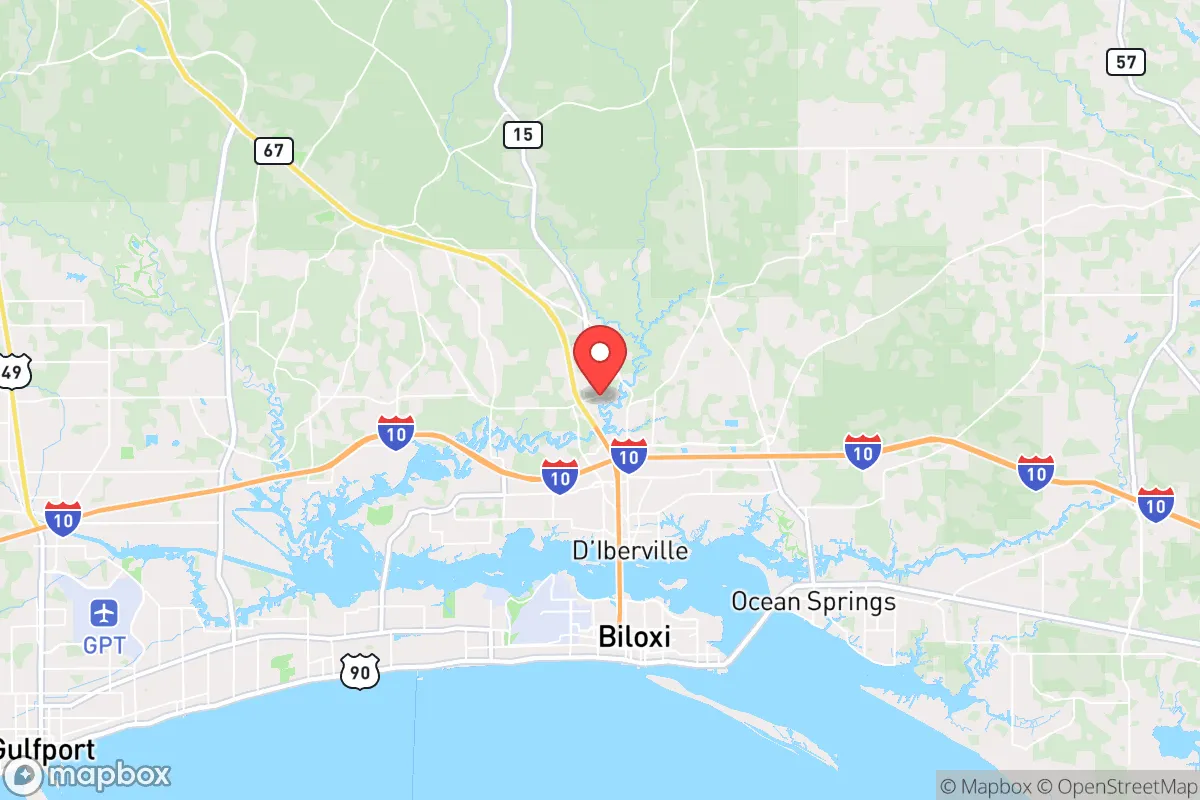
Demographics of Diberville, MS
Affluence Level in Diberville, MS
A middle-class area roughly in line with national averages across income, home values, education, and employment.
People of Diberville, MS
Today, Diberville’s 13,033 residents form a working-class, racially diverse community on the Mississippi Gulf Coast, with a population density of roughly 1,100 people per square mile. The city is notably more diverse than neighboring Biloxi, with a distinctive blend of White (59.5%), Black (17.7%), and East/Southeast Asian (9.5%) residents, alongside a growing Hispanic population (8.9%). The city’s identity is rooted in its role as a suburban bedroom community for Biloxi and Gulfport, with a strong blue-collar ethos tied to the casino, shipbuilding, and service industries. Only 20.4% of adults hold a college degree, reflecting a population that values practical trades and family stability over white-collar credentials.
How the city was settled and grew
Diberville’s human history begins not with colonial settlement but with post-1900 suburban expansion. The area was originally part of the Biloxi backcountry, a sparsely populated pine forest and marshland used for timber and small-scale farming. The first permanent residents were White families of English and Scots-Irish descent who moved inland from Biloxi’s crowded waterfront in the 1910s and 1920s, building modest homes along what is now Old Highway 67 and around the D’Iberville Park area. These early settlers worked in Biloxi’s seafood canneries and shipyards, and their descendants still form the core of the city’s White population in neighborhoods like Lamey Bridge and Rodriguez Street. The city was not formally incorporated until 1988, meaning its growth was organic and unplanned, driven by the post-World War II housing boom and the expansion of Keesler Air Force Base in Biloxi. The 1950s and 1960s saw a second wave of White families from the rural Deep South, drawn by defense-industry jobs, settling in the Bayou Auguste and Lemoyne Boulevard corridors.
Modern era (post-1965)
The 1965 Hart-Cellar Act and the subsequent collapse of legal segregation reshaped Diberville’s population dramatically. Black families, who had historically been confined to Biloxi’s east side, began moving into Diberville in the 1970s and 1980s, seeking affordable land and newer housing stock. They concentrated in the Briarfield and St. Martin neighborhoods, where Black homeownership rates rose steadily. The 1990s brought a surge of East/Southeast Asian immigration, primarily Vietnamese and Filipino families, who arrived after Hurricane Katrina’s diaspora and the expansion of the Gulf Coast casino industry. These communities settled heavily in the D’Iberville Commons area and along Promenade Parkway, where Vietnamese-owned nail salons, restaurants, and grocery stores now anchor a small but visible commercial corridor. The Hispanic population, largely Mexican and Central American, grew from near-zero in 1990 to 8.9% today, with families moving into rental apartments near I-110 and Lamey Bridge Road for construction and hospitality work. The Indian subcontinent population remains tiny at 0.3%, with no distinct neighborhood concentration.
The future
Diberville’s population is trending toward greater diversity but also toward economic stratification. The White population, now 59.5%, is aging and slowly declining as younger families move to newer subdivisions in Jackson County. The East/Southeast Asian community, at 9.5%, is stable and increasingly assimilated, with second-generation Vietnamese and Filipino residents moving into professional jobs in Biloxi and Gulfport. The Hispanic share is likely to continue rising, driven by continued demand for service and construction labor, though it remains below the national average. The Black population, at 17.7%, is growing modestly through natural increase and in-migration from New Orleans and the Mississippi Delta. The city is not tribalizing into hostile enclaves, but distinct neighborhood identities persist: Briarfield remains predominantly Black, Old Highway 67 remains predominantly White, and D’Iberville Commons is the Asian commercial hub. The next decade will likely see Diberville become a majority-minority city, with no single group holding a demographic majority, as the White share continues its slow decline.
For someone moving in now, Diberville offers a stable, affordable, and increasingly diverse community where working-class values and family ties remain central. The city is not a high-growth boomtown, but a steady, middle-income suburb where newcomers can find established ethnic neighborhoods and a low cost of living. The key trade-off is limited upward mobility—only one in five adults holds a college degree—but for those seeking a safe, grounded place to raise a family near the coast, Diberville’s demographic trajectory suggests it will remain a solid, if unglamorous, choice for decades to come.

* Values derived from national, state, county, city and local statistics and may differ in a specific area. Last updated: 2026-05-03T05:05:37.000Z
Narrative content on this page is AI-generated and may contain mistakes. Verify any details that matter before acting on them.
ReloMaps may earn a commission from affiliate links at no extra cost to you.

