Strategic Assessment of Diberville, MS
Meaningful friction. Expect exposure to either population pressure, blast zones, or natural disaster risk. Consider buying a retreat property.
What does the Strategic Assessment tell us?
Our Strategic Assessment grades tactical survivability of an area. Major population centers, military targets, fallout zones, natural disasters, and border exposure all drive risk — lower exposure means a more defensible position in a crisis.
This is heavily inspired by Joel Skousen's Strategic Relocation book. Highly recommended you checkout the book ($)What does this tell us?
Our Strategic Assessment grades tactical survivability of an area. Major population centers, military targets, fallout zones, natural disasters, and border exposure all drive risk — lower exposure means a more defensible position in a crisis.
This is heavily inspired by Joel Skousen's Strategic Relocation book. Highly recommended you checkout the book ($)Strategic Pillars

Key Distances
Regional Safe Places
Below is our recommended "safe zones" in Mississippi and the surrounding area based on our strategic heuristics. For most people, it's unrealistic to live in a “safe zone” full-time due to work, family or other personal reasons. They tend to be more rural. However, many of these areas are perfect for second homes and retreat properties that double as a vacation home or even a short-term rental.
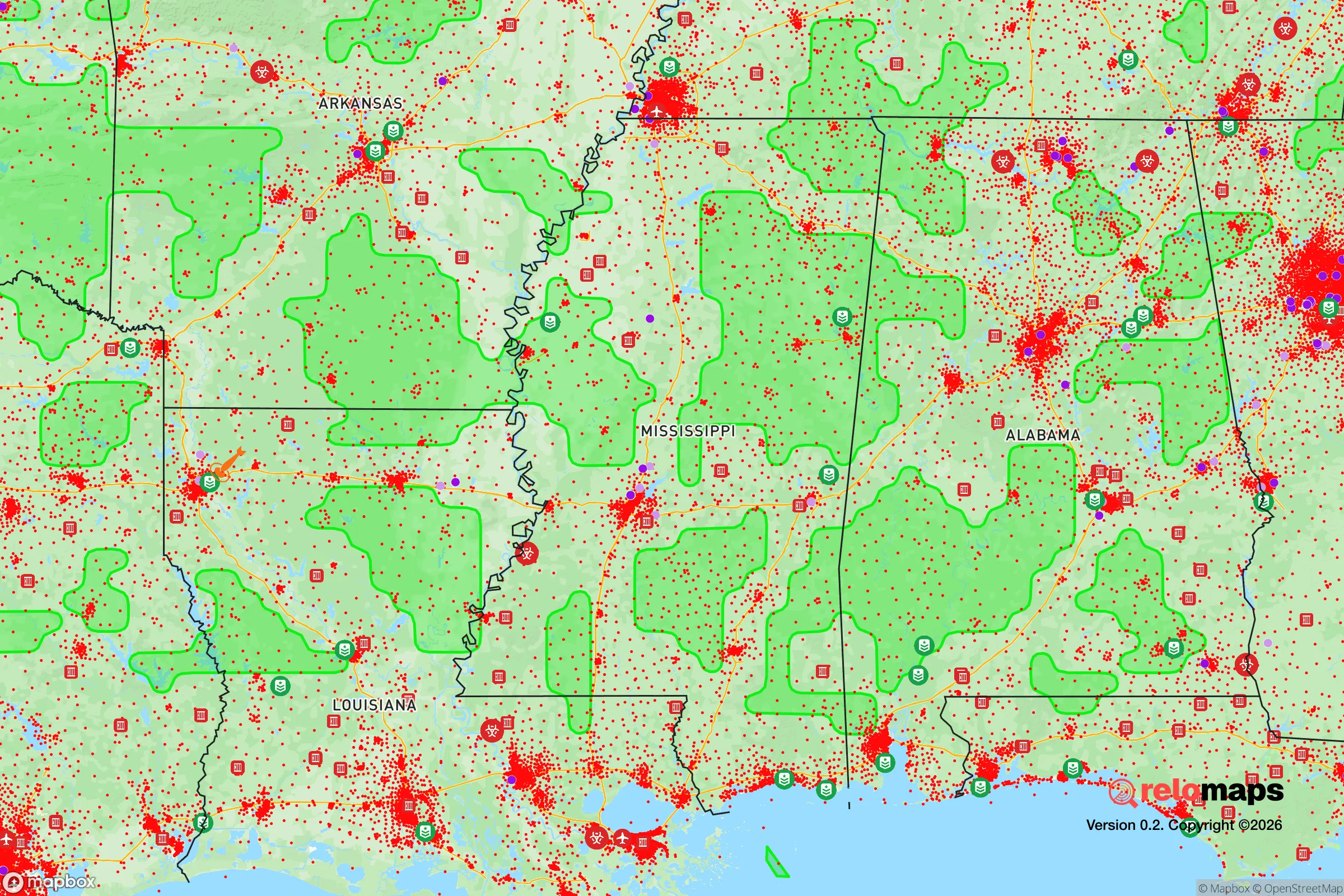
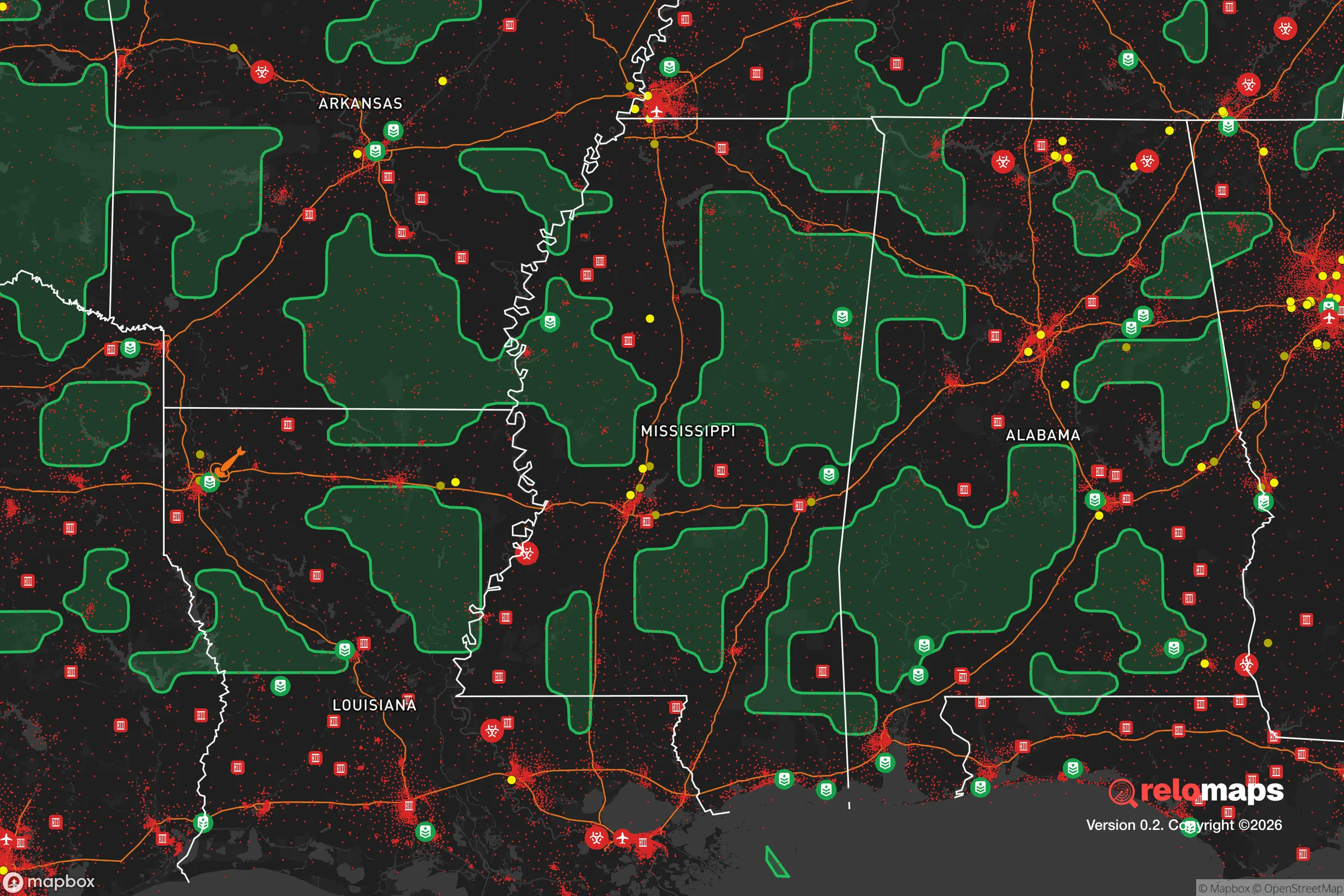


Important Note: For informational purposes only. This does not mean nothing bad ever happens in the green zones. Please use common sense. This is based on public data and modeled with AI. We tried to take a conservative approach but mistakes happen. We update this regularly as new information becomes available.
Solar Generator Recommendations
Backup power matters more here than in safer locations. We've picked three solar generators across budgets and capacity tiers — start with the budget unit if you only need a few essentials, or step up if you want to run a fridge and HVAC for days at a time.

Jackery Portable Power Station Explorer 300
Budget OptionPower on the Go: Weighing only 11 lbs, it's convenient to set up and store with book-sized foldable solar panels

BLUETTI Portable Power Station AC180
Designed for both indoor and outdoor scenarios, AC180 is highly capable as it has a robost capacity and continuous output power.

EF ECOFLOW DELTA Pro Ultra Power Station
Upgraded PickEcoFlow DELTA Pro Ultra is a whole-home energy system designed to grow with your family. Integrated with the Smart Home Panel 2, it scales to meet your evolving energy needs — keeping your home powered, intelligent, and secure through every stage of life.
We earn a commission, at no additional cost to you.
Strategic Assessment Analysis
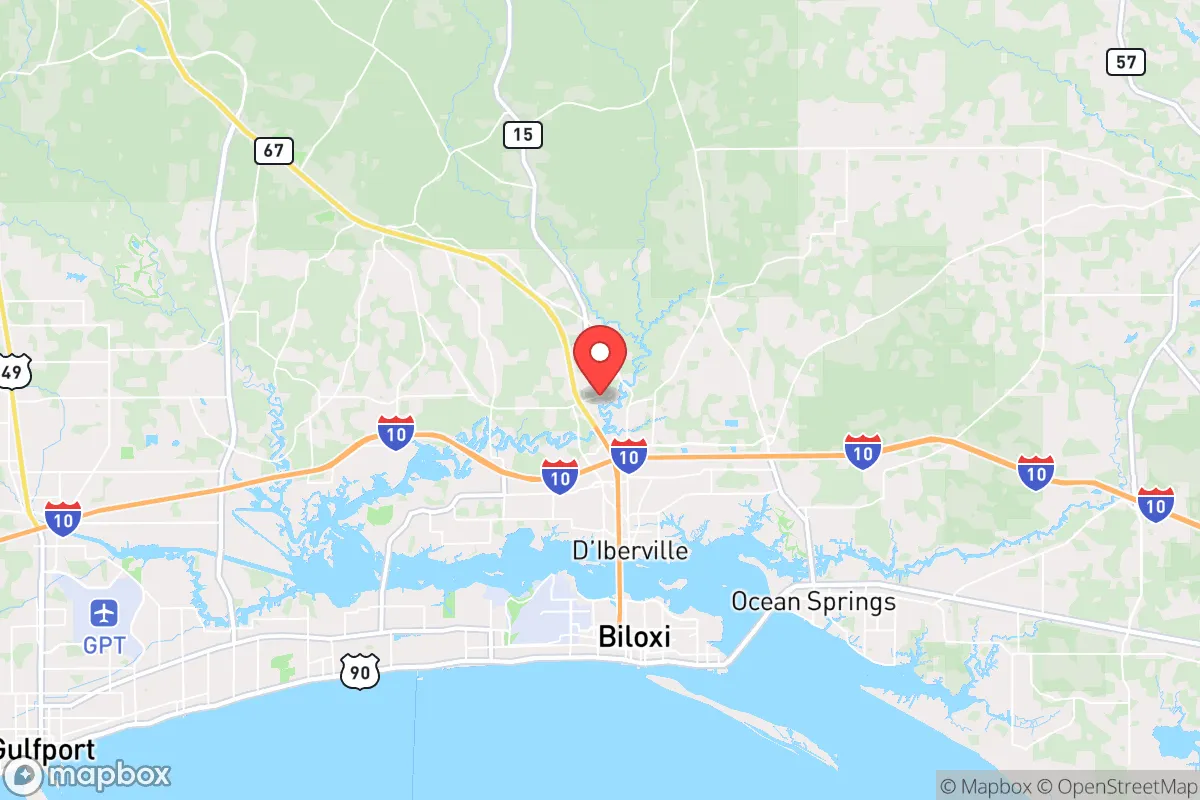
D’Iberville, Mississippi, sits in a strategic sweet spot that few relocation analyses fully appreciate: close enough to the Gulf Coast’s economic engine to sustain a normal life, yet far enough from the obvious bullseyes to offer genuine resilience in a crisis. This city of roughly 15,000, tucked between Biloxi and the sprawling marshlands of the Back Bay, benefits from a location that is neither isolated nor exposed. For a conservative-leaning relocator thinking about civic unrest, natural disasters, or supply-chain disruptions, D’Iberville’s position offers a rare combination of access and buffer—provided you understand its specific vulnerabilities and plan accordingly.
Geographic position and natural advantages for long-term stability
D’Iberville’s geography is its first and most underrated asset. The city sits on a peninsula formed by the Biloxi Back Bay to the south and the Tchoutacabouffa River to the east, with the Gulf of Mexico about five miles south. This water-bounded layout creates natural chokepoints: only a handful of bridges and highways connect D’Iberville to the rest of the Mississippi Gulf Coast. In a scenario where civil order degrades or a major evacuation is underway, those chokepoints become defensible. The city’s elevation—averaging 15 to 25 feet above sea level—is higher than most of coastal Mississippi, which reduces flood risk compared to Biloxi or Gulfport. The surrounding marshlands and bayous also act as a natural buffer against large-scale ground movement, making D’Iberville less attractive as a transit corridor for unrest spilling out of New Orleans or Mobile. For a relocator prioritizing physical security, the ability to control access to your immediate area is a major advantage, and D’Iberville’s layout delivers that without requiring a bunker in the woods.
Risks, exposures, and proximity to fallout-relevant landmarks
No strategic assessment is honest without naming the downsides. D’Iberville’s biggest exposure is its proximity to Keesler Air Force Base, located just across the Back Bay in Biloxi. Keesler is a major training and technical hub for the U.S. Air Force, and in any conflict scenario—whether foreign or domestic—it becomes a high-value target. A conventional strike, EMP event, or even a targeted cyberattack on the base’s infrastructure could ripple across the entire Biloxi-D’Iberville area. The base is roughly four miles from downtown D’Iberville, close enough that a ground-level detonation or large-scale fire would affect the city directly. Additionally, D’Iberville sits about 45 miles from the Pascagoula shipyards, which build Navy vessels, and about 90 miles from the Strategic Petroleum Reserve at Bryan Mound in Texas. Both are plausible targets in a major conflict. On the natural disaster side, the Gulf Coast’s hurricane risk is real: D’Iberville took a direct hit from Hurricane Katrina in 2005, with storm surge pushing into the Back Bay and flooding low-lying areas. While the city has rebuilt with stricter codes, a Category 4 or 5 storm would still overwhelm local infrastructure for weeks. For the prepper-minded relocator, these risks mean you cannot treat D’Iberville as a bug-out location—it’s a living-in-place scenario that requires active mitigation.
Practical resilience for a relocator: food, water, energy, and defensibility
D’Iberville’s practical resilience depends heavily on how you set up your property. The city is part of the Harrison County Water and Sewer District, which draws from the Pascagoula River Basin and the Coastal Plain Aquifer. Municipal water is treated and reliable in normal times, but a hurricane or grid failure could knock out pumping stations for days. A well is not standard in most D’Iberville subdivisions, but properties on the eastern edge near the Tchoutacabouffa River or in the rural pockets off Highway 67 may have access to groundwater. Rainwater catchment is legal and practical given the region’s 60+ inches of annual rainfall, but you’ll need a filtration system for potable use. Food resilience is mixed: D’Iberville has a Walmart Supercenter, a Rouses Market, and several smaller grocery stores, but these are vulnerable to supply-chain disruptions. The local agricultural base is thin—Mississippi’s coastal counties are not major crop producers—so gardening and livestock are viable only if you have acreage. Most residential lots in D’Iberville are a quarter-acre or less, limiting food production. For energy, Mississippi Power (a Southern Company subsidiary) serves the area, and outages after storms are common. Solar panels with battery storage are a smart investment, but check HOA restrictions in subdivisions like the Reserve or Bay Colony. Defensibility is where D’Iberville shines: the city’s layout, with its limited bridge access and winding bayou roads, makes it easy to monitor movement. A small group of prepared households could effectively secure a neighborhood like the ones off Sangani Boulevard or along the riverfront. The local police department is professional but small—about 40 officers—so in a prolonged crisis, you cannot rely on them for perimeter security.
The overall strategic picture for D’Iberville is one of calculated trade-offs. It offers a livable, affordable base with natural defensibility and proximity to Gulf Coast amenities, but it is not a remote survivalist retreat. The risks from Keesler Air Force Base, hurricane exposure, and limited local food production mean that a relocator must invest in redundancy—backup power, water storage, and a solid community network—to make the location work in a crisis. For the conservative-leaning individual or family who wants to stay connected to normal life while maintaining a serious preparedness posture, D’Iberville is a viable option. Just don’t mistake its quiet suburban surface for inherent safety. The resilience is there, but it requires active effort to unlock.

* Values derived from national, state, county, city and local statistics and may differ in a specific area. Last updated: 2026-05-03T05:05:37.000Z
Narrative content on this page is AI-generated and may contain mistakes. Verify any details that matter before acting on them.
ReloMaps may earn a commission from affiliate links at no extra cost to you.

