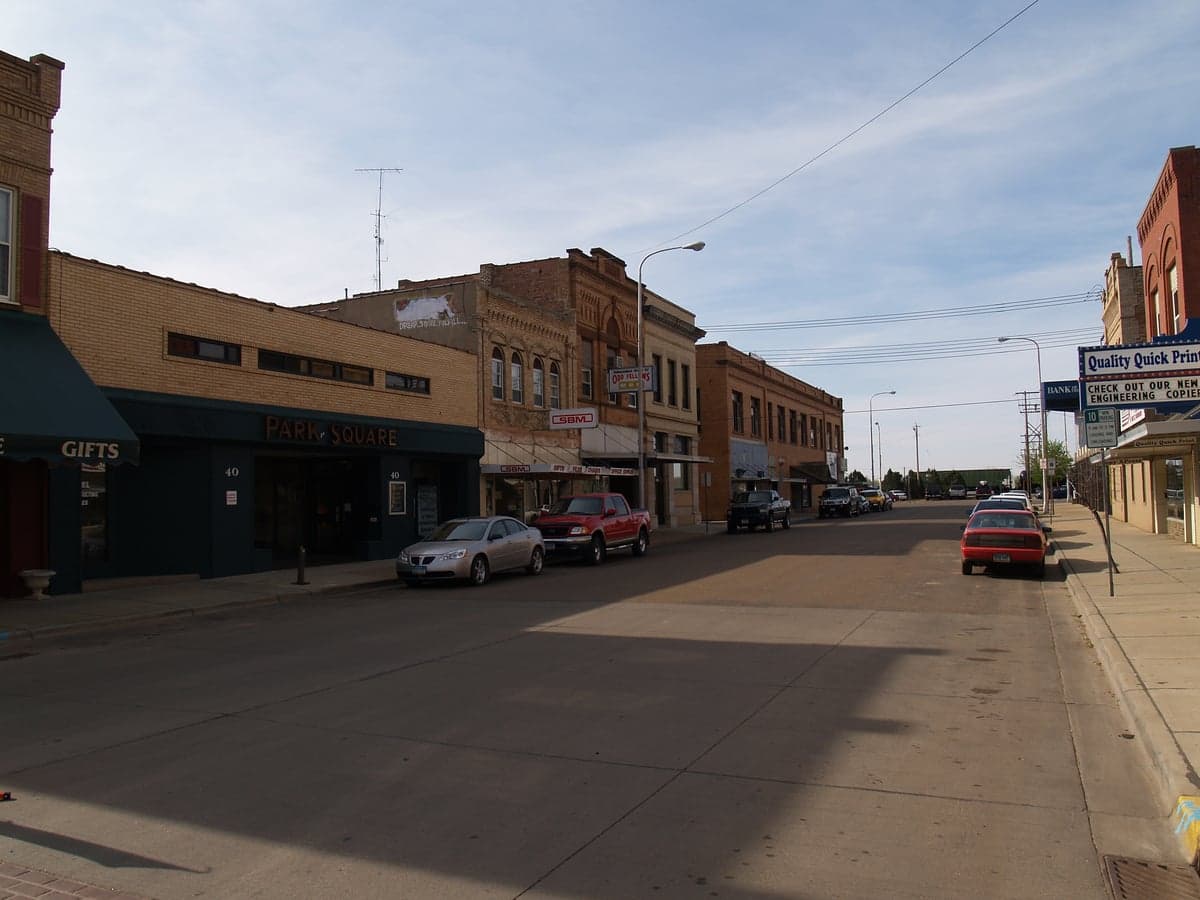
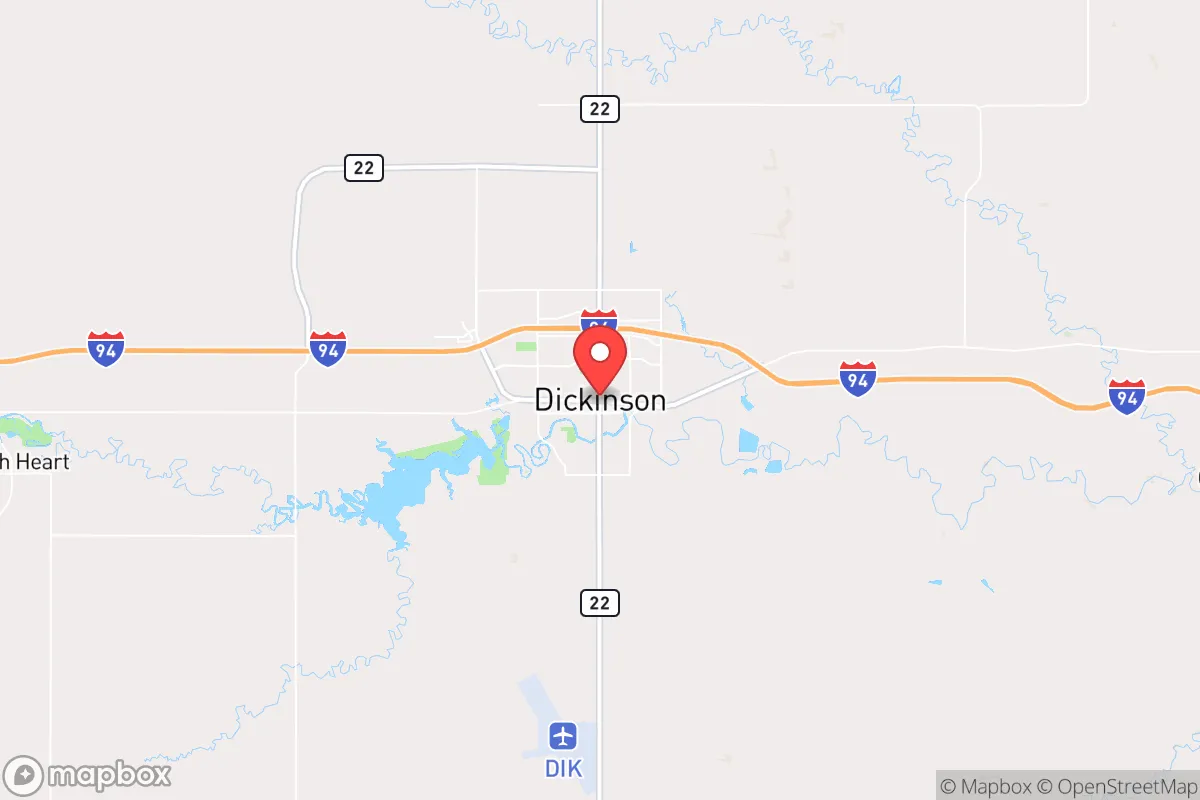
Photo: Wikipedia
Demographics of Dickinson, ND
Affluence Level in Dickinson, ND
A middle-class area roughly in line with national averages across income, home values, education, and employment.
People of Dickinson, ND
The people of Dickinson, North Dakota today number 25,216, forming a compact, predominantly white (83.0%) community with a growing Hispanic presence (8.4%) and small but notable Black (3.0%) and East/Southeast Asian (1.3%) populations. The city’s character remains rooted in its energy and agricultural heritage, with a lower college attainment rate (27.4%) than the national average, reflecting a workforce drawn to trades, oil fields, and farming. Distinctively, Dickinson is a place where a historic German-Russian and Scandinavian foundation is now overlaying with newer, more diverse arrivals, creating a community that is both traditional and gradually shifting.
How the city was settled and grew
Dickinson’s population story begins with the arrival of the railroad in 1880, which transformed a small trading post into a regional hub. The original settlers were predominantly German-Russian immigrants—ethnic Germans who had lived in the Russian Empire—alongside Norwegian and other Scandinavian homesteaders drawn by the promise of cheap land under the Homestead Act. These groups built the city’s early neighborhoods. The German-Russian community concentrated in the area around 1st Street West and the original downtown core, establishing churches like St. Patrick’s Catholic and St. John’s Lutheran that still anchor the historic district. Scandinavian settlers, meanwhile, clustered in the north side near the railroad tracks, where they built the Scandinavian Lutheran Church and formed tight-knit farming enclaves. By the early 20th century, Dickinson’s population was overwhelmingly white, with a small number of African American railroad workers and Chinese laborers who passed through but did not settle permanently. The city grew steadily through the mid-20th century, reaching about 10,000 by 1960, driven by agriculture, the railroad, and the establishment of Dickinson State University in 1918.
Modern era (post-1965)
The post-1965 period brought modest but meaningful demographic change. The Immigration and Nationality Act of 1965 opened doors for new groups, but Dickinson’s remote location meant that most new arrivals were domestic migrants rather than foreign-born. The foreign-born population today is just 2.1%, well below the national average. The biggest shift came with the North Dakota oil boom beginning in the late 2000s, which drew workers from across the U.S. and abroad. Hispanic workers, many from Texas and the Southwest, arrived to work in the oil fields and related services, settling in the southwest side near the Interstate 94 corridor, where newer apartment complexes and mobile home parks absorbed the influx. The Black population (3.0%) grew during this period as well, with many African American workers coming from Louisiana and Texas for energy-sector jobs, concentrating in the east side near the Dickinson High School area. East/Southeast Asian residents (1.3%) include a small number of Filipino and Vietnamese families, often connected to healthcare and university jobs, living in the northwest side near the hospital and Dickinson State University. The Indian-subcontinent population (0.3%) remains tiny, mostly professionals in medicine or academia. The historic German-Russian neighborhoods downtown have seen some outmigration of younger families to newer subdivisions, but they remain culturally significant as the city’s ethnic core.
The future
Dickinson’s population is heading toward gradual diversification, but the pace is slow. The Hispanic share (8.4%) is the fastest-growing segment, driven by continued oil-industry demand and family reunification, and is likely to reach 10-12% within a decade. This growth is concentrated in the southwest side and newer developments near the Dickinson Recreation Center, where Hispanic-owned businesses and a Spanish-language church have emerged. The white population, while still dominant, is aging and seeing modest outmigration of younger adults to larger cities. The Black and East/Southeast Asian communities are likely to plateau or grow slowly, as the oil industry’s cyclical nature limits sustained in-migration. The city is not tribalizing into distinct enclaves—neighborhoods remain largely integrated—but the southwest side is becoming a de facto Hispanic corridor, while the historic downtown and north side remain overwhelmingly white and older. The next 10-20 years will likely see Dickinson become slightly more Hispanic and slightly less white, but it will remain a predominantly white, working-class community with a strong German-Russian cultural imprint.
For someone moving in now, Dickinson is a place where the old ethnic foundations are still visible in church steeples and family names, but the new energy-driven economy is slowly reshaping who lives here. The city offers a stable, safe environment with a clear sense of its past, but newcomers—especially those from Hispanic or other minority backgrounds—will find a community that is welcoming but still largely homogeneous. The bottom line: Dickinson is becoming more diverse at a measured pace, but its identity remains firmly rooted in its German-Russian and Scandinavian heritage, with the oil patch driving the next chapter of its human history.

* Values derived from national, state, county, city and local statistics and may differ in a specific area. Last updated: 2026-04-19T06:10:18.000Z
Narrative content on this page is AI-generated and may contain mistakes. Verify any details that matter before acting on them.
ReloMaps may earn a commission from affiliate links at no extra cost to you.

