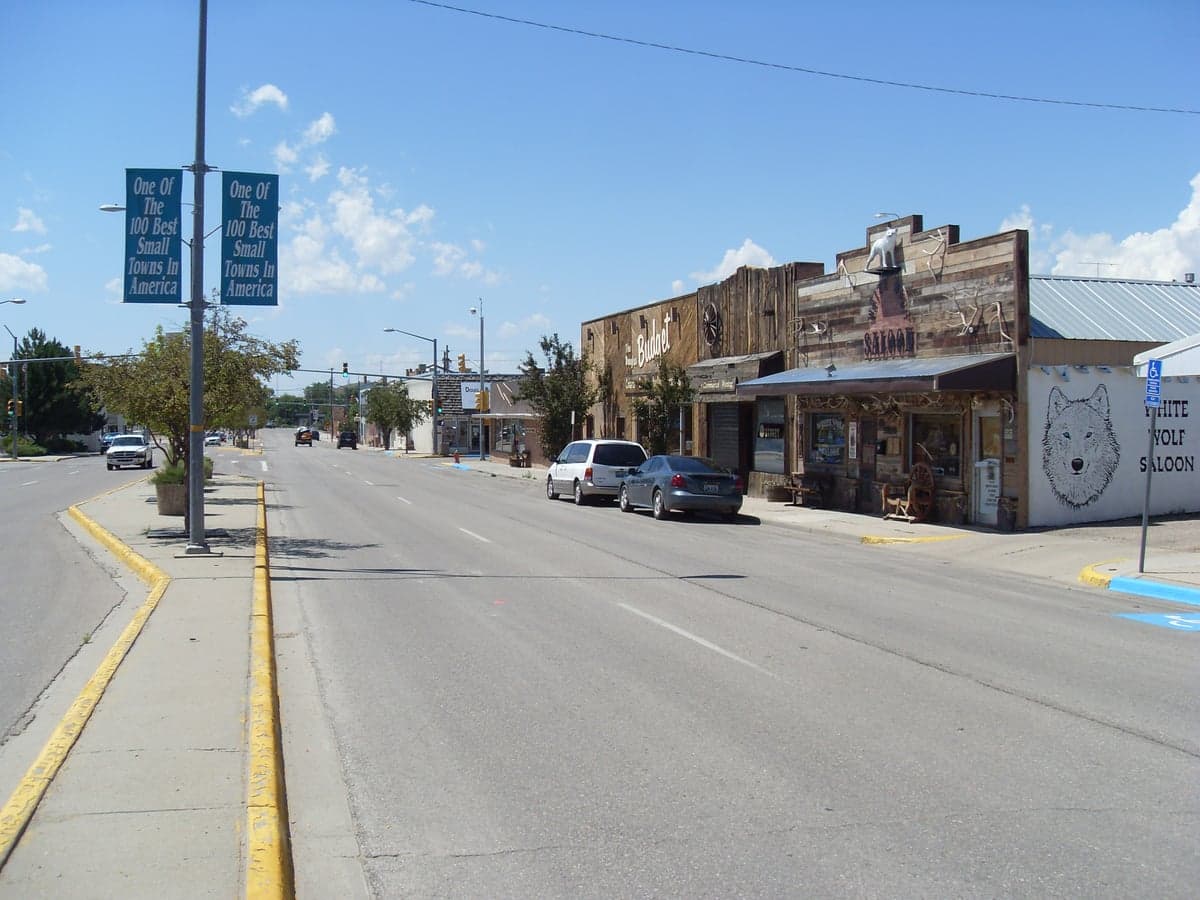
Photo: Wikipedia
Personal Sovereignty in Douglas, WY
Viable for self-reliance. Generally workable, though some barriers may limit total independence.
What does Personal Sovereignty tell us?
Personal Sovereignty measures your capacity for self-reliance and independence with minimal government friction. Higher scores mean fewer barriers between you and the way you want to live... but it assumes you have the space you need and good neighbors.
What does this tell us?
Personal Sovereignty measures your capacity for self-reliance and independence with minimal government friction. Higher scores mean fewer barriers between you and the way you want to live... but it assumes you have the space you need and good neighbors.
State Policy
Energy independence: Net exporter (800% of energy produced in-state)
Personal Liberty
Homesteading

Personal Liberty Analysis
Douglas, Wyoming, offers a personal sovereignty environment that stands in stark contrast to the regulatory-heavy states many conservatives and preppers are looking to leave. Nestled in Converse County, this community of roughly 6,500 people operates under Wyoming’s state-level framework, which is consistently ranked among the most liberty-respecting in the nation. For individuals and families prioritizing autonomy—whether that means minimal government intrusion, the right to keep and bear arms without compromise, or the ability to live off-grid—Douglas provides a legal and cultural foundation that actively supports self-reliance. The key question for a strategic relocation is whether this small-town atmosphere translates into genuine freedom or merely a quieter version of the same overreach found elsewhere. The answer, based on state law and local governance, leans heavily toward the former.
Tax burden and regulatory posture: How Wyoming’s fiscal policies protect your autonomy
Wyoming’s tax structure is a primary driver of personal sovereignty here, and Douglas benefits directly from it. There is no state income tax—on wages, capital gains, or retirement distributions—meaning the state does not take a cut of your earnings or investments. Property taxes are among the lowest in the nation, with Converse County’s effective rate hovering around 0.6% of assessed value, and the state offers a property tax refund program for qualifying residents that further reduces the burden. Sales tax in Douglas is 5.5% (4% state, 1% county, 0.5% city), but groceries and prescription drugs are exempt. This fiscal posture is not accidental: Wyoming’s constitution and legislature have deliberately kept the state lean, avoiding the expansion of social programs that often come with higher taxes and more regulatory oversight. For a prepper or conservative, this means less of your income is siphoned to fund policies you may oppose, and more stays in your control for land, supplies, and self-sufficiency projects. The regulatory environment for small businesses and homesteads is similarly light—no state-level business license requirement, minimal zoning in unincorporated areas, and a right-to-farm law that protects agricultural operations from nuisance lawsuits. Douglas itself has a planning department, but its reach is limited compared to urban jurisdictions; most residential and rural properties operate under county rules that prioritize property rights over bureaucratic approval.
Self-defense and gun law specifics: What the Second Sanctuary status means for daily carry and storage
Wyoming is a constitutional carry state, and Douglas sits in a county that has formally declared itself a Second Amendment Sanctuary. This means local law enforcement is directed not to enforce any federal or state gun control measures that infringe on the right to keep and bear arms—a stance that carries real weight in daily life. No permit is required to carry a concealed firearm, open carry is legal without a license, and there are no magazine capacity restrictions, no assault weapon bans, and no waiting periods for purchases. The state preempts local gun ordinances, so Douglas cannot pass its own restrictions, ensuring consistency. For a survivalist, the practical implications are significant: you can keep firearms in your vehicle, store them loaded in your home without safe storage mandates, and carry them in most public spaces (with standard exceptions like schools and government buildings). Stand-your-ground laws are in effect, meaning there is no duty to retreat before using deadly force if you are lawfully present and believe it is necessary to prevent death or great bodily harm. Castle doctrine protections extend to your home, vehicle, and workplace. Background checks are required for commercial purchases through licensed dealers, but private sales between individuals are unregulated. This legal framework gives residents maximum latitude to prepare for and defend against threats, whether from crime or broader societal breakdown, without fear of prosecution for exercising that right.
Self-reliance and homesteading viability: Lot sizes, zoning, and off-grid feasibility in Converse County
For those serious about self-reliance, Douglas and its surrounding areas offer some of the most permissive conditions in the lower 48. Converse County has no county-wide zoning in unincorporated areas, meaning you can buy a parcel of land and use it for homesteading, livestock, or off-grid living without needing a special permit or variance. Lot sizes vary widely: within city limits, standard residential lots are around 7,000 to 10,000 square feet, but just outside town, you can find 5-acre, 10-acre, or larger parcels at prices that are a fraction of what you’d pay in Colorado or Montana. The county allows alternative energy systems (solar, wind, micro-hydro) without restrictive permitting, and rainwater collection is legal and encouraged. Septic systems are regulated by the county health department, but the requirements are straightforward and designed for rural properties. Well water is a common solution, and the Wyoming State Engineer’s Office issues permits for domestic wells with relative ease, provided the aquifer is not over-appropriated. For those wanting to disconnect from the grid entirely, there are no state laws requiring connection to municipal utilities. The climate is semi-arid with cold winters, so a serious prepper will need to plan for heating (wood, propane, or solar thermal) and water storage, but the legal environment does not hinder those preparations. Douglas’s city government is generally supportive of agricultural and self-sufficient uses within its zoning code, but the real freedom lies in the county, where you can build a cabin, raise chickens, and store supplies without asking permission.
Personal liberties: Parental rights, medical autonomy, speech, and property protections
Wyoming’s legal culture extends beyond taxes and guns into broader personal liberties that matter to conservative families and preppers. Parental rights are strongly protected under state law, with statutes affirming that parents have the fundamental right to direct the upbringing, education, and healthcare of their children. This includes the ability to homeschool without onerous reporting requirements—Wyoming requires only a basic notice of intent and annual progress report, with no standardized testing mandates or curriculum approval. Medical autonomy is similarly robust: there is no state vaccine mandate for adults or children, and the legislature has passed laws prohibiting discrimination based on vaccination status. Wyoming has no certificate of need laws for healthcare facilities, which keeps the medical market more open to alternative providers and direct-pay clinics. Free speech is protected by the state constitution, and there are no hate speech laws or social media content restrictions that could be used to suppress political or religious expression. Property rights are enshrined in the state constitution, with strong protections against eminent domain abuse—the state cannot take land for private economic development, only for genuine public use. For a prepper concerned about government overreach, these protections mean that your ability to raise your children according to your values, make medical decisions without state interference, speak your mind, and keep your land are all backed by law and precedent. The local culture in Douglas reinforces these values; it is a community where self-reliance is expected, not questioned.
In the broader landscape of American relocation options, Douglas, Wyoming, ranks among the top-tier locations for personal sovereignty. The combination of no income tax, constitutional carry, minimal zoning, strong parental rights, and a Second Amendment Sanctuary county creates an environment where government overreach is the exception, not the rule. Compared to states like Colorado, Oregon, or Washington, where regulatory creep has steadily eroded individual freedoms, Douglas offers a legal and cultural foundation that allows a survivalist or conservative family to live on their own terms. The trade-offs are real—harsh winters, limited healthcare access, and a small-town economy—but for those prioritizing autonomy above convenience, this is a place where the state stays out of your life, and you are free to prepare for whatever comes next.

* Values derived from national, state, county, city and local statistics and may differ in a specific area. Last updated: 2026-04-21T11:35:01.000Z
Narrative content on this page is AI-generated and may contain mistakes. Verify any details that matter before acting on them.
ReloMaps may earn a commission from affiliate links at no extra cost to you.

