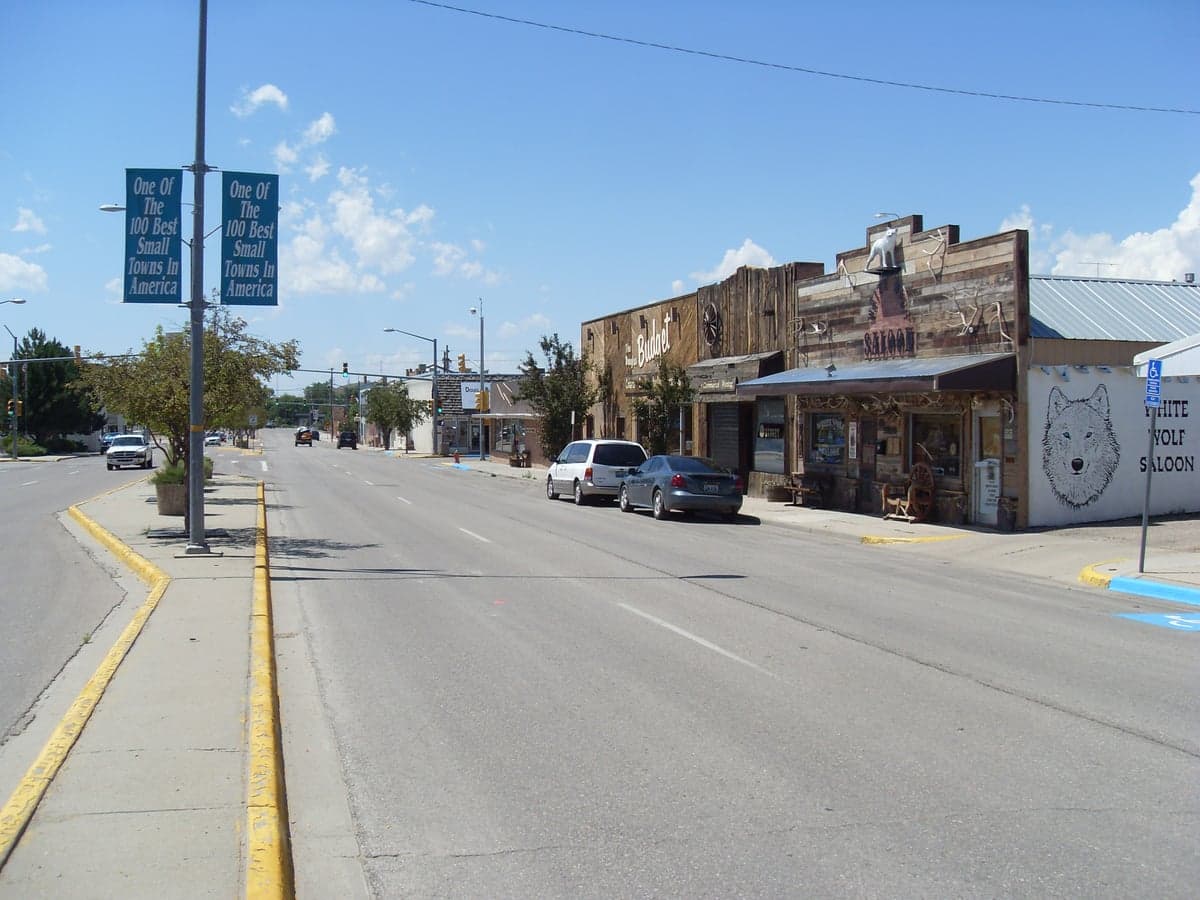
Photo: Wikipedia
Political ClimatePolitical Climate in Douglas, WY
District shown is the primary district for this city’s centroid. Cities may span multiple districts.
Inherited from parent state — no local data available.
Local Political AnalysisPolitical Analysis of Douglas, WY
Douglas, Wyoming, is about as solidly conservative as it gets, with a Cook PVI of R+23 that tells you everything you need to know about the local political DNA. This isn't a place that's been dragged leftward by coastal trends; it's a community where personal responsibility, limited government, and Second Amendment rights are still the baseline expectations, not talking points. If you look at the voting patterns over the last decade, you'll see a steady, unapologetic red streak that's actually gotten a bit deeper as surrounding areas like Casper have flirted with more moderate stances on energy and land use. The trajectory here isn't toward some progressive pivot—it's a quiet, determined hold on the values that built the West.
How it compares
Drive 45 minutes north to Casper, and you'll notice a different energy—more transient population, more out-of-state money in real estate, and a city council that's had to navigate some uncomfortable conversations about zoning and homelessness that Douglas simply hasn't had to deal with in the same way. Head south to Laramie, and you're in a college town with a noticeably younger, more liberal tilt, where the university's influence can make local elections feel like a different country. Douglas, by contrast, is the kind of place where the county commission still meets in a room that smells like old coffee and hard decisions, and where the biggest political fights are usually about water rights or federal land overreach, not social experiments. The contrast with nearby Glenrock or Wheatland is less stark, but even there, Douglas feels like the anchor of the region's conservative identity—less swayed by the boom-and-bust cycles that can shift a town's politics overnight.
What this means for residents
For folks living here, the political climate translates into a daily life that's largely free from the kind of government overreach you hear about in blue states. You won't see mask mandates lingering in local businesses, and the school board isn't debating critical race theory or gender ideology curricula—those fights are happening elsewhere. Property taxes are low, regulations on small businesses are minimal, and the local sheriff's office isn't interested in becoming the ATF's enforcement arm. That said, there's a growing unease among long-time residents about the slow creep of federal control over public lands and energy development, which is the real existential threat to the local economy and way of life. The concern isn't about what's happening in town hall; it's about what's coming out of Washington and Denver, and whether the next generation will have the same freedoms to hunt, ranch, and build without a dozen permits.
Culturally, Douglas still holds onto distinctions that set it apart from the homogenized suburbs of the Front Range. The annual Wyoming State Fair is a genuine gathering of the tribe, not a tourist trap, and the local gun culture isn't performative—it's practical, tied to hunting and self-defense. You'll see more "Don't Tread on Me" flags than rainbow banners, and the local newspaper's letters to the editor are still about grazing fees and school choice, not diversity quotas. The long-term outlook depends on whether the state can hold the line against the kind of migration that's turned places like Bozeman and Jackson into playgrounds for the wealthy left. If Douglas stays affordable and keeps its local character, it'll remain a refuge for people who want to live free and be left alone. If the feds keep squeezing energy production and the state starts bending to corporate ESG pressure, that's when the real trouble starts. For now, though, this is still a place where your vote actually means something, and where the government is still your servant, not your master.

State Political ClimatePolitical Climate in Wyoming
State Political AnalysisPolitical Environment in the State
Wyoming is one of the most reliably conservative states in the Union, with a deep-rooted Republican lean that has only hardened over the past two decades. The state hasn’t voted for a Democratic presidential candidate since 1964, and in 2024, Donald Trump carried it by roughly 45 points. The dominant coalition is a blend of traditional ranchers, energy-sector workers, and a growing wave of freedom-minded transplants fleeing blue states. Over the last 10-20 years, the GOP has moved from a moderate, establishment-heavy party to a more libertarian-leaning, constitutional conservative force, driven by grassroots activism and a distrust of federal overreach.
Urban vs. rural divide
The political map of Wyoming is starkly divided between its few small cities and its vast rural expanse. Cheyenne, the capital and largest city, is the most moderate area, with Laramie County occasionally electing a Democratic state senator or two, but even there the county went +30 for Trump in 2024. Casper, in Natrona County, is reliably red but has a small pocket of progressive influence around the college and hospital. The real conservative strongholds are the rural counties: Sublette County (home to Pinedale) and Lincoln County (Afton, Kemmerer) routinely vote 80%+ Republican. Teton County, home to Jackson Hole, is the glaring exception—it’s the only county that consistently votes blue, driven by wealthy out-of-state transplants and a tourism economy that attracts a left-leaning workforce. That county’s politics are a constant source of tension, with locals in the rest of the state viewing it as an alien enclave.
Policy environment
Wyoming’s policy environment is aggressively pro-business and pro-individual liberty, with a few notable wrinkles. There is no state income tax, and the sales tax is a low 4%, though local options can push it to 6%. Property taxes are among the lowest in the nation, with no tax on retirement income. The regulatory posture is light-touch, especially for energy extraction (coal, oil, gas, and now uranium and tritium for next-gen reactors). Education policy is a mixed bag: the state funds schools through a mineral trust, so per-pupil spending is decent, but school choice is limited compared to states like Arizona or Florida. In 2023, the legislature passed a school choice bill allowing education savings accounts, but it was vetoed by Governor Mark Gordon—a move that angered many conservatives. Election laws are solid: voter ID is required, and the state has no no-excuse mail-in voting (you need an excuse like being out of town or disabled). There’s no ballot harvesting, and the state uses paper ballots with audits. Healthcare is a sore spot: Wyoming did not expand Medicaid, and the state has a shortage of providers, especially in rural areas. Medical freedom is strong—no vaccine mandates were ever enforced, and the legislature banned COVID-19 vaccine mandates for state employees and contractors in 2022.
Trajectory & freedom
Wyoming is trending more free in several key areas, but there are warning signs. On the plus side, the state passed a constitutional carry law in 2021, allowing permitless concealed carry. In 2023, the legislature passed a law prohibiting the enforcement of federal gun laws that violate the Second Amendment—a direct nullification move. Parental rights were strengthened with a 2023 law requiring schools to notify parents of any curriculum involving sexuality or gender identity, and another law banning transgender athletes from female sports. Medical autonomy got a boost with a 2024 law protecting doctors who refuse to perform gender transition procedures on minors. However, property rights are under pressure from federal land control—the federal government owns 48% of Wyoming, and the state has been fighting for more local control through the “Transfer of Public Lands” movement. The biggest freedom concern is the growing influence of out-of-state money in Teton County, which is pushing for more government spending and land-use restrictions that could spill over into state policy.
Civil unrest & political movements
Wyoming is remarkably stable compared to the rest of the country. There have been no major riots or sustained protest movements. The most visible political activism comes from the Wyoming Liberty Group and the Wyoming Republican Party’s grassroots wing, which has successfully primaried moderate Republicans in recent cycles. The “Freedom Caucus” in the state legislature has been a driving force, pushing for school choice, election integrity, and anti-federal overreach bills. Immigration politics are quiet—Wyoming has a very small foreign-born population (under 4%), and there are no sanctuary cities. The state passed a law in 2023 requiring law enforcement to cooperate with ICE. Election integrity controversies are minimal; the 2020 and 2022 elections were smooth, with no major fraud allegations. The most heated flashpoint is the Jackson Hole area, where wealthy left-leaning residents have clashed with the state over land use, housing policy, and wildlife management. There’s a growing “secession” rhetoric in some rural counties, but it’s more about wanting to break away from federal control than from the state itself.
Projection
Over the next 5-10 years, Wyoming will likely become more conservative and more libertarian, but with a growing tension between the rural heartland and the Jackson Hole corridor. In-migration is accelerating, especially from California, Colorado, and Washington state. These newcomers are often conservative-leaning (many are fleeing high taxes and lockdowns), but they bring higher housing costs and a demand for more services. The state’s population is projected to grow modestly, with the biggest gains in Laramie County (Cheyenne) and Natrona County (Casper). The energy transition away from coal is a real threat to the state’s economy and tax base, but the legislature is actively courting crypto mining, data centers, and advanced nuclear. The political trajectory is toward more school choice (the veto may be overridden in a future session), more gun rights, and more resistance to federal mandates. The biggest wild card is whether the Jackson Hole influence can be contained—if it spreads, you could see a slow drift toward moderate Republicanism. But for now, the state is on a solidly conservative path.
For a new resident, the bottom line is this: Wyoming offers one of the highest levels of personal freedom in the country, with low taxes, strong gun rights, and a government that mostly stays out of your life. You’ll find a community that values self-reliance and distrusts federal overreach. The trade-offs are a harsh climate, limited job diversity, and a healthcare system that requires travel for specialists. If you’re looking for a place where your rights are respected and your vote actually matters, Wyoming is hard to beat—just don’t expect the amenities of a big city, and be prepared to drive an hour for a good grocery store.
* Values derived from national, state, county, city and local statistics and may differ in a specific area. Last updated: 2026-04-21T11:35:01.000Z
Narrative content on this page is AI-generated and may contain mistakes. Verify any details that matter before acting on them.
ReloMaps may earn a commission from affiliate links at no extra cost to you.

