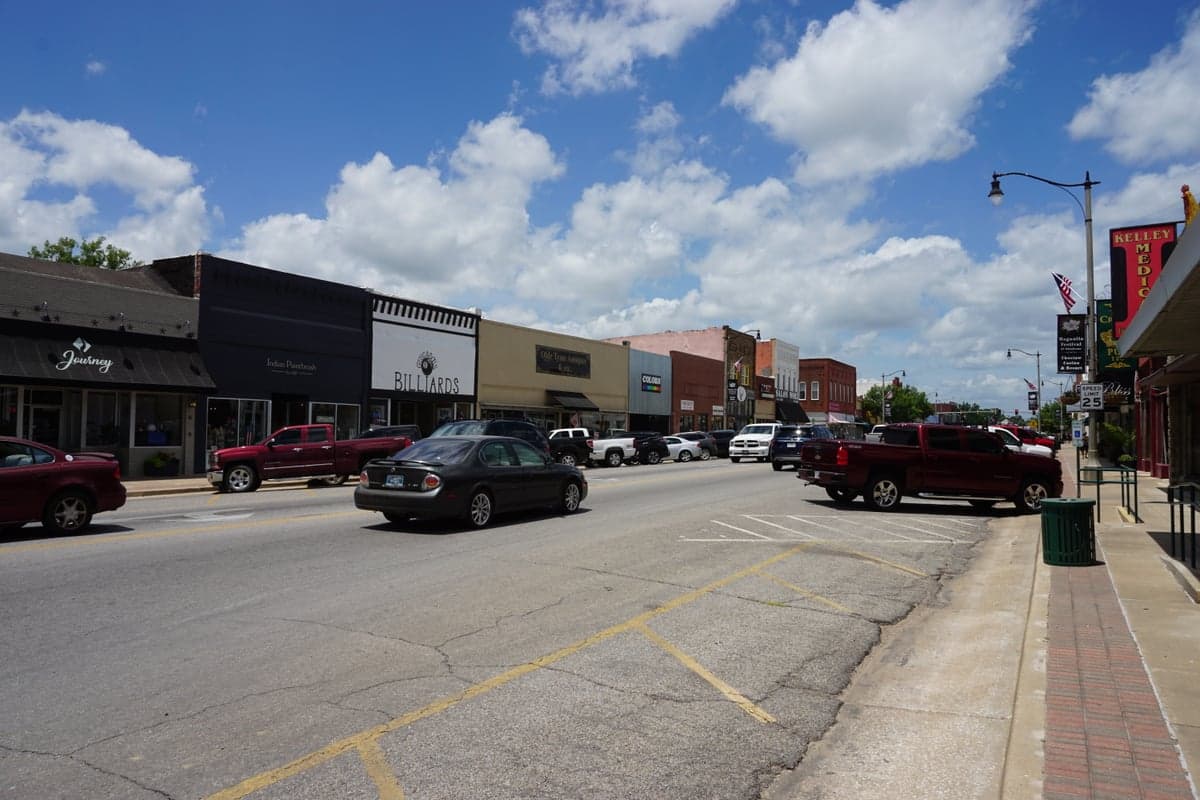
Photo: Wikipedia
Demographics of Durant, OK
Affluence Level in Durant, OK
A low-income area with significant economic hardship. Household wealth and educational attainment are well below national averages.
People of Durant, OK
The people of Durant, Oklahoma today form a predominantly white (63.3%) and increasingly Hispanic (10.1%) community of 19,209, anchored by a strong working-class identity tied to the Choctaw Nation, Southeastern Oklahoma State University, and regional manufacturing. The city’s population is notably less diverse than the national average, with a foreign-born share of just 2.5% and small Black (2.6%), East/Southeast Asian (0.5%), and Indian-subcontinent (0.4%) communities. Durant’s distinctive character blends a historic Native American governmental presence with a conservative, family-oriented culture, where college attainment (28.4%) lags behind state and national averages, reflecting a workforce oriented toward trades, education, and healthcare rather than white-collar professions.
How the city was settled and grew
Durant’s original population was shaped by the Choctaw Nation’s removal to Indian Territory in the 1830s, with the area serving as a rural agricultural settlement for Choctaw families. The city’s formal founding came in 1872 with the arrival of the Missouri-Kansas-Texas Railroad, which drew white settlers, merchants, and laborers to what became the Downtown Durant district along Main Street. The early population was overwhelmingly Native American and white, with the Choctaw Nation establishing its headquarters in Durant in the 1890s, cementing the city as a tribal administrative hub. The North Durant neighborhood, near the railroad depot, became the initial landing point for railroad workers and small business owners, while Choctaw families concentrated in the Choctaw Heights area east of downtown. The 1900s saw slow growth through agriculture and the establishment of Southeastern Oklahoma State University in 1909, which drew faculty and students to the University District around the campus. By 1950, Durant’s population had reached roughly 10,000, remaining overwhelmingly white and Native American, with no significant immigrant presence.
Modern era (post-1965)
After the 1965 Hart-Cellar Act, Durant saw negligible foreign-born growth—the city’s 2.5% foreign-born share today is far below the national average of 13.7%. The most significant demographic shift since the 1970s has been the growth of the Hispanic population, rising from near zero to 10.1% by 2020, driven by labor demand in poultry processing and construction. Hispanic families have concentrated in the West Durant corridor along West Main Street and in the Parkway Addition subdivision, where affordable housing and proximity to Tyson Foods’ plant drew Mexican and Central American workers. The Black population has remained small and stable at 2.6%, with most families living in the East Durant area near the historic Black school site. The East/Southeast Asian community (0.5%) is almost entirely tied to the university, with faculty and international students living in the University District and nearby apartment complexes. The Indian-subcontinent population (0.4%) is similarly small and university-linked. White flight to the Southern Hills and Lake Durant subdivisions has occurred since the 1990s, creating a more suburbanized, predominantly white periphery around a diversifying core. The Choctaw Nation’s expanded governmental and casino operations have drawn some Native American families back to the Choctaw Heights area, though the overall Native share has declined as a percentage of the total population.
The future
Durant’s population is likely to continue growing slowly, driven by Hispanic in-migration for labor and by Choctaw Nation expansion, but the city shows no signs of rapid diversification. The Hispanic share is projected to rise to 12-14% by 2035, with continued concentration in West Durant and Parkway Addition, while the white population will likely remain the majority but shrink slightly as a share. The East/Southeast Asian and Indian-subcontinent communities are expected to remain tiny, tied to university recruitment rather than chain migration. The city is not tribalizing into distinct ethnic enclaves—rather, it is slowly homogenizing around a white-Hispanic binary, with the small Black and Asian populations assimilating into predominantly white neighborhoods like Southern Hills. The Choctaw Nation’s growing economic footprint may attract more Native American families to Choctaw Heights, but this will be a modest countertrend. The college-educated share (28.4%) is likely to rise slowly as the university expands online programs, but Durant will remain a blue-collar and service-oriented community.
For someone moving to Durant now, the city offers a stable, conservative, family-oriented environment with a growing Hispanic presence that is largely integrated into the workforce. The population is not fragmenting into isolated groups but rather blending into a predominantly white and Hispanic community with a strong Native American institutional anchor. New residents should expect a slow-growing, affordable city where the university and tribal government are the primary engines of stability, and where ethnic diversity remains modest compared to national trends.

* Values derived from national, state, county, city and local statistics and may differ in a specific area. Last updated: 2026-04-21T11:46:25.000Z
Narrative content on this page is AI-generated and may contain mistakes. Verify any details that matter before acting on them.
ReloMaps may earn a commission from affiliate links at no extra cost to you.

