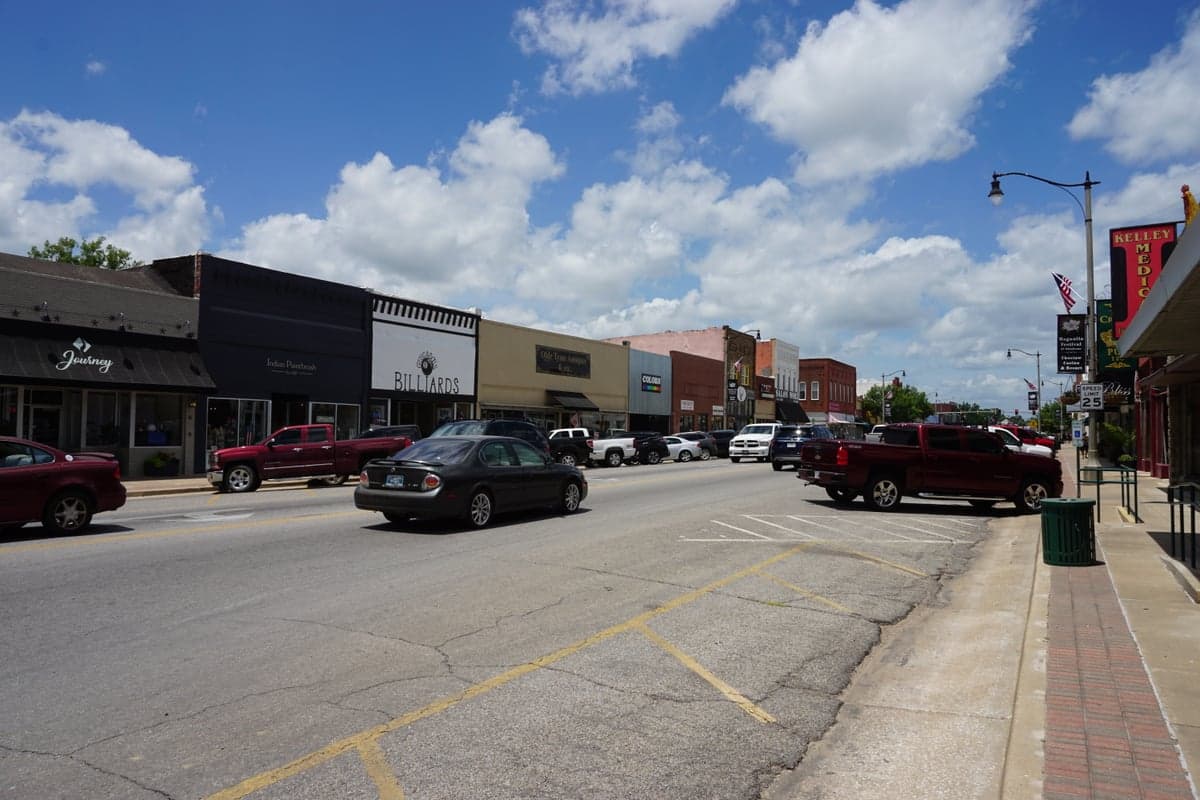
Photo: Wikipedia
Political ClimatePolitical Climate in Durant, OK
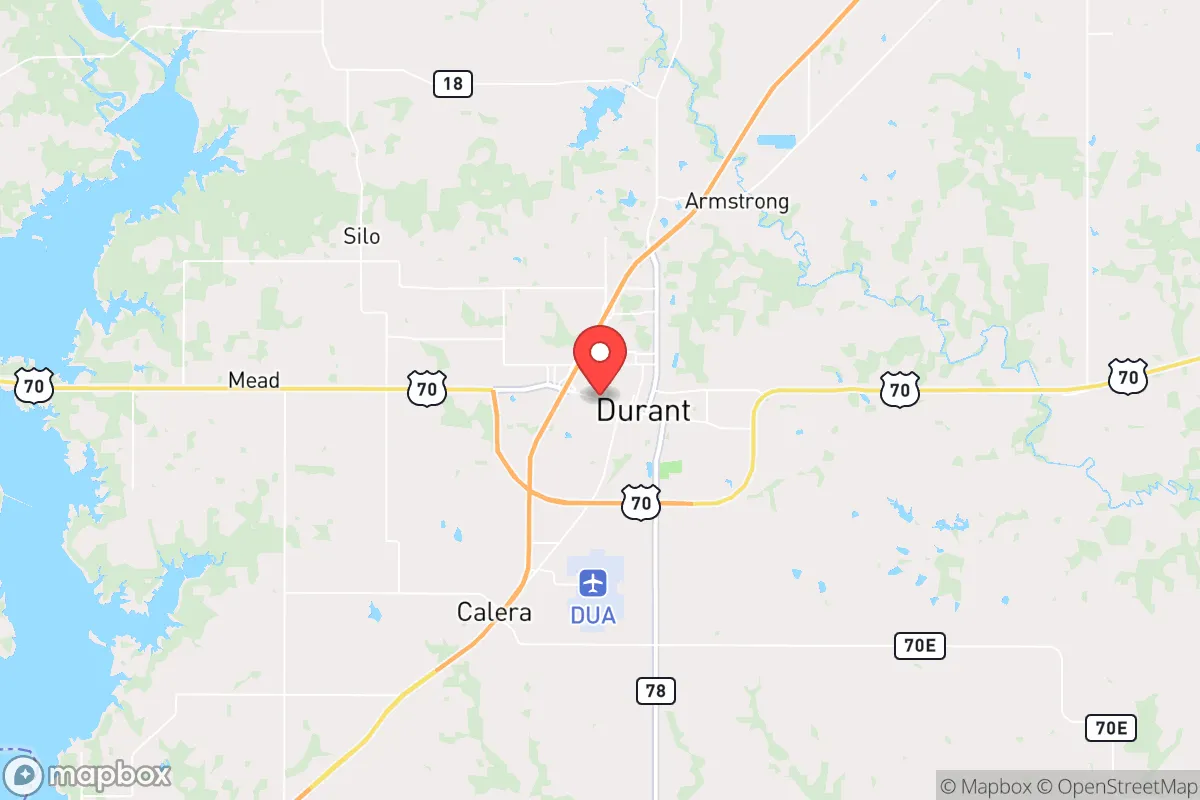
District shown is the primary district for this city’s centroid. Cities may span multiple districts.
Local Political AnalysisPolitical Analysis of Durant, OK
Durant, Oklahoma, is about as solidly conservative as it gets, with a Cook PVI of R+28 that tells you everything you need to know about the area's political DNA. This isn't a place that's trending left or waffling in the middle—it's a community that has consistently voted for conservative candidates and policies for decades, and the local culture reflects that. You see it in the way folks talk about taxes, gun rights, and the role of government: there's a deep-seated belief that the less interference from D.C. or Oklahoma City, the better. If you're looking for a place where your vote actually counts in a conservative direction, this is it.
How it compares
Drive an hour north to Oklahoma City, and you'll find a more mixed political landscape, with pockets of progressive influence in the urban core and suburbs like Norman. Head south across the Red River into Sherman or Denison, Texas, and you're still in conservative territory, but it's a different flavor—more focused on Texas-style individualism and property rights. Durant, by contrast, feels like the old guard of Oklahoma conservatism: slower to change, more skeptical of new regulations, and deeply rooted in local traditions. The surrounding towns like Calera and Colbert are even more rural and conservative, but Durant is the hub where that worldview gets reinforced through local churches, civic groups, and the chamber of commerce. There's no real progressive counterweight nearby; even the college, Southeastern Oklahoma State University, tends to lean more traditional than its counterparts in bigger cities.
What this means for residents
For the people living here, the political climate translates into a daily life that feels free from a lot of the bureaucratic overreach you hear about in other parts of the country. You won't see heavy-handed zoning laws or aggressive code enforcement that tells you what color to paint your fence or how many cars you can park in your driveway. The local government generally takes a hands-off approach, which is exactly how most folks want it. That said, there's a growing concern among longtime residents about creeping state-level mandates—things like unfunded education requirements or environmental rules that trickle down from federal agencies. The worry is that even in a red county like Bryan County, the government can still find ways to intrude on personal freedoms if you're not paying attention. The local elections here matter a lot, because the school board and county commission seats are where the rubber meets the road on issues like curriculum content, property taxes, and land use.
One thing that sets Durant apart is the strong sense of self-reliance that comes with the political culture. People here don't look to the government to solve their problems—they form church groups, volunteer fire departments, and community fundraisers. That's not just a talking point; it's how things actually get done. The downside is that if you're used to a more progressive or interventionist government, you might find the lack of social services or public transit frustrating. But for those who value limited government and personal responsibility, Durant offers a political environment that's consistent, predictable, and aligned with traditional conservative values. The trajectory looks stable for the near future, but the long-term concern is whether national trends toward bigger government will eventually erode the local way of life. For now, though, it's a place where you can still live by your own rules, as long as you're willing to hold the line at the ballot box.

State Political ClimatePolitical Climate in Oklahoma
State Political AnalysisPolitical Environment in the State
Oklahoma has been a reliably red state for decades, with Republicans holding every statewide office and supermajorities in both legislative chambers, but the real story is how much deeper that red has gotten since the early 2000s. The state voted for Donald Trump by 33 points in 2020, up from a 14-point margin for George W. Bush in 2004, and the GOP now controls all five congressional seats. That shift tracks a broader realignment: rural and exurban areas have hardened their conservative lean, while Oklahoma City and Tulsa have become more polarized, with suburban pockets trending right and urban cores drifting left.
Urban vs. rural divide
The political map of Oklahoma is a study in contrasts. Oklahoma City and Tulsa are the only blue-ish anchors, but even they are surrounded by deep-red suburbs and exurbs that keep the state solidly conservative. In Oklahoma County, which includes OKC proper, the margin has tightened from a 12-point GOP win in 2012 to a 2-point Republican win in 2020, driven by younger voters and a growing Hispanic population in the city’s south side. Meanwhile, Edmond and Yukon — classic suburban bedroom communities — vote 20-30 points Republican. Tulsa County went for Trump by 10 points in 2020, but the city of Tulsa itself is a blue island, with precincts near downtown and the Pearl District voting heavily Democratic. The real muscle of the state’s conservative majority comes from the rural Panhandle (Texas County, Cimarron County), south-central farm country (Stephens County, Grady County), and the southeast timber and lake region (McCurtain County, Pushmataha County), where GOP margins routinely exceed 50 points. The only notable exception is Norman, home to the University of Oklahoma, which flipped to Biden in 2020 by 2 points — a shift that alarms many conservatives who see the university as a progressive beachhead.
Policy environment
Oklahoma’s policy environment is aggressively conservative, with a low-tax, low-regulation posture that has attracted businesses and families fleeing blue states. The state has a flat income tax of 4.75%, which the legislature is actively working to reduce further, and no estate tax. Property taxes are among the lowest in the nation, averaging about 0.9% of assessed value, thanks to a constitutional cap. On education, the state passed the Oklahoma Parental Choice Tax Credit Act in 2023, which provides up to $7,500 per child for private school tuition — one of the most generous school choice programs in the country. That law was a direct response to COVID-era school closures and mask mandates that many parents saw as government overreach. Healthcare policy is similarly conservative: Oklahoma rejected Medicaid expansion for years before a 2020 ballot initiative forced it through, and the state has some of the strictest abortion laws in the nation, with a near-total ban effective from conception. Election integrity is a major focus: the state requires voter ID, has purged inactive voter rolls, and passed SB 440 in 2021 to ban private funding of election administration — a direct response to the Zuckerberg-funded grants that many conservatives saw as corrupting the 2020 election.
Trajectory & freedom
Oklahoma has been on a clear trajectory toward more personal freedom over the last decade, particularly on gun rights, parental rights, and economic liberty. The state adopted constitutional carry in 2019, allowing any adult who can legally possess a firearm to carry it openly or concealed without a permit. In 2022, the legislature passed HB 4327, which prohibits any state or local entity from enforcing federal gun laws that violate the Second Amendment — a nullification-style measure that signals Oklahoma’s willingness to push back against federal overreach. On parental rights, HB 1775 (2021) banned the teaching of critical race theory and other divisive concepts in public schools, and the 2023 Students’ Bill of Rights gave parents explicit authority to review curriculum and opt their children out of objectionable material. Medical freedom has been a flashpoint: the state passed SB 658 in 2022, which prohibits employers from mandating COVID-19 vaccines as a condition of employment, and HB 1013 in 2023, which bans any government entity from requiring a vaccine passport. The one area where freedom has arguably contracted is medical marijuana: after a 2018 ballot initiative legalized it, the legislature has tightened regulations, capping dispensary licenses and imposing stricter testing requirements, which some see as a slow rollback of voter intent.
Civil unrest & political movements
Oklahoma has seen relatively little civil unrest compared to coastal states, but there have been notable flashpoints. The 2020 George Floyd protests in Oklahoma City and Tulsa were largely peaceful, though Tulsa saw a night of property damage and arson that led to a heavy police response and a curfew. The Tulsa Race Massacre centennial in 2021 drew national attention, with President Biden visiting and activists pushing for reparations, but the Republican-controlled legislature rejected any direct payments, instead funding a $2 million grant program for economic development in the historic Greenwood District. Immigration politics are less visible here than in border states, but HB 4156 (2024) requires local law enforcement to cooperate with federal immigration authorities and bans sanctuary city policies — a preemptive strike against any future progressive local government. Election integrity remains a hot-button issue: after the 2020 election, the state auditor launched a review of voting machines, and the legislature passed SB 440 to ban private election funding. There is a small but vocal Oklahoma State Sovereignty Commission movement that advocates for nullification of federal laws, particularly on gun control and environmental regulations, though it remains fringe. The most visible political movement in recent years has been the parental rights uprising — groups like Oklahoma Parents for Education have packed school board meetings and successfully pushed for conservative curriculum changes, especially in suburban districts like Owasso and Jenks.
Projection
Over the next 5-10 years, Oklahoma is likely to become even more conservative, driven by two demographic trends: in-migration from blue states and the continued exodus of younger, left-leaning residents from rural areas to cities or out of state. The state’s population grew by about 5% between 2010 and 2020, with most growth in the Oklahoma City and Tulsa suburbs — places like Mustang, Piedmont, and Bixby — where new arrivals from California, Illinois, and Colorado are often fleeing high taxes and progressive policies. These transplants tend to be conservative-leaning, reinforcing the state’s political direction. The urban cores of OKC and Tulsa will continue to drift left, but the legislature is likely to preempt any progressive city ordinances — we’ve already seen this with HB 1020 (2023), which bans local governments from enacting rent control or mandating paid sick leave. The biggest wildcard is the Native American tribal nations, which have been asserting greater sovereignty after the McGirt v. Oklahoma Supreme Court decision in 2020. That ruling, which affirmed that much of eastern Oklahoma remains tribal land for criminal jurisdiction, has created a complex legal patchwork that could lead to friction over taxation and regulation. Expect the state to continue pushing back against federal overreach, with more nullification-style bills and a likely attempt to call a convention of states to propose constitutional amendments limiting federal power.
For a new resident, the bottom line is this: Oklahoma offers a high degree of personal freedom — low taxes, strong gun rights, parental control over education, and a government that actively resists federal mandates. The trade-off is that you’ll be living in a state where the political culture is uniformly conservative, and any progressive leanings you might have will put you in a distinct minority, especially outside of Norman or downtown OKC. If you value limited government and a community that shares those values, Oklahoma is a solid bet. If you’re looking for ideological diversity or a place where your vote might actually matter in a statewide race, you’ll be disappointed — but for most conservatives, that’s exactly the point.
* Values derived from national, state, county, city and local statistics and may differ in a specific area. Last updated: 2026-04-21T11:46:25.000Z
Narrative content on this page is AI-generated and may contain mistakes. Verify any details that matter before acting on them.
ReloMaps may earn a commission from affiliate links at no extra cost to you.

