Photo: Wikipedia
Strategic Assessment of Edgewood, NM
Meaningful friction. Expect exposure to either population pressure, blast zones, or natural disaster risk. Consider buying a retreat property.
What does the Strategic Assessment tell us?
Our Strategic Assessment grades tactical survivability of an area. Major population centers, military targets, fallout zones, natural disasters, and border exposure all drive risk — lower exposure means a more defensible position in a crisis.
This is heavily inspired by Joel Skousen's Strategic Relocation book. Highly recommended you checkout the book ($)What does this tell us?
Our Strategic Assessment grades tactical survivability of an area. Major population centers, military targets, fallout zones, natural disasters, and border exposure all drive risk — lower exposure means a more defensible position in a crisis.
This is heavily inspired by Joel Skousen's Strategic Relocation book. Highly recommended you checkout the book ($)Strategic Pillars

Key Distances
Regional Safe Places
Below is our recommended "safe zones" in New Mexico and the surrounding area based on our strategic heuristics. For most people, it's unrealistic to live in a “safe zone” full-time due to work, family or other personal reasons. They tend to be more rural. However, many of these areas are perfect for second homes and retreat properties that double as a vacation home or even a short-term rental.

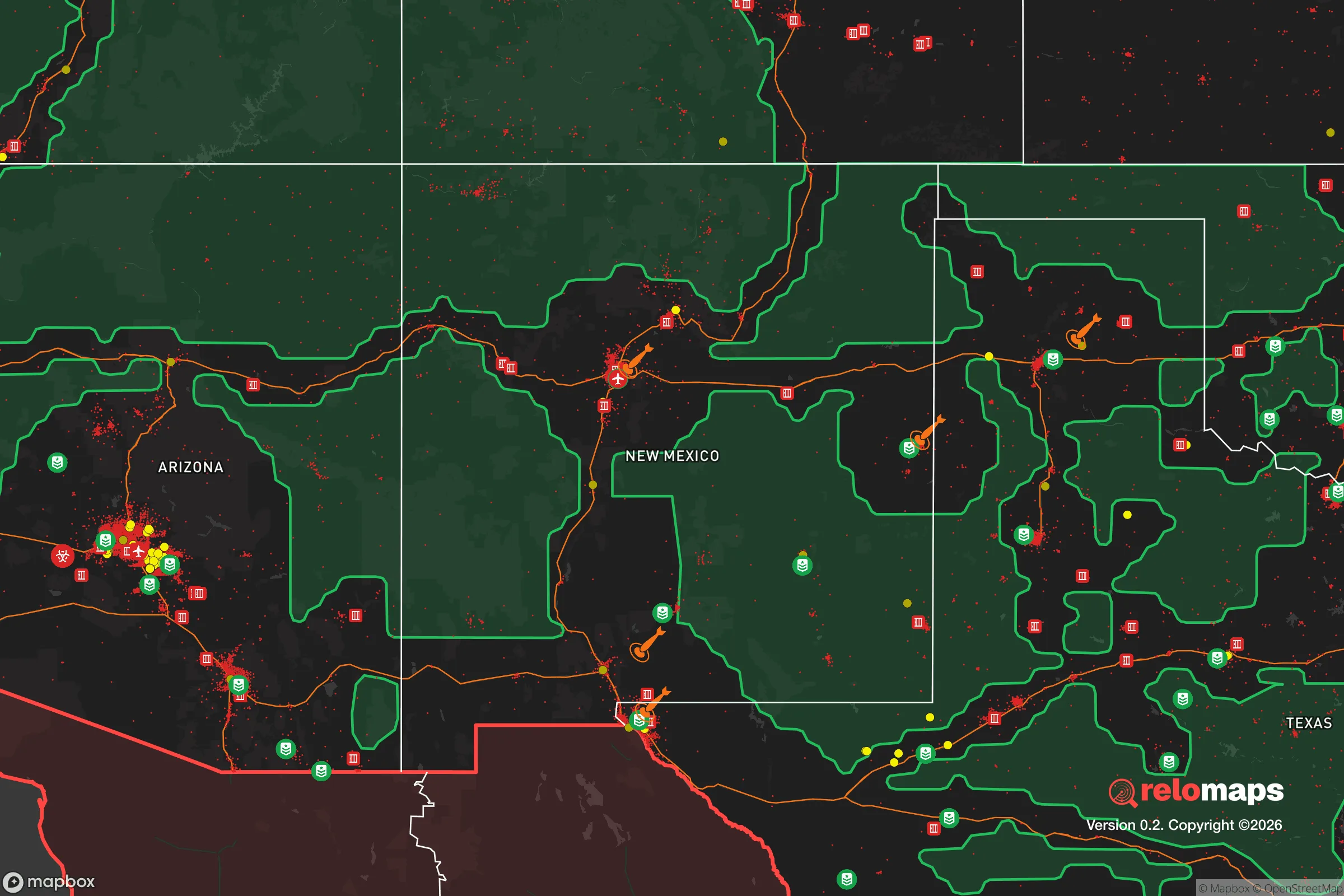


Important Note: For informational purposes only. This does not mean nothing bad ever happens in the green zones. Please use common sense. This is based on public data and modeled with AI. We tried to take a conservative approach but mistakes happen. We update this regularly as new information becomes available.
Solar Generator Recommendations
Backup power matters more here than in safer locations. We've picked three solar generators across budgets and capacity tiers — start with the budget unit if you only need a few essentials, or step up if you want to run a fridge and HVAC for days at a time.

Jackery Portable Power Station Explorer 300
Budget OptionPower on the Go: Weighing only 11 lbs, it's convenient to set up and store with book-sized foldable solar panels

BLUETTI Portable Power Station AC180
Designed for both indoor and outdoor scenarios, AC180 is highly capable as it has a robost capacity and continuous output power.

EF ECOFLOW DELTA Pro Ultra Power Station
Upgraded PickEcoFlow DELTA Pro Ultra is a whole-home energy system designed to grow with your family. Integrated with the Smart Home Panel 2, it scales to meet your evolving energy needs — keeping your home powered, intelligent, and secure through every stage of life.
We earn a commission, at no additional cost to you.
Strategic Assessment Analysis
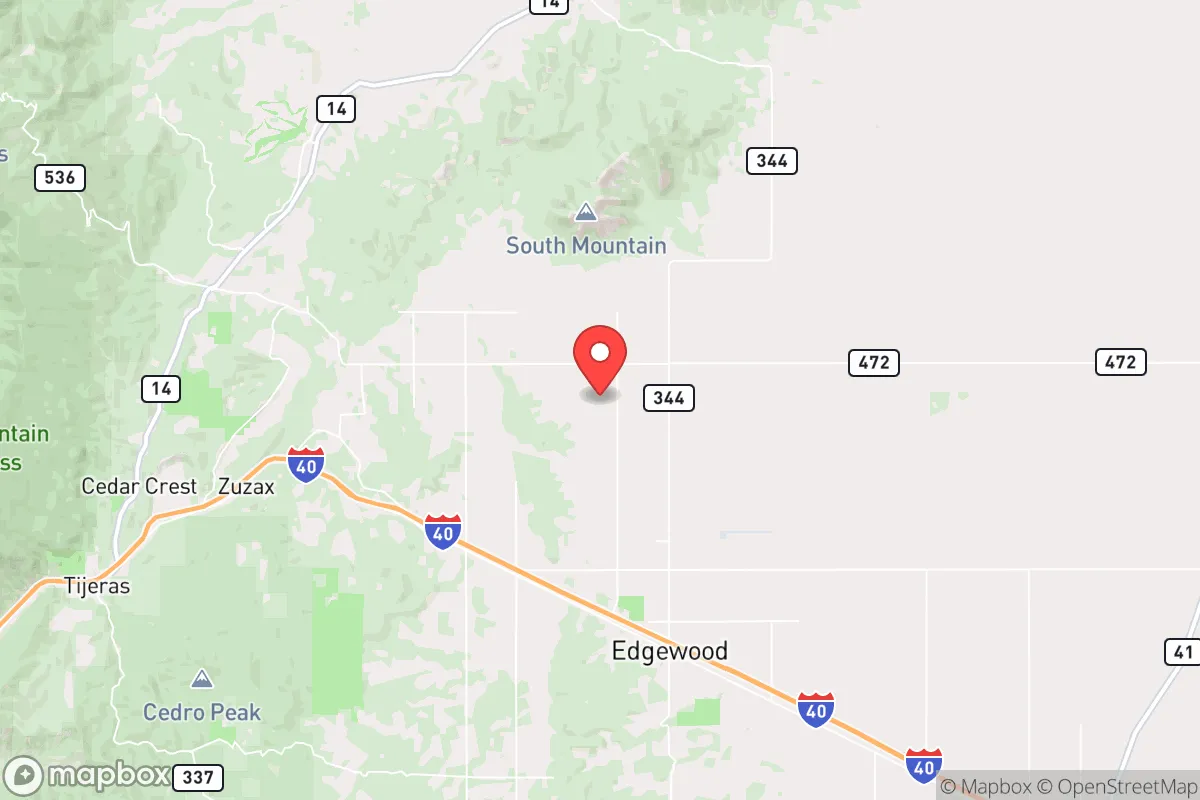
Edgewood, New Mexico, sits in a strategic sweet spot that few relocators fully appreciate: close enough to Albuquerque for supply runs and medical access, but far enough to avoid the blast radius of a major urban collapse or a nuclear event. Perched at roughly 6,700 feet on the eastern flank of the Sandia Mountains, this unincorporated community of about 6,000 people offers a combination of elevation, isolation, and resource access that makes it a serious contender for anyone thinking long-term about resilience. The area’s position along I-40 gives it a logistical backbone, but the real advantage is what lies off the highway—rugged terrain, limited through-traffic, and a population density that keeps your neighbors at a safe distance.
Geographic position and natural advantages for long-term security
Edgewood’s location is its strongest card. It sits in Santa Fe County, roughly 25 miles east of Albuquerque’s city limits, but the Sandia Mountains act as a natural barrier that buffers noise, light pollution, and most importantly, the chaos that would follow a major disaster in the metro area. The elevation—over 6,500 feet—means cooler summers and a lower risk of the extreme heat waves that plague lower-elevation parts of the Southwest. Water is the critical variable in any survival scenario, and while Edgewood isn’t on a major river, it sits atop the Estancia Basin aquifer, a groundwater source that, with proper well infrastructure, can provide a reliable supply. The terrain is a mix of piñon-juniper woodland and open grassland, offering both cover for concealment and grazing potential for livestock. The area’s position on the eastern side of the mountains also means it’s somewhat shielded from the worst of the prevailing westerly winds, which can carry fallout or airborne contaminants from a distant event.
Risks, exposures, and proximity to fallout-relevant landmarks
No location is perfect, and Edgewood has its share of vulnerabilities. The most obvious is its proximity to Albuquerque—a city of over 560,000 people that would become a humanitarian disaster zone in the event of a major earthquake, grid failure, or civil unrest. I-40 runs directly through Edgewood, which is a double-edged sword: it’s your supply line in normal times, but it’s also the primary evacuation route for the East Mountains population, meaning it could become a parking lot or a chokepoint during a crisis. More concerning is the proximity to Kirtland Air Force Base and Sandia National Laboratories, both located in Albuquerque. These are high-value targets in any conflict scenario, and while Edgewood is outside the immediate blast zone of a conventional strike, fallout patterns depend on wind direction. A prevailing westerly wind would push contamination toward the East Mountains, making Edgewood a potential downwind exposure zone. The area also sits near the Rio Grande Rift, a seismic zone that, while not highly active, has produced magnitude 5+ quakes in the past. A quake large enough to damage the Sandia Mountains could trigger landslides along the I-40 corridor, cutting off access to the west.
Practical resilience for a relocator: food, water, energy, and defensibility
For someone serious about self-sufficiency, Edgewood offers a workable baseline but requires upfront investment. Water is the first priority—municipal water is available in some subdivisions, but a private well is the gold standard for resilience. Wells in the area typically run 200 to 400 feet deep, and drilling costs have climbed to around $15,000 to $25,000, but once you’re on well water, you’re insulated from municipal system failures. Rainwater catchment is legal in New Mexico and can supplement, but annual precipitation is only about 14 inches, so it’s not a primary solution. Food production is feasible but not easy. The growing season is short—roughly 120 days—and the soil is alkaline and rocky, so raised beds or greenhouse setups are almost mandatory. The area’s rural zoning allows for livestock, including chickens, goats, and even cattle on larger parcels. Energy is a mixed bag. The grid is moderately reliable but vulnerable to winter storms and wildfire-related outages. Solar is the obvious backup: Edgewood averages over 280 sunny days per year, making photovoltaic panels a strong investment. Battery storage is essential, as net metering policies in New Mexico have become less favorable in recent years. Defensibility is where Edgewood shines. The terrain is uneven, with arroyos and ridges that create natural chokepoints. Many properties are set back from main roads, and the lack of streetlights in rural areas means darkness works in your favor. The local sheriff’s office is responsive but understaffed—Santa Fe County covers over 1,900 square miles with fewer than 200 deputies—so you’re largely responsible for your own security. That’s not a bug; it’s a feature for those who prefer to keep a low profile and maintain operational security.
The overall strategic picture for Edgewood is one of calculated trade-offs. It’s not a remote bunker in the Idaho wilderness, nor is it a suburban safe zone with full infrastructure support. It’s a middle-ground location that offers genuine advantages—elevation, water access, defensible terrain, and proximity to a major city for resupply—while carrying real risks tied to that same proximity. For a relocator with a prepper mindset, the key is to treat Edgewood as a base that requires hardening: secure your water source, invest in off-grid energy, stockpile supplies for at least 90 days, and develop a plan for the I-40 corridor becoming impassable. The community itself is a mix of longtime locals, second-home owners, and a growing number of out-of-state transplants, which means social cohesion is still forming. That’s an opportunity to build relationships with like-minded neighbors before a crisis forces the issue. Edgewood won’t save you from every scenario, but for someone looking to balance access with isolation, it’s one of the more viable options in the Southwest.

* Values derived from national, state, county, city and local statistics and may differ in a specific area. Last updated: 2026-05-01T09:02:29.000Z
Narrative content on this page is AI-generated and may contain mistakes. Verify any details that matter before acting on them.
ReloMaps may earn a commission from affiliate links at no extra cost to you.

