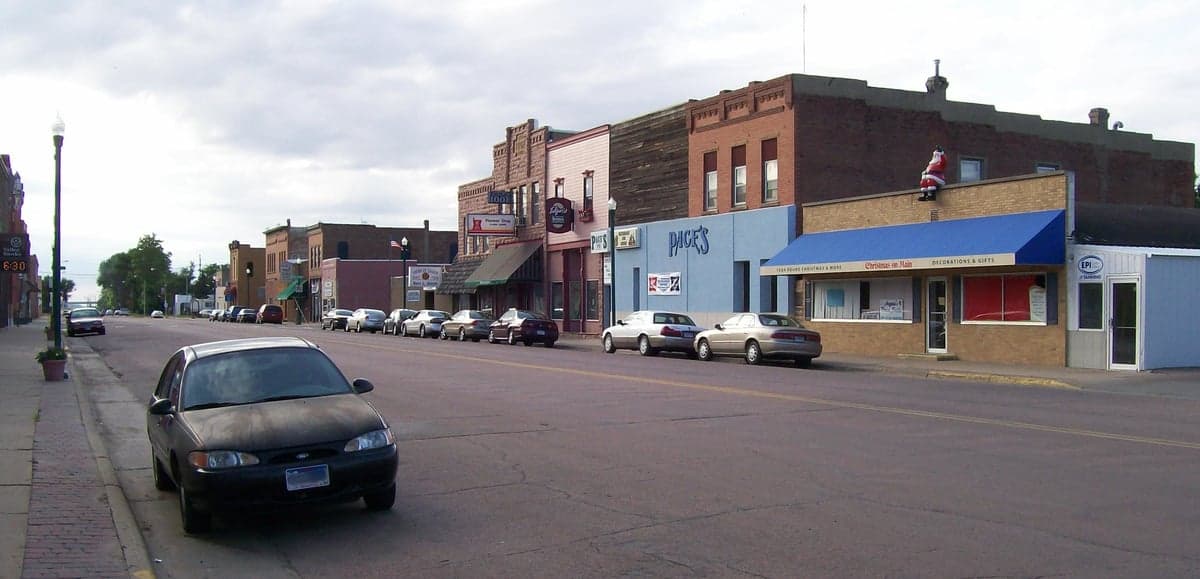
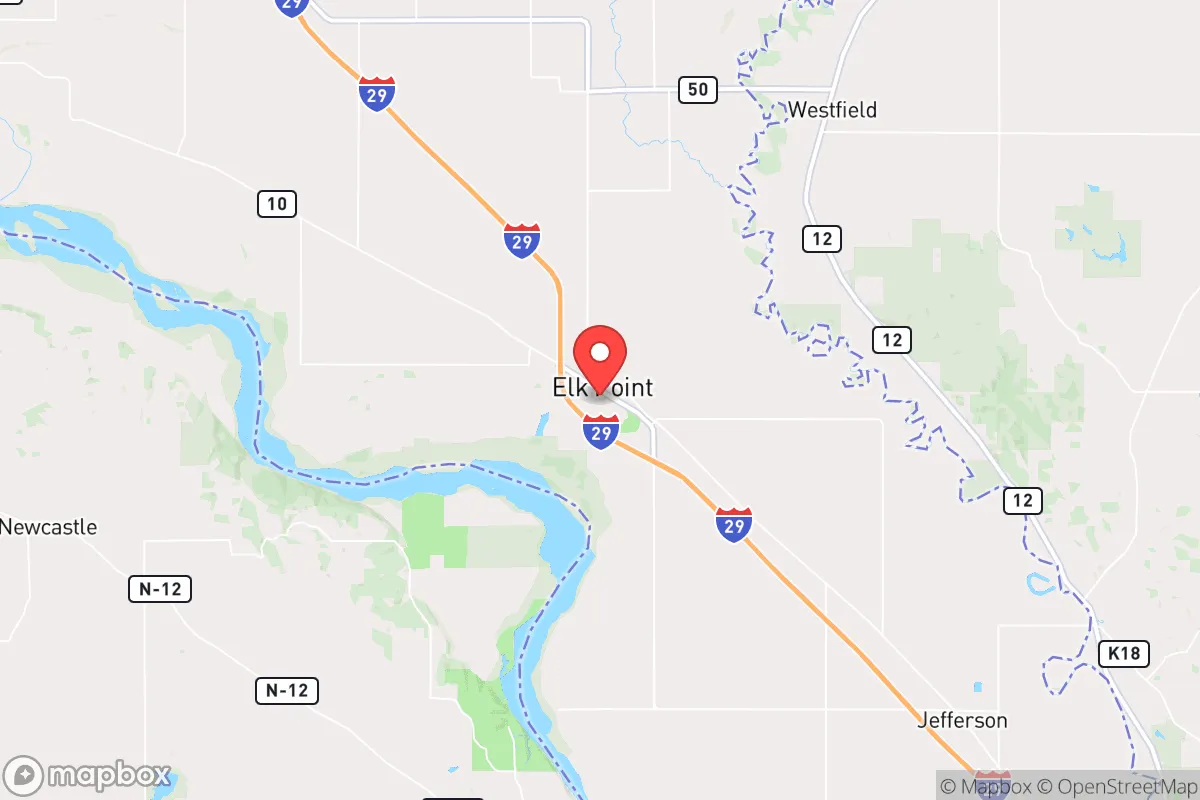
Photo: Wikipedia
Demographics of Elk Point, SD
Affluence Level in Elk Point, SD
A middle-class area roughly in line with national averages across income, home values, education, and employment.
People of Elk Point, SD
Elk Point, South Dakota, is a small, predominantly white community of 2,391 residents that retains a strong agricultural and small-town character. The city’s population is 93.5% white, with a 2.8% Hispanic share and negligible foreign-born presence at 0.0%, making it one of the most ethnically homogeneous towns in Union County. Its identity is rooted in its pioneer history and a stable, family-oriented culture, with 32.8% of adults holding a college degree—a figure that reflects a mix of local professionals and commuters to nearby Sioux City, Iowa. The people here are largely descendants of European settlers, and the city’s social fabric remains tightly knit around local schools, churches, and agricultural traditions.
How the city was settled and grew
Elk Point was founded in 1859 as a river town on the Missouri River, drawing its first wave of settlers from the Upper Midwest—primarily German, Norwegian, and Irish immigrants—who were attracted by the fertile bottomlands and the promise of land under the Homestead Act of 1862. The original settlement clustered around the riverfront and what is now Old Town Elk Point, a historic district near Main Street where the first log cabins and general stores were built. By the 1880s, the arrival of the Chicago, St. Paul, Minneapolis & Omaha Railway spurred a second wave of settlers, including Danish and Czech families, who established farms and businesses in the North Side neighborhood, centered along the rail corridor. The city’s growth plateaued after World War II, as the agricultural economy mechanized and younger generations began moving to larger cities. The South Union Street area, developed in the 1950s, became home to many of these post-war families, with ranch-style homes and larger lots reflecting the era’s suburban aspirations. No significant immigrant waves arrived after 1900, and the city’s population remained overwhelmingly white and native-born through the mid-20th century.
Modern era (post-1965)
After the 1965 Immigration and Nationality Act, Elk Point saw virtually no new foreign-born settlement—the foreign-born share remains 0.0% today. Instead, the modern era has been defined by domestic in-migration from rural Union County and nearby Nebraska and Iowa, as families sought the city’s low cost of living and strong school system. The Elk Point Estates subdivision, developed in the 1990s on the city’s west side, absorbed many of these new residents—mostly white, middle-class families employed in manufacturing or healthcare in Sioux City. The Hispanic population, now 2.8%, began to grow slowly after 2000, primarily through second-generation families moving from larger regional hubs like Sioux Falls; these households are scattered across the city, with a small cluster near East Main Street where a few Hispanic-owned businesses have opened. The Black population remains negligible at 0.6%, and East/Southeast Asian residents account for just 0.2%, with no distinct ethnic enclaves forming. The city’s racial homogeneity has actually deepened since 2000, as out-migration of younger, more diverse residents to Sioux Falls has been offset by in-migration of older, white retirees to neighborhoods like Riverside Addition, a quiet area near the Missouri River levee.
The future
Elk Point’s population is projected to remain stable or decline slightly over the next 10–20 years, as the city’s aging white population (median age is roughly 40) is not being replaced by younger families at the same rate. The Hispanic share may grow to 4–5% by 2040, driven by natural increase and some migration from Sioux City, but the city is unlikely to see significant diversification—the foreign-born rate will likely stay near zero. The Prairie View Addition, a new subdivision approved in 2023 on the city’s southeast edge, is expected to attract a few dozen white families from the surrounding area, but it will not alter the city’s demographic trajectory. The city is homogenizing rather than tribalizing, as the small non-white populations are assimilating into the broader community without forming distinct enclaves. For a conservative-leaning mover, this means Elk Point will remain a culturally stable, low-diversity environment where traditional values and community institutions—like the Union County Fair and local churches—continue to anchor daily life.
Elk Point is becoming a quieter, older version of itself—a place where the population is stable, the schools are small, and the pace of change is slow. For someone moving in now, the city offers a predictable, safe, and family-oriented setting, but with limited economic growth and little demographic dynamism. It is best suited for those seeking a low-cost, low-crime rural lifestyle within commuting distance of Sioux City, rather than for those looking for a diverse or rapidly evolving community.

* Values derived from national, state, county, city and local statistics and may differ in a specific area. Last updated: 2026-04-19T08:15:44.000Z
Narrative content on this page is AI-generated and may contain mistakes. Verify any details that matter before acting on them.
ReloMaps may earn a commission from affiliate links at no extra cost to you.

