Photo: Wikipedia
Demographics of Elkton, MD
Affluence Level in Elkton, MD
A below-average socioeconomic profile. Incomes, home values, and educational attainment trail the U.S., with higher poverty and unemployment.
People of Elkton, MD
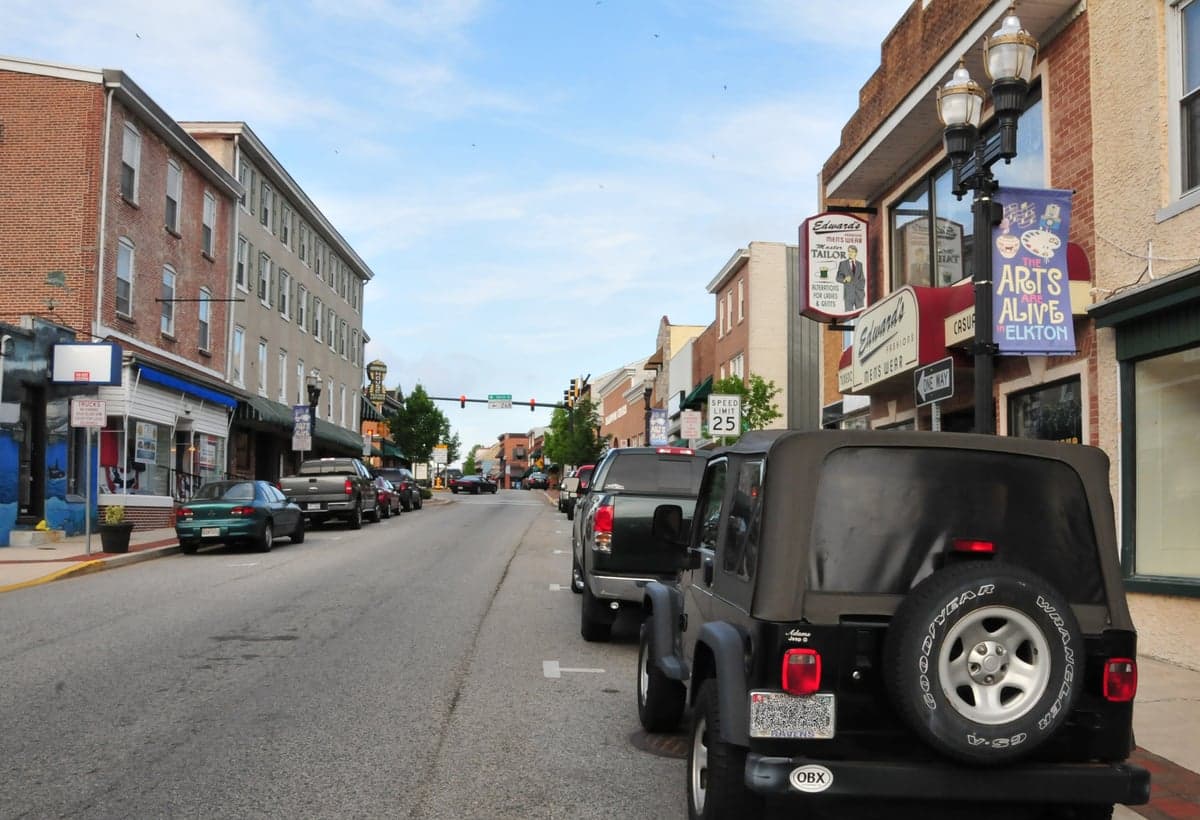
The people of Elkton, Maryland, today form a small, predominantly native-born population of 15,867, characterized by a working-class, family-oriented identity rooted in the town’s historic role as a county seat and transportation hub. With a median age of 37.4 and a low foreign-born share of just 2.7%, the city is notably less diverse than Cecil County as a whole, though its Black (15.3%) and Hispanic (8.1%) communities are growing. The population is dense for a town of its size, concentrated in older grid neighborhoods near the downtown core and in newer subdivisions along the Route 40 corridor. Distinctive markers include a strong sense of local history, a reliance on nearby Wilmington and Newark for employment, and a demographic profile that is slowly shifting from its historically white, rural base toward a more multiethnic, but still modestly diverse, composition.
How the city was settled and grew
Elkton’s population history begins with its 1694 founding as the county seat of Cecil County, drawing English and Scots-Irish settlers who established farms and mills along the Elk River. The town’s early growth was fueled by its position on the post road between Philadelphia and Baltimore, and later by the arrival of the railroad in the 1830s, which attracted German and Irish laborers who built the tracks and settled in the West End neighborhood, near the rail yards. By the late 19th century, the canning and fertilizer industries brought a wave of Italian and Polish immigrants, who clustered in the South Bridge Street area, establishing small grocery stores and Catholic parishes. The historic Main Street district became the commercial and civic heart, home to the town’s merchant class—mostly of English and German descent—who built the Victorian homes that still line the street. Through the mid-20th century, Elkton remained a predominantly white, Protestant town, with a small Black population concentrated in the Cherry Hill neighborhood, a historically African American enclave formed by post-Civil War migration from the Eastern Shore.
Modern era (post-1965)
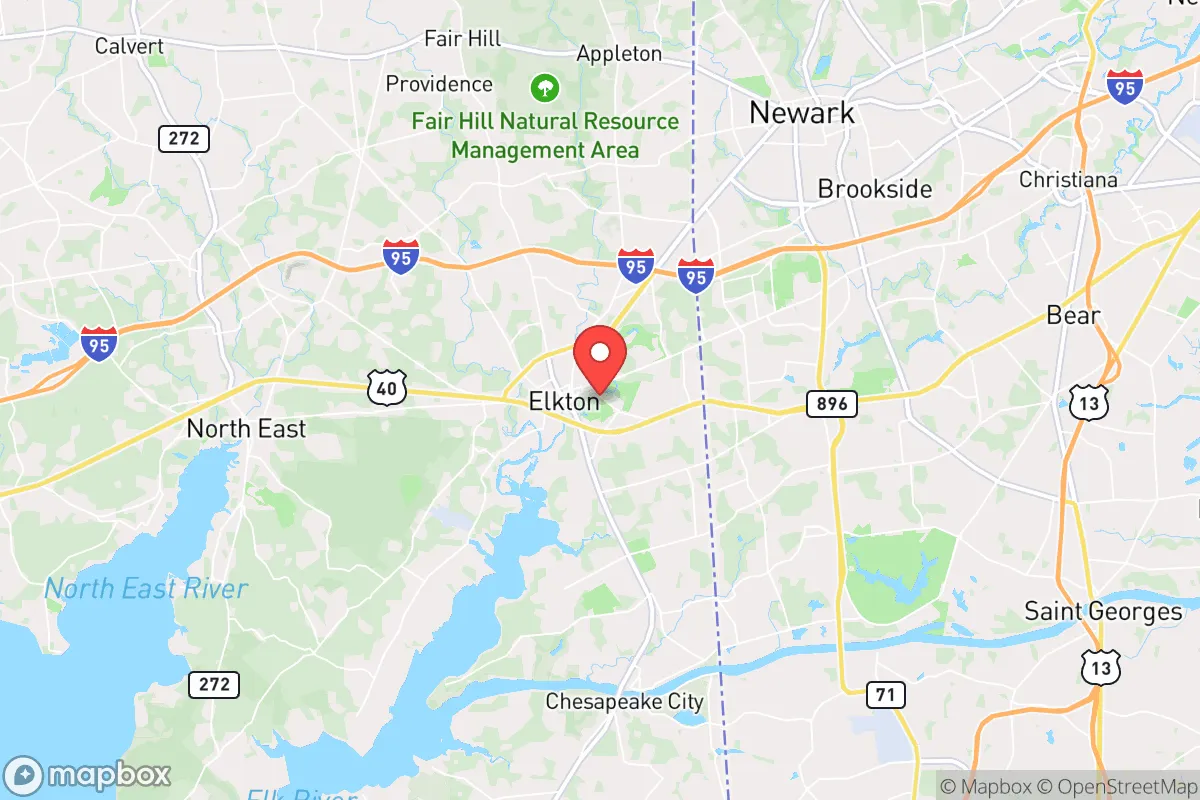
The 1965 Immigration and Nationality Act had a muted effect on Elkton, as the town’s foreign-born share remained below 3% through the 1990s, far lower than in nearby Wilmington or Baltimore. The most significant demographic shift came from domestic in-migration: the construction of Interstate 95 in the 1960s and the expansion of the Route 40 corridor turned Elkton into a bedroom community for workers commuting to Wilmington, Newark, and Aberdeen. This drew white and Black families from the Philadelphia and Baltimore metros, who settled in the Elkton Heights subdivision (built in the 1970s) and the Meadowview development (1980s), both of which remain predominantly white and middle-class. The Hispanic population, now 8.1%, began growing in the 1990s, driven by Mexican and Central American laborers working in poultry processing and construction; they concentrated in the West End and along the Route 40 strip, where affordable rentals and Spanish-language services emerged. The Black population, at 15.3%, is largely native-born and concentrated in the Cherry Hill and South Elkton neighborhoods, with a smaller presence in newer subdivisions. The Indian subcontinent community (2.0%) is a recent arrival, primarily professionals in healthcare and IT who have settled in the Meadowview area, while East/Southeast Asian residents (0.5%) remain a tiny presence, mostly in the downtown rental stock. The college-educated share, at 18.8%, is low, reflecting the town’s blue-collar character and the limited local demand for advanced degrees.
The future
Elkton’s population is slowly diversifying, but the pace is modest compared to regional trends. The Hispanic share is likely to continue growing, driven by family reunification and the availability of low-skill jobs in warehousing and logistics along the Route 40 corridor, potentially reaching 12-15% by 2040. The Black population is stable, with little net in-migration from outside Cecil County, and may plateau near its current share. The Indian subcontinent community, though small, is growing faster than the East/Southeast Asian group, as professionals are drawn by lower housing costs relative to Newark and Wilmington; they are likely to remain concentrated in the Meadowview and newer subdivisions near the Maryland-Delaware line. The white population, while still the majority at 62.9%, is aging and declining slightly, as younger white families move to newer suburbs in Delaware or Pennsylvania. The town is not tribalizing into distinct enclaves—neighborhoods remain relatively mixed by class and race—but the West End and Route 40 strip are becoming more Hispanic, while Cherry Hill remains predominantly Black. The foreign-born share will likely rise to 5-6% by 2040, still well below the national average, meaning Elkton will remain a predominantly native-born, English-dominant community.
For a conservative-leaning mover, Elkton is becoming a slightly more diverse but still culturally traditional small town, where the pace of change is slow enough that established social norms and local institutions remain intact. The population is stable in size, family-oriented, and rooted in local history, with a growing Hispanic presence that is integrating into the workforce and schools. The low college-educated share and modest foreign-born population mean the town retains a blue-collar, pragmatic character, with little of the cosmopolitan or progressive drift seen in larger Maryland cities. New arrivals will find a place where neighborhoods are defined more by income and housing stock than by ethnicity, and where the demographic future points toward gradual diversification rather than rapid transformation.

* Values derived from national, state, county, city and local statistics and may differ in a specific area. Last updated: 2026-04-22T03:47:34.000Z
Narrative content on this page is AI-generated and may contain mistakes. Verify any details that matter before acting on them.
ReloMaps may earn a commission from affiliate links at no extra cost to you.

