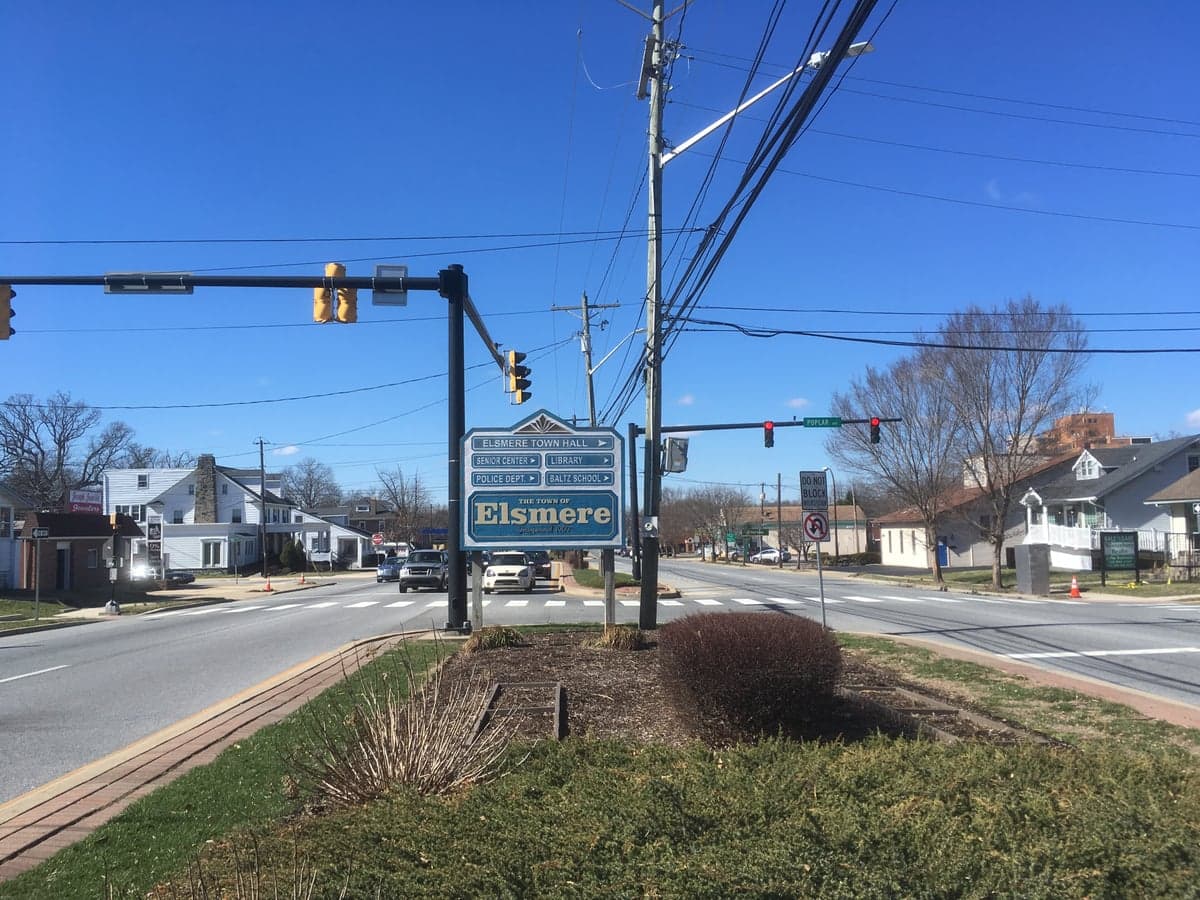
Photo: Wikipedia
Demographics of Elsmere, DE
Affluence Level in Elsmere, DE
A middle-class area roughly in line with national averages across income, home values, education, and employment.
People of Elsmere, DE
Elsmere, Delaware, is a compact, densely populated suburb of Wilmington with 6,189 residents, characterized by its working-class roots and significant ethnic diversity. The city is a majority-minority community where no single racial or ethnic group holds a numerical majority, with a notably high Hispanic population of 32.7% and a Black population of 16.4%. Its residents are overwhelmingly native-born, with only 3.4% foreign-born, and the city has a distinctly blue-collar identity, reflected in a low college education rate of 14.9%.
How the city was settled and grew
Elsmere was not a colonial-era settlement but a product of the late 19th and early 20th centuries, emerging as a streetcar suburb of Wilmington. The area was originally farmland, but the arrival of the Wilmington and Northern Railroad in the 1870s spurred development. The city was officially incorporated in 1909, drawing its early population from working-class families, many of whom were of Irish and German descent, who worked in Wilmington's factories, railroads, and the nearby DuPont powder mills. These early residents built modest homes in what is now the Old Elsmere neighborhood, the historic core centered around Main Street and Elsmere Avenue. The community grew steadily through the 1920s and 1930s, with a second wave of Italian and Polish immigrants settling in the South Elsmere area, near the railroad tracks, establishing tight-knit ethnic enclaves. By mid-century, Elsmere was a predominantly white, blue-collar town, with a population that peaked near 8,000 in the 1950s.
Modern era (post-1965)
The post-1965 era brought significant demographic change to Elsmere, driven by suburbanization and the decline of Wilmington's industrial base. As white, middle-class families began moving to newer suburbs in the 1970s and 1980s, Elsmere's population dropped and its racial composition shifted. Black families, many moving from Wilmington's inner city, began settling in the Elsmere Gardens area, a neighborhood of garden apartments and duplexes near the city's eastern edge. The most dramatic shift began in the 1990s and accelerated through the 2000s, as Hispanic immigrants—primarily from Mexico and Central America—arrived to work in construction, landscaping, and the service industries. This wave concentrated in the West Elsmere neighborhood, west of the railroad tracks, where older housing stock was affordable and rental properties were plentiful. Today, the Hispanic population stands at 32.7%, making Elsmere one of the most Hispanic communities in New Castle County. The white population has fallen to 48.6%, while the Black population has stabilized at 16.4%. East/Southeast Asian residents make up just 0.5% of the population, and there is no measurable Indian subcontinent population. The foreign-born share remains low at 3.4%, indicating that most Hispanic residents are U.S.-born or long-term residents.
The future
Elsmere's population is trending toward further diversification, though the pace of change may slow. The Hispanic share is likely to continue growing, as the community is young and family-oriented, but it may plateau as the city's housing stock is limited and new development is constrained. The white population is aging and declining, while the Black population appears stable. There is no evidence of significant new immigrant waves from Asia or the Indian subcontinent. The city is not homogenizing into a single ethnic bloc; rather, it is tribalizing into distinct neighborhoods: Old Elsmere remains predominantly white and older, West Elsmere is heavily Hispanic, and Elsmere Gardens is a mixed Black and Hispanic area. The Elsmere Heights neighborhood, a small pocket of newer single-family homes near the northern border, is the most economically diverse. Over the next 10-20 years, Elsmere is likely to become a Hispanic-plurality city, with whites remaining a large minority. The low college attainment rate and limited economic mobility suggest the city will retain its working-class character.
Elsmere is becoming a predominantly Hispanic, working-class suburb with a stable Black minority and a shrinking white population. For a conservative-leaning individual or family moving in now, the city offers affordable housing and a dense, community-oriented feel, but with limited economic opportunity and a population that is increasingly divided by ethnicity and neighborhood. The city's future is one of ethnic consolidation rather than assimilation, with distinct enclaves persisting.

* Values derived from national, state, county, city and local statistics and may differ in a specific area. Last updated: 2026-04-29T20:09:49.000Z
Narrative content on this page is AI-generated and may contain mistakes. Verify any details that matter before acting on them.
ReloMaps may earn a commission from affiliate links at no extra cost to you.

