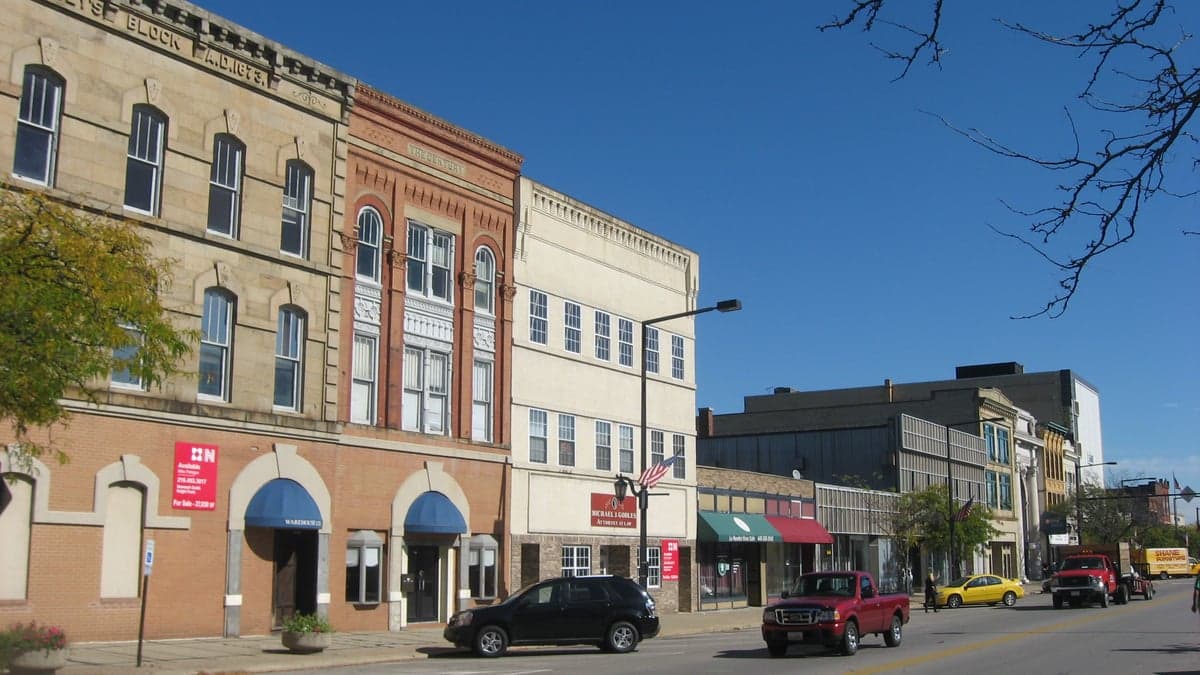
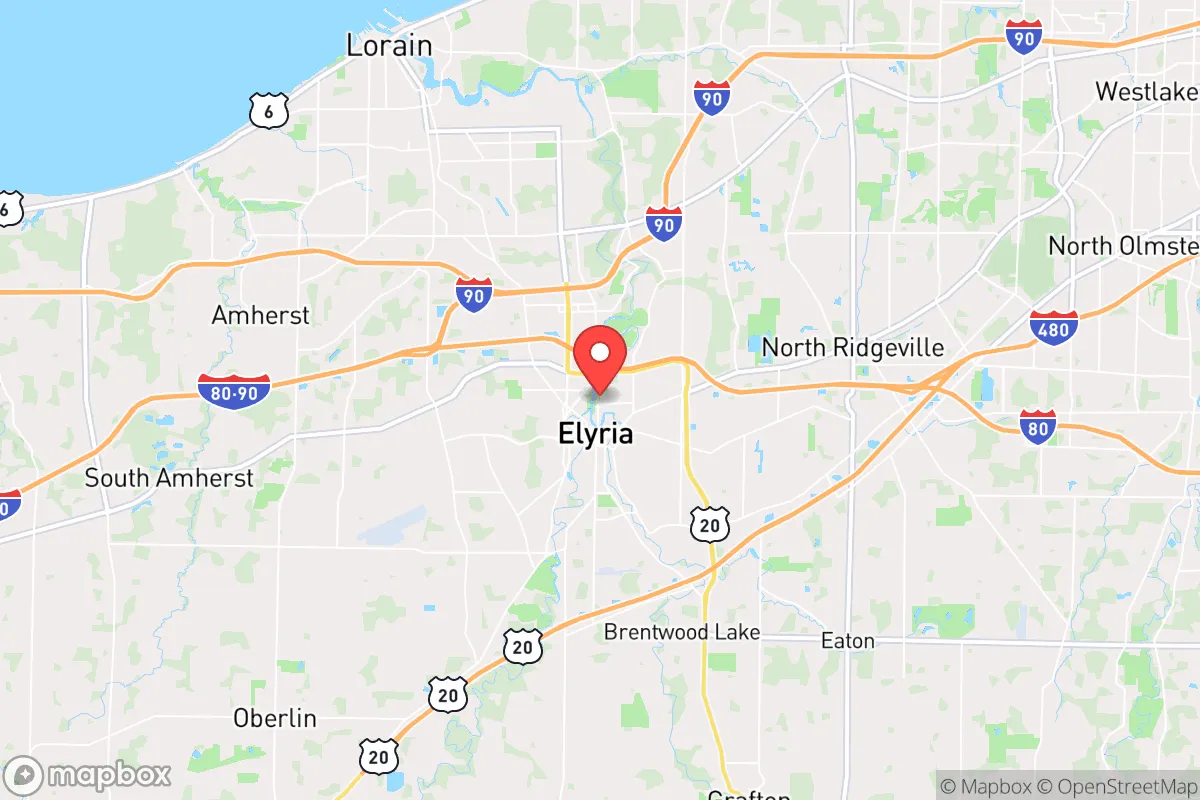
Photo: Wikipedia
Demographics of Elyria, OH
Affluence Level in Elyria, OH
A below-average socioeconomic profile. Incomes, home values, and educational attainment trail the U.S., with higher poverty and unemployment.
People of Elyria, OH
The people of Elyria, Ohio today number 52,833, forming a predominantly white (67.5%) city with significant Black (12.8%) and Hispanic (10.5%) communities. The city is notably less diverse than the national average in foreign-born residents (1.5%) and college graduates (16.6%), giving it a working-class, Midwestern character shaped by its industrial roots. Distinct neighborhoods still bear the imprint of the ethnic and racial groups that built them, from Eastern European factory workers to Southern Black migrants.
How the city was settled and grew
Elyria was founded in 1817 by Heman Ely, who dammed the Black River to power mills, drawing the first wave of settlers—Yankee farmers and craftsmen from New England. The completion of the Lake Shore and Michigan Southern Railway in the 1850s turned Elyria into a manufacturing hub, attracting German and Irish immigrants who settled in the West Side neighborhoods near the rail yards and foundries. By the early 1900s, steel and auto parts plants (like the Elyria Foundry and Bendix-Westinghouse) pulled in Southern and Eastern Europeans—Poles, Slovaks, and Italians—who clustered in South Elyria around Middle Avenue and the industrial corridor. These groups built dense, walkable blocks of two-family homes and Catholic parishes that remain ethnic anchors today.
Modern era (post-1965)
The post-1965 immigration reforms had a muted effect on Elyria compared to coastal cities. The foreign-born share remains low at 1.5%, with the largest recent influx being Hispanic (10.5% of the population), primarily Mexican and Puerto Rican families drawn to warehouse and logistics jobs along the I-90 corridor. These newcomers have concentrated in the East Side neighborhoods around East River Road and the Midway Mall area, where older strip malls now house taquerias and bodegas. The Black population (12.8%) grew sharply during the Great Migration (1940–1970) as Southern families arrived for factory work, settling in the Downtown and Southwest Elyria blocks near the former steel mills. Since 2000, the Black share has plateaued, while the white share has declined from 78% to 67.5%, reflecting suburban flight to neighboring Amherst and North Ridgeville. East and Southeast Asian residents (1.3%) and Indian-subcontinent residents (0.4%) remain tiny, scattered without a distinct ethnic enclave—most are professionals at the nearby Cleveland Clinic or Lorain County Community College.
The future
Elyria’s population is slowly homogenizing by class rather than race. The white working-class base is aging and shrinking, while Hispanic growth (projected to reach 14–16% by 2035) is concentrated in the East Side and Southwest Elyria rental stock. The Black population is stable but not growing, as younger families leave for more affordable suburbs like Sheffield Village. The city’s low college attainment (16.6%) and high poverty rate (18.2%) suggest continued outmigration of the educated, while immigrant communities remain small and slow-growing—Elyria lacks the chain-migration networks that fuel enclave expansion in larger Ohio cities. The next decade likely sees a gradual increase in Hispanic share, a flat Black share, and a continued white decline, with the city becoming more economically stratified between the stable West Side owner-occupied homes and the struggling East Side rental districts.
For a conservative-leaning mover, Elyria offers a low-cost, low-diversity environment where traditional neighborhoods still hold, but the economic base is fragile and the population is slowly shifting toward a younger, more Hispanic working class. The city is not tribalizing into hostile enclaves—it is simply aging and being replaced by a different demographic in specific, predictable blocks.

* Values derived from national, state, county, city and local statistics and may differ in a specific area. Last updated: 2026-04-21T20:15:54.000Z
Narrative content on this page is AI-generated and may contain mistakes. Verify any details that matter before acting on them.
ReloMaps may earn a commission from affiliate links at no extra cost to you.

