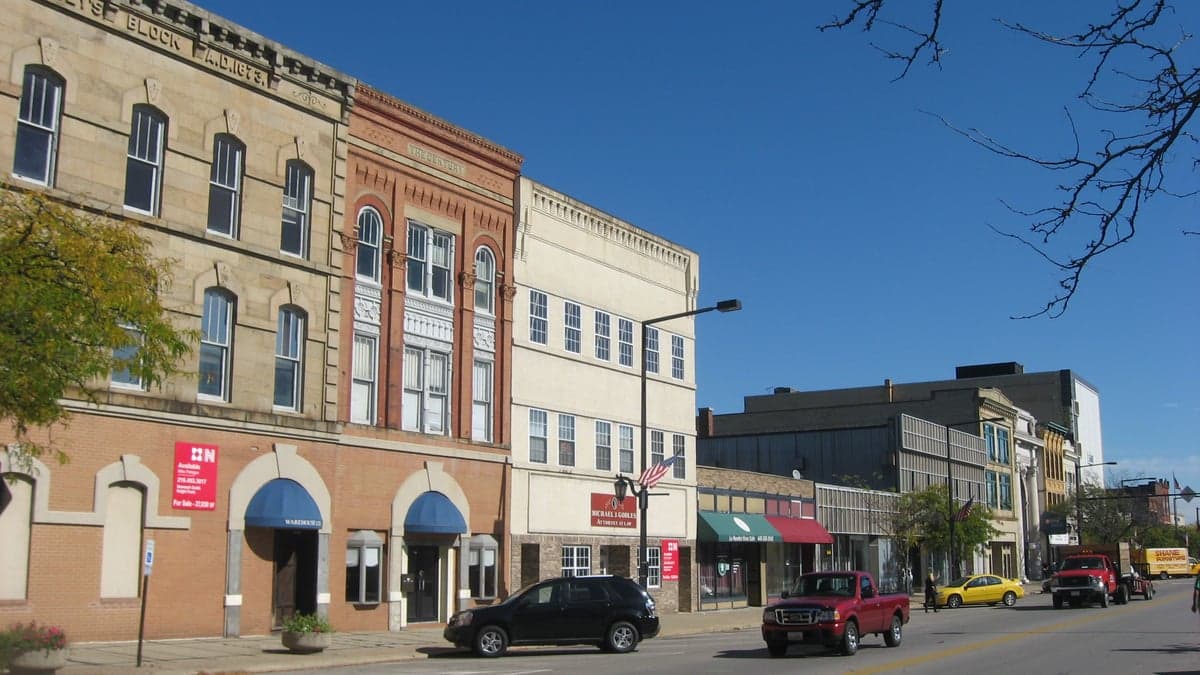
Photo: Wikipedia
Political ClimatePolitical Climate in Elyria, OH
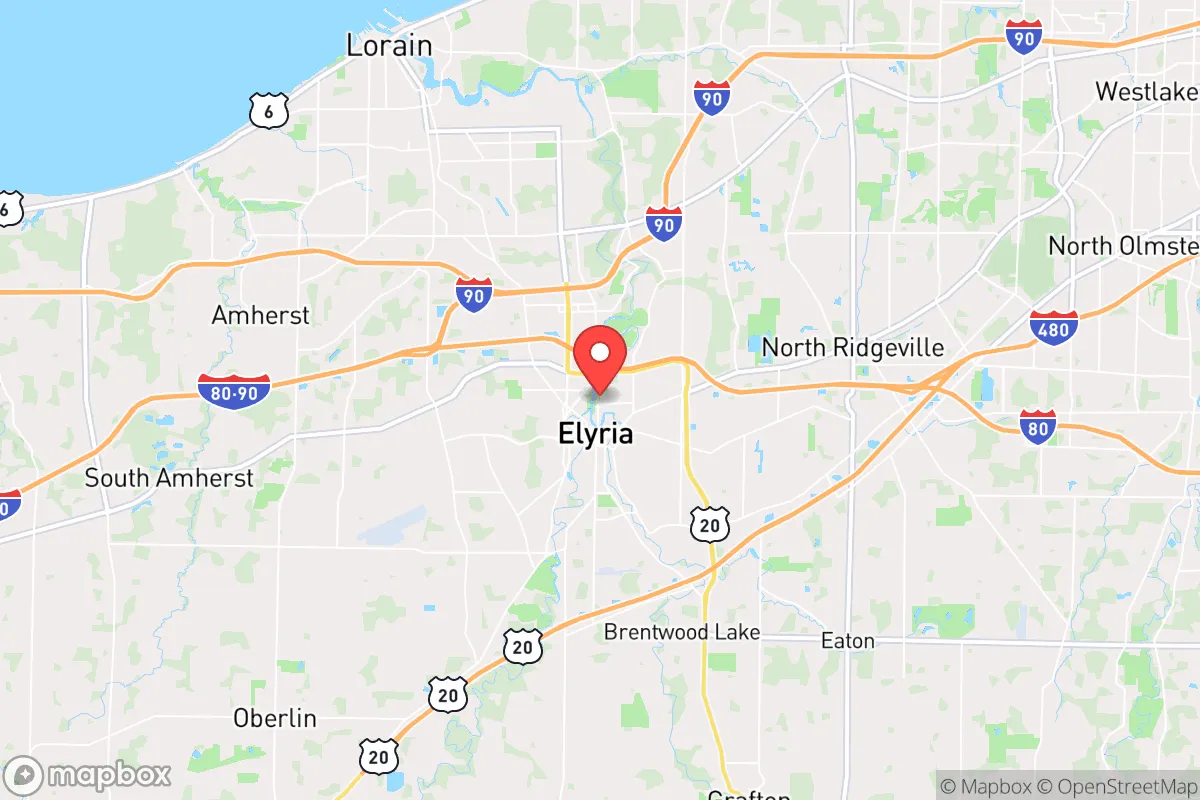
District shown is the primary district for this city’s centroid. Cities may span multiple districts.
Local Political AnalysisPolitical Analysis of Elyria, OH
Elyria, Ohio, sits in a county that leans solidly Republican with a Cook PVI of R+14, but don’t let that number fool you into thinking it’s a straight red stronghold anymore. The city itself has been shifting leftward over the past decade, especially in local elections, while the surrounding rural townships and communities like North Ridgeville and Grafton have held the line. It’s a tale of two worlds: the old-school, blue-collar conservatism that built this place, and the newer, more progressive energy creeping in from the county seat and the influence of nearby Cleveland.
How it compares
Drive ten minutes south to Wellington or west to Oberlin, and you’ll see the political contrast starkly. Oberlin is a liberal college town where progressive policies on housing and taxes are the norm, while Wellington votes more like the rest of Lorain County’s rural areas—solidly conservative. Elyria sits in the middle, but it’s leaning closer to Oberlin’s orbit with each election cycle. In 2020, the city voted for Biden by a slim margin, while the county overall went for Trump. That split tells you everything: the city’s growing progressive base is at odds with the surrounding communities that still value limited government and personal responsibility. It’s a tension you feel at county commission meetings and school board votes, where the push for higher taxes and new regulations often comes from Elyria’s city hall, not the townships.
What this means for residents
For folks who’ve lived here a while, the biggest concern is how this shift affects everyday freedoms. Property taxes have crept up as the city pushes for more public spending—new parks, bike lanes, and social programs that sound nice but hit your wallet hard. There’s also been a quiet push for stricter zoning and business regulations, which makes it harder for small shops and contractors to operate without jumping through hoops. If you value keeping government out of your backyard and your paycheck, you’ll want to keep an eye on city council elections. The long-term trend is worrying: as Elyria gets younger and more diverse, the progressive agenda gains momentum, and that means more mandates, more fees, and less room for the independent spirit that made this area thrive.
Culturally, Elyria still has its conservative roots—gun rights are respected, and you’ll see plenty of Trump signs in the suburbs—but the city’s core is changing. The old factories and union halls that once anchored a working-class Republican base are fading, replaced by service jobs and a younger crowd that leans left on social issues. The local school board has seen debates over curriculum and library books that would’ve been unthinkable a decade ago. If you’re looking for a place where your values on personal freedom and limited government are the norm, the surrounding townships are a safer bet. Elyria itself? It’s a battleground, and the fight over how much government should be in your life is only heating up.

State Political ClimatePolitical Climate in Ohio
State Political AnalysisPolitical Environment in the State
Ohio has long been the quintessential swing state, but over the past decade it has shifted decisively to the right, voting for Donald Trump by 8 points in both 2016 and 2020 and by a similar margin in 2024. The state’s political center of gravity now sits solidly Republican, driven by a coalition of working-class voters in small cities and rural areas, while the Democratic base is increasingly concentrated in a handful of urban counties. This isn’t your grandfather’s Ohio—the old manufacturing-heavy, union-strong Democratic lean has been replaced by a populist-conservative tilt that shows no signs of reversing.
Urban vs. rural divide
The political map of Ohio is a textbook study in geographic polarization. The three major metros—Cleveland (Cuyahoga County), Columbus (Franklin County), and Cincinnati (Hamilton County)—anchor the Democratic vote, with Cuyahoga alone delivering roughly 200,000-vote margins for Democratic candidates. But outside these islands, the state is overwhelmingly red. Butler County (north of Cincinnati) and Delaware County (north of Columbus) are among the fastest-growing and most reliably Republican suburbs. Meanwhile, the Appalachian southeast—counties like Meigs, Vinton, and Monroe—routinely vote 75-80% Republican. The real story is the Mahoning Valley (Youngstown area), which flipped from blue-collar Democratic to Trump country in 2016 and has stayed there. Even Lucas County (Toledo) is trending right, with Trump narrowing the margin in 2024. The divide isn’t just urban vs. rural—it’s also about the exurbs and small cities like Middletown, Lima, and Zanesville that have become reliably red.
Policy environment
Ohio’s policy environment is broadly conservative, with a few notable exceptions. The state has a flat income tax of 3.5% (down from 4.8% in 2020), and the legislature is actively working to phase it out entirely. Property taxes are moderate, though they vary widely by district. The regulatory climate is business-friendly, with right-to-work laws not on the books but a strong anti-union sentiment in the legislature—Issue 2 (2023) failed, but the fight over collective bargaining continues. Education policy is a major battleground: the state has a robust school choice program, including the EdChoice voucher system, which has expanded significantly under Governor Mike DeWine. Parents have strong rights, including a 2023 law requiring schools to notify parents of any changes in a student’s health or well-being (the Parental Rights in Education bill). On healthcare, Ohio did not expand Medicaid under the Affordable Care Act until 2013, and the program remains controversial. Election laws have tightened: House Bill 458 (2023) requires photo ID for voting, limits drop boxes, and shortens the absentee ballot window. The state also passed a 6-week abortion ban in 2019 (the Heartbeat Bill), which was upheld after the Dobbs decision but is currently being challenged by a 2023 ballot initiative that enshrined abortion rights in the state constitution—a rare progressive win that many conservatives view as judicial overreach.
Trajectory & freedom
On balance, Ohio is becoming more free in several key areas, but there are worrying signs of government overreach. The most significant expansion of liberty came with Constitutional Carry (permitless carry of firearms), signed into law in 2022—Ohio now has some of the strongest Second Amendment protections in the Midwest. Parental rights were strengthened by the 2023 notification law, and the state has resisted federal vaccine mandates and COVID-era lockdowns more aggressively than many peers. However, the 2023 abortion rights amendment (Issue 1) was a major setback for conservatives, enshrining a right to abortion up to viability in the state constitution—a direct override of the legislature’s will. Property rights remain strong, with no statewide rent control and limited eminent domain abuse. The tax trajectory is positive: the income tax is being phased down, and the state has no estate tax. But watch out for local government overreach—cities like Columbus and Cleveland have passed their own gun control ordinances (magazine limits, waiting periods) that conflict with state preemption laws, leading to ongoing legal battles. The state’s preemption law (Ohio Revised Code 9.68) is strong but not always enforced.
Civil unrest & political movements
Ohio has seen its share of political flashpoints. The 2020 George Floyd protests in Columbus and Cincinnati turned violent, with property damage and clashes with police. More recently, the 2023 East Palestine train derailment sparked a populist backlash against both corporate negligence and federal inaction, with local residents organizing independent safety committees. The state has a growing “Ohio Freedom” movement—a loose coalition of Second Amendment advocates, school choice parents, and anti-vaccine activists that holds regular rallies at the Statehouse. Immigration politics are less heated than in border states, but Springfield (Clark County) became a national flashpoint in 2024 after a surge of Haitian migrants strained local resources, leading to city council resolutions and a state-level push for stricter enforcement. Election integrity remains a live issue: the 2020 and 2024 cycles saw lawsuits over ballot drop boxes and mail-in voting procedures, though no widespread fraud was ever proven. The “Stop the Steal” movement had a strong presence in rural counties, and the 2024 election saw record numbers of poll watchers. On the left, the “Ohio Progressive Caucus” has organized around Issue 1 and environmental justice, but they remain a minority voice outside the urban cores.
Projection
Over the next 5-10 years, Ohio will likely become more Republican, but with a growing internal tension between the populist-conservative base and a more libertarian-leaning suburban wing. The demographic trends favor the GOP: the fastest-growing counties are the red exurbs (Delaware, Butler, Warren), while the urban cores are stagnant or losing population. In-migration is modest but tilting conservative—people moving from California and Illinois often cite lower taxes and gun rights as reasons. The biggest wildcard is the abortion amendment: if it leads to a surge in Democratic turnout in presidential years, it could keep the state competitive at the top of the ticket. But for state-level races, the GOP’s structural advantage in the legislature (thanks to aggressive redistricting) is nearly insurmountable. Expect continued fights over school choice expansion, income tax elimination, and local gun preemption. The state’s political culture will remain pragmatically conservative—not as red as Texas or Florida, but far from the purple of a decade ago. A new resident moving in now should expect a state that values personal responsibility, low taxes, and gun rights, but with a persistent undercurrent of progressive activism in the cities that will keep the culture wars alive.
Bottom line for a new resident: If you’re looking for a state where your vote actually matters in national elections, Ohio still delivers—but the state is trending your way if you’re conservative. You’ll find strong Second Amendment protections, a flat tax heading toward zero, and robust school choice. The trade-off is that you’ll have to navigate local government overreach in the blue cities and a constant battle over abortion policy. For a family or individual who values freedom from government intrusion, Ohio is a solid bet—just know that the fight isn’t over, and you’ll need to stay engaged at the local level to keep it that way.
* Values derived from national, state, county, city and local statistics and may differ in a specific area. Last updated: 2026-04-21T20:15:54.000Z
Narrative content on this page is AI-generated and may contain mistakes. Verify any details that matter before acting on them.
ReloMaps may earn a commission from affiliate links at no extra cost to you.

