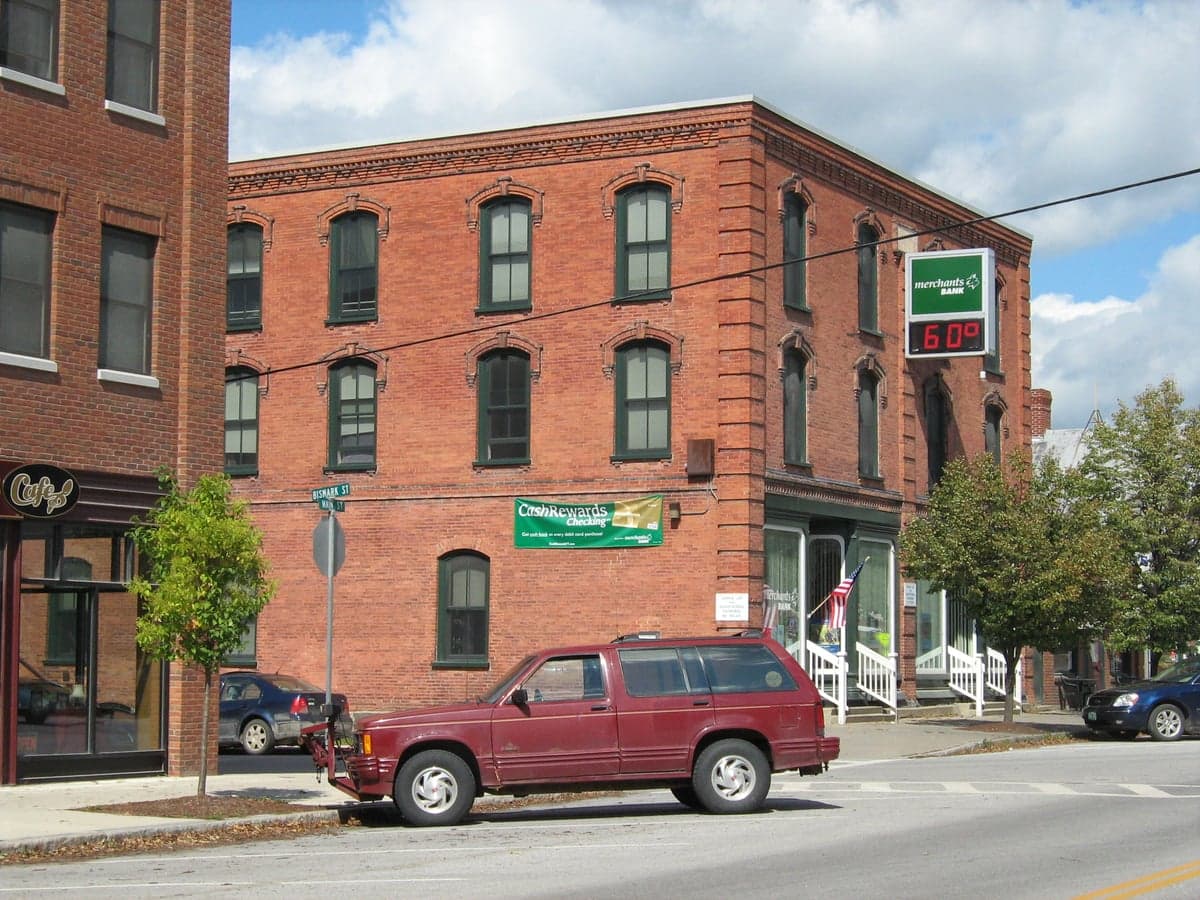
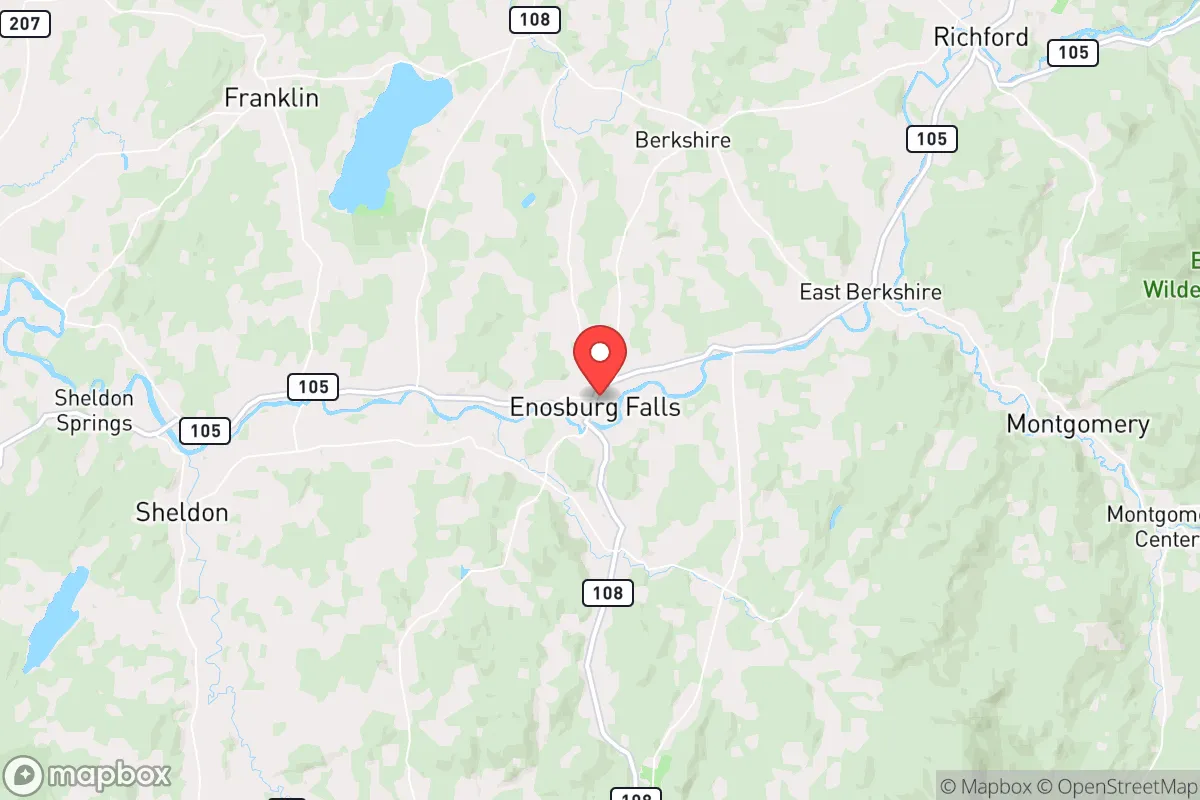
Photo: Wikipedia
Demographics of Enosburg Falls, VT
Affluence Level in Enosburg Falls, VT
A below-average socioeconomic profile. Incomes, home values, and educational attainment trail the U.S., with higher poverty and unemployment.
People of Enosburg Falls, VT
Enosburg Falls, Vermont, is a small, tight-knit village of 1,595 residents where the population is overwhelmingly white (81.5%) and older, with a median age of 43.8. The community is characterized by its rural, working-class character, a strong French-Canadian heritage, and a very low foreign-born population (0.3%). It is a place where family names have remained constant for generations, and the local identity is deeply rooted in dairy farming and small-town self-reliance.
How the city was settled and grew
Enosburg Falls was originally chartered in 1780 as part of a land grant to Revolutionary War veterans, but permanent settlement did not begin in earnest until the early 1800s. The first wave of settlers were primarily Yankees from southern New England, who built farms along the Missisquoi River and established the village core around the falls that powered early grist and saw mills. By the mid-19th century, a second, much larger wave arrived: French-Canadian families from Quebec, drawn by work in the region's growing dairy industry and the construction of the Missisquoi Valley Railroad. These French-Canadian immigrants settled heavily in what is now known as the Lower Village, the area along the river below the falls, where they built St. John the Baptist Catholic Church (1870) as their cultural and religious anchor. A smaller but notable group of Irish laborers, who worked on the railroad and in the local marble quarries, concentrated in the Railroad Street district, near the depot. By 1900, the village was a thriving manufacturing center, producing butter, cheese, and woodenware, with a population that was roughly two-thirds French-Canadian and one-third Yankee.
Modern era (post-1965)
After the 1965 Hart-Cellar Act, Enosburg Falls saw virtually no new immigration, a pattern consistent with its remote location and lack of industrial diversification. The foreign-born share today is a mere 0.3%, and the population is 81.5% white, with no Hispanic residents and only 0.3% Black. The most significant demographic shift since the 1960s has been domestic out-migration of young adults seeking jobs in Burlington or beyond, leaving an aging population. The East Enosburg neighborhood, once a cluster of small family farms, has seen many of its dairy operations consolidated into larger agribusinesses, with farmhouses converted to seasonal homes for out-of-state buyers. The Village Center around Main Street has lost its grocery store and hardware store, but retains a post office, a library, and a handful of local businesses. The small East/Southeast Asian population (0.9%) is almost entirely composed of a few families who operate the local Chinese takeout restaurant and a small motel, living in the Route 108 corridor near the village limits. The Indian-subcontinent population is 0.0%.
The future
Enosburg Falls is heading toward further homogenization and population decline. The village lost roughly 5% of its population between 2010 and 2020, and the trend is expected to continue as the remaining dairy farms mechanize and the older generation passes away. The 14.0% college-educated rate is well below the state average, limiting the area's ability to attract knowledge-economy workers or remote professionals. There is no sign of new immigrant communities forming; the foreign-born share is effectively zero and is projected to remain so. The Sampsonville area, a small cluster of homes on the western edge of town, has seen a few new subdivisions built for retirees and second-home buyers from southern New England, but these are not changing the village's fundamental demographic trajectory. The population is slowly tribalizing into two groups: long-term locals (mostly elderly French-Canadian families) and seasonal residents who own vacation properties but do not participate in local civic life.
For a conservative-leaning individual or family considering a move, Enosburg Falls offers a stable, safe, and culturally homogeneous environment with very low crime and a strong sense of community among year-round residents. However, the shrinking population, limited job opportunities, and aging infrastructure mean that newcomers should expect to be self-reliant and prepared for a quiet, slow-paced life where the nearest Walmart is 20 minutes away in Richford and the nearest hospital is 40 minutes away in St. Albans. This is a place that is becoming more of a retirement and seasonal enclave than a growing, dynamic community.

* Values derived from national, state, county, city and local statistics and may differ in a specific area. Last updated: 2026-04-30T08:10:15.000Z
Narrative content on this page is AI-generated and may contain mistakes. Verify any details that matter before acting on them.
ReloMaps may earn a commission from affiliate links at no extra cost to you.

