Photo: Wikipedia
Demographics of Erie, PA
Affluence Level in Erie, PA
A low-income area with significant economic hardship. Household wealth and educational attainment are well below national averages.
People of Erie, PA
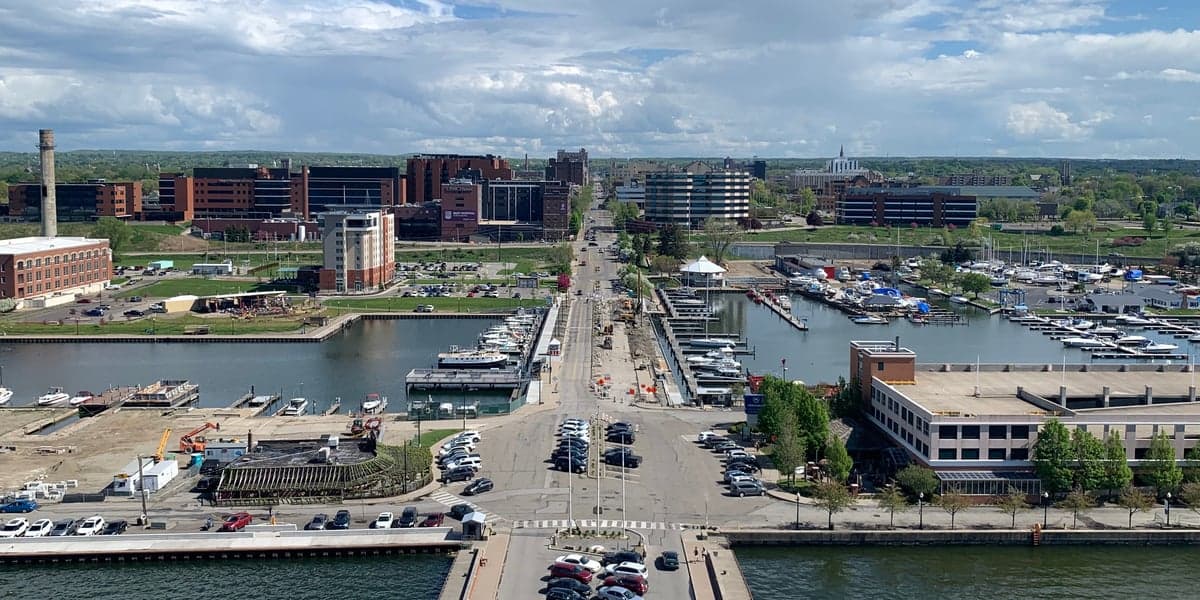
The people of Erie, Pennsylvania today form a predominantly white (66.7%) and working-class city of 94,156, marked by a strong sense of place rooted in industrial heritage and Great Lakes geography. The city is notably less diverse than the national average, with a foreign-born population of just 3.3%, and its residents are concentrated in distinct neighborhoods that still reflect the ethnic waves of the 19th and early 20th centuries. Erie's identity is one of resilience and transition, shaped by the decline of manufacturing and a slow, ongoing demographic shift toward a more Hispanic and Black population.
How the city was settled and grew
Erie was founded in 1795 as a strategic port on Lake Erie, with its early growth driven by the construction of the Erie Extension Canal in the 1840s, which connected the city to the Ohio River and the coal fields of Pennsylvania. The first major wave of settlers were Yankees from New England and New York, who established the city's commercial and political elite. They were followed by German and Irish immigrants in the 1840s and 1850s, who built the city's infrastructure and worked in the emerging iron and shipbuilding industries. The Germans settled heavily in the Little Italy neighborhood (now a historic district) and the area around East 26th Street, while the Irish concentrated in the Bayfront district near the docks. A second major wave came from Southern and Eastern Europe between 1880 and 1920: Italians, Poles, and Slovaks arrived to work in the booming iron and steel mills, particularly at the Erie Forge and Steel Company and the General Electric plant. The Italians established a strong presence in the Little Italy neighborhood, while Poles and Slovaks settled in the East Side around East Avenue and the Lower East Side near the lakefront. By 1920, Erie's population had swelled to over 93,000, and the city was a classic industrial melting pot, with ethnic enclaves that remained distinct for generations.
Modern era (post-1965)
The post-1965 era brought significant demographic change, driven by the decline of heavy industry and the 1965 Hart-Cellar Immigration Act. Erie's manufacturing base began to erode in the 1970s and 1980s, with the loss of thousands of jobs at General Electric, Erie Forge, and other plants. This triggered a domestic out-migration of white working-class families to the suburbs, particularly to Millcreek Township and Harborcreek. At the same time, the city saw an influx of Black families from the rural South, who settled primarily in the Lower East Side and the Bayfront area, where housing was cheaper and industrial jobs were still available. The Hispanic population, primarily of Puerto Rican descent, began to grow in the 1990s and 2000s, concentrating in the West Side neighborhoods around West 18th Street and the Little Italy area. Today, Erie's Black population stands at 15.4% and its Hispanic population at 8.4%, while the white population has fallen to 66.7%. The East/Southeast Asian population is very small at 0.9%, and the Indian-subcontinent population is 1.5%, with both groups largely concentrated in the West Side near the Penn State Behrend campus and the Bayfront district. The foreign-born share of 3.3% is well below the national average of 13.7%, reflecting Erie's limited appeal to new international migrants compared to larger cities.
The future
Erie's population is projected to continue its slow decline, with the city losing roughly 1-2% of its residents per decade since the 1960s. The white population is aging and shrinking, while the Hispanic and Black populations are growing modestly, primarily through natural increase and domestic migration from other Rust Belt cities. The city is not homogenizing; instead, it is becoming more tribalized into distinct ethnic enclaves, with the West Side becoming increasingly Hispanic, the Lower East Side remaining predominantly Black, and the East Side and Little Italy retaining their white ethnic character. The Indian and East/Southeast Asian communities are small and stable, with little growth expected due to the lack of high-skilled job opportunities. The next 10-20 years will likely see Erie become a smaller, more racially diverse city, but with a persistent economic challenge: the college-educated share is only 22.3%, well below the national average, limiting the city's ability to attract knowledge-economy workers and new immigrants.
Erie is becoming a smaller, more diverse, and more economically challenged city, where the industrial past still defines the neighborhoods and the population is slowly shifting from a white ethnic majority to a multi-ethnic working-class community. For someone moving in now, the city offers affordable housing and a strong sense of community in its historic neighborhoods, but the job market remains weak and the demographic trends point to continued population loss rather than a revival.

* Values derived from national, state, county, city and local statistics and may differ in a specific area. Last updated: 2026-05-02T00:27:13.000Z
Narrative content on this page is AI-generated and may contain mistakes. Verify any details that matter before acting on them.
ReloMaps may earn a commission from affiliate links at no extra cost to you.

