Photo: Wikipedia
Demographics of Evanston, WY
Affluence Level in Evanston, WY
A middle-class area roughly in line with national averages across income, home values, education, and employment.
People of Evanston, WY
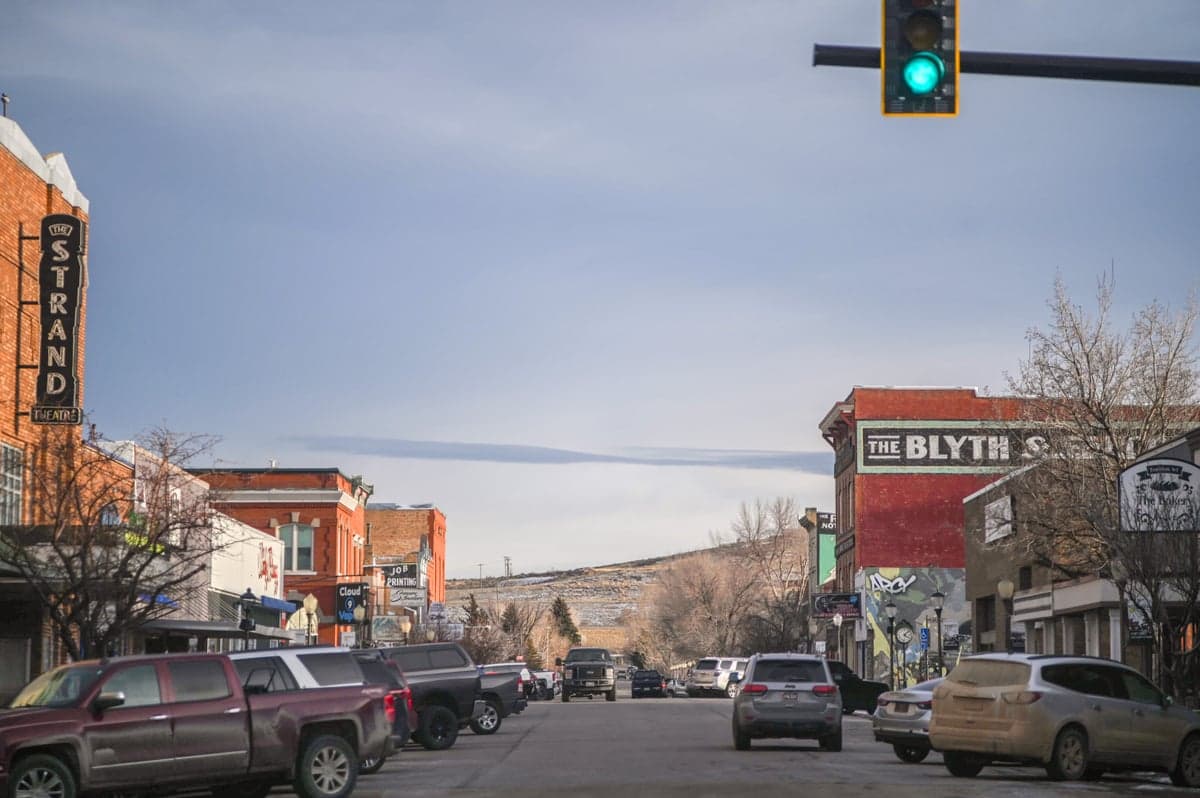
The people of Evanston, Wyoming, today number 11,803, forming a predominantly white (84.0%) and Hispanic (12.3%) community with a very low foreign-born share of just 1.6%. The city’s identity is rooted in its railroad and energy history, producing a blue-collar, politically conservative character with a population density of roughly 1,100 people per square mile. Only 19.9% of adults hold a college degree, reflecting a workforce oriented toward industry, transportation, and local services rather than professional or tech sectors. Evanston remains a small, tight-knit city where family ties and outdoor recreation—hunting, fishing, and snowmobiling in the surrounding Uinta Mountains—define daily life.
How the city was settled and grew
Evanston’s founding and early growth were driven entirely by the transcontinental railroad. The Union Pacific Railroad established the townsite in 1868 as a division point and maintenance hub, drawing a first wave of Irish and Chinese laborers who built the tracks through the rugged Bear River Valley. The Chinese workers, numbering several hundred in the early 1870s, were housed in a segregated camp near the rail yards in what is now the Depot District, while Irish immigrants settled in the Old Town area around Front Street. After the railroad’s completion, many Chinese left, and the Irish and later Scandinavian immigrants—Swedes and Norwegians—became the dominant ethnic groups, working as railroad mechanics, section hands, and shop workers. The South Evanston neighborhood grew as a working-class enclave for these railroad families, with small frame houses built on narrow lots near the tracks. A second major wave arrived in the 1910s and 1920s when coal mining expanded in the nearby Almy and Cumberland fields, drawing Italian and Greek immigrants who settled in the Almy District just north of town. By 1930, Evanston’s population had reached roughly 3,000, and the city’s character as a railroad-and-mining town was firmly set.
Modern era (post-1965)
After the 1965 Hart-Cellar Act, Evanston saw very little new immigration—the foreign-born share today is just 1.6%, far below the national average. Instead, the city’s modern demographic story is one of domestic in-migration and Hispanic growth. The energy boom of the 1970s and 1980s, driven by oil and gas drilling in the Overthrust Belt, brought workers from Texas, Oklahoma, and the Gulf Coast, many of whom settled in the Bear River Estates subdivision on the city’s west side. This wave was predominantly white and conservative, reinforcing Evanston’s political leanings. Hispanic growth accelerated in the 1990s and 2000s, as families moved from the Southwest and Mexico for construction, service, and energy jobs. Today, the Hispanic population (12.3%) is concentrated in the East Evanston neighborhood, particularly around the 100-block of Cheyenne Drive and the mobile home parks near the interstate. The Black population remains negligible at 0.4%, and East/Southeast Asian communities (0.1%) and Indian-subcontinent residents (0.0%) are virtually absent. The city’s college-educated share (19.9%) is low, reflecting the continued dominance of blue-collar employment in energy, transportation, and local government.
The future
Evanston’s population is projected to remain stable or grow slowly, with the Hispanic share likely rising to 15-18% over the next decade through natural increase and continued domestic migration from the Southwest. The white population is aging and declining slightly, as younger adults leave for college or jobs in Salt Lake City (85 miles west) or Denver (120 miles east). The city is not tribalizing into distinct enclaves—Hispanic and white residents live in mixed neighborhoods, with the Depot District and Old Town seeing some reinvestment and gentrification from remote workers and retirees. The foreign-born share will likely remain below 3%, as Evanston lacks the job diversity and social networks to attract new immigrants. The next 10-20 years will likely see a slow homogenization: a slightly more Hispanic, still overwhelmingly white, and persistently blue-collar community.
For someone moving in now, Evanston is becoming a stable, low-diversity city where the population is gradually becoming more Hispanic but remains culturally and politically conservative. The lack of significant immigration or professional-class growth means the city will retain its railroad-and-energy character, with limited demographic change. New residents should expect a community where family ties, outdoor life, and traditional values dominate, and where the population is neither shrinking nor booming—just slowly evolving.

* Values derived from national, state, county, city and local statistics and may differ in a specific area. Last updated: 2026-04-21T11:28:45.000Z
Narrative content on this page is AI-generated and may contain mistakes. Verify any details that matter before acting on them.
ReloMaps may earn a commission from affiliate links at no extra cost to you.

