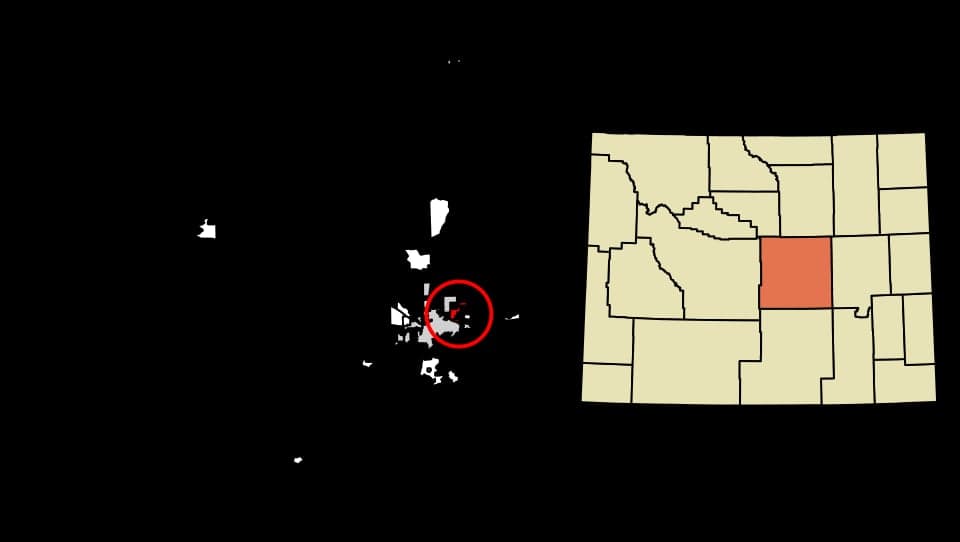
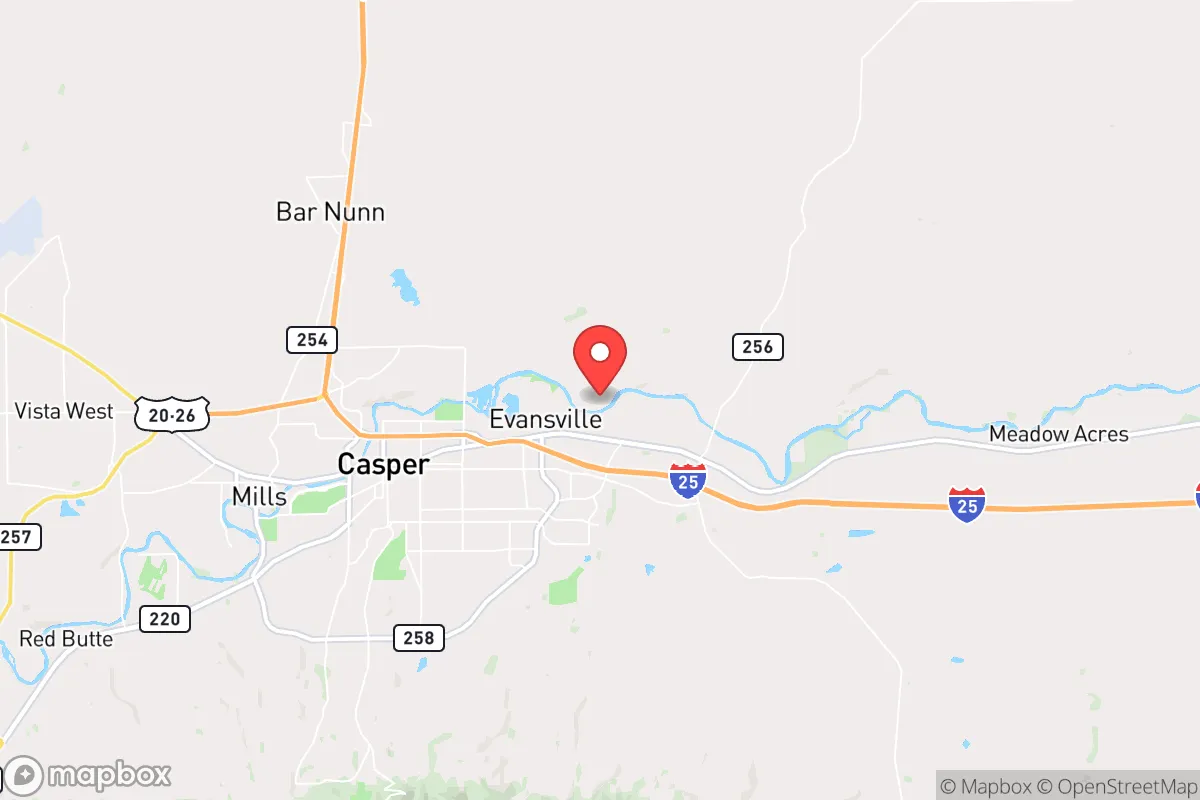
Photo: Wikipedia
Political ClimatePolitical Climate in Evansville, WY
District shown is the primary district for this city’s centroid. Cities may span multiple districts.
Inherited from parent state — no local data available.
Local Political AnalysisPolitical Analysis of Evansville, WY
Evansville, Wyoming, sits squarely in deep-red territory, with a Cook PVI of R+23 that reflects a community where conservative values aren't just a preference—they're the baseline. This isn't a place that's drifted leftward over the years; if anything, the local political climate has held steady or even hardened against progressive trends, especially when you compare it to the chaos you see in places like Laramie or even parts of Casper just a few miles away. The real story here is how Evansville has managed to stay grounded while the world around it gets crazier, and that's something worth paying attention to if you're thinking about relocating.
How it compares
Drive ten minutes north to Casper, and you'll find a different animal entirely. Casper has seen a slow but steady creep of progressive influence—more city council debates about "equity" initiatives, more noise about climate policies that would hammer the local energy sector, and a general vibe that government knows best. Evansville, by contrast, is like a breath of fresh air. The town council here isn't interested in grand social experiments; they're focused on keeping taxes low, maintaining basic services, and staying out of your business. Compare that to places like Lander or Jackson Hole, where the political scene is practically unrecognizable—all green mandates and identity politics. Evansville residents look at those towns and shake their heads. The R+23 rating isn't just a number; it's a reflection of a place where the Second Amendment isn't debated, where energy workers aren't vilified, and where the idea of government telling you how to live your life is met with a hard no.
What this means for residents
For the people who live here, the political climate translates into a daily life that feels free. You're not constantly looking over your shoulder for some new regulation or mandate. Want to build a shed on your property? You probably won't need a permit that takes six months and a lawyer. Want to send your kids to a school that teaches actual skills and history, not social justice theory? The local schools are still focused on the basics. The downside? You won't find much in the way of progressive amenities—no bike-share programs, no "green zones," no city-funded diversity workshops. But for most residents, that's a feature, not a bug. The trade-off is a community where your personal freedoms aren't treated as negotiable, and where the local government's main job is to stay small and stay out of the way.
One thing that stands out about Evansville is how it handles the tension between individual rights and community standards. There's a strong sense of neighborly responsibility here—people look out for each other—but it's not the kind of place that tries to legislate morality or enforce a particular lifestyle. The local culture is rooted in self-reliance and a healthy skepticism of authority, which means you're expected to take care of your own problems without running to the government for help. That's a sharp contrast to the "nanny state" mentality you see in other parts of the country, where every little issue gets a task force and a new ordinance. If you're the type who values your privacy and your right to make your own choices—even the bad ones—Evansville is a rare find. Just don't expect the local government to hold your hand or bail you out when things go sideways. That's the deal, and it's why the people who stay here tend to stay for good.

State Political ClimatePolitical Climate in Wyoming
State Political AnalysisPolitical Environment in the State
Wyoming is, and has long been, one of the most reliably conservative states in the Union, with a Republican trifecta that has held for decades and a partisan lean that routinely places it in the top three most GOP-friendly states nationally. The dominant coalition is a blend of traditional Western libertarianism, energy-industry pragmatism, and a deep-seated distrust of federal overreach, though the state’s small population—under 600,000—means that local politics can feel intensely personal. Over the last 10-20 years, the trajectory has been a slow but noticeable hardening of the conservative edge, driven by an exodus of moderate Democrats from the state legislature and a steady influx of out-of-state conservatives seeking lower taxes and fewer restrictions, particularly in the booming towns of Jackson and Sheridan.
Urban vs. rural divide
The political map of Wyoming is not a simple city-versus-country story; it’s more of a gradient where the few population centers lean slightly less red, but still vote Republican. Cheyenne, the capital and largest city (pop. ~65,000), is the most moderate area, with Laramie County often being the only county that occasionally flirts with Democratic candidates in state-level races, though it still went +24 points for Trump in 2024. Casper, the second-largest city, is reliably conservative, driven by its energy-sector workforce and a strong ranching culture. The real divide is between the sparsely populated, deeply red rural counties—like Sublette and Carbon, where Trump won by 60+ points—and the Teton County bubble around Jackson. Teton County is the state’s lone blue stronghold, voting Democratic by a 2-to-1 margin in 2024, fueled by wealthy second-home owners, environmental nonprofits, and a tourism economy that attracts a more progressive crowd. Outside of that one county, the state is a sea of red, with no other urban area providing any real counterweight.
Policy environment
Wyoming’s policy environment is a textbook example of small-government conservatism, with a few notable wrinkles. There is no state income tax, and the sales tax is a low 4%, though local options can push it to 6%. Property taxes are among the lowest in the nation, but the state relies heavily on mineral extraction taxes (coal, oil, natural gas, and trona), which makes the budget volatile. Education policy is a mixed bag: the state funds schools through a complex formula that has led to lawsuits over equity, but there is no state-level school choice program beyond a weak charter school law, though a 2025 bill to expand education savings accounts (ESAs) is gaining traction. Healthcare is a perennial issue—Wyoming did not expand Medicaid under the ACA, and the state has the highest uninsured rate in the country, which is a point of pride for some and a practical headache for others. Election laws are solid: voter ID is required, same-day registration is not allowed, and the state has no mail-in voting unless you have an excuse. The legislature has consistently rejected any form of ranked-choice voting or ballot harvesting, keeping the process clean and simple.
Trajectory & freedom
On the freedom front, Wyoming is moving in a decidedly more libertarian direction, though not without some internal friction. The state has some of the most permissive gun laws in the country—constitutional carry has been law since 2011, and there are no state-level restrictions on magazine capacity or firearm types. In 2023, the legislature passed the Wyoming Freedom Act, which explicitly nullifies federal gun laws within state borders, a bold move that has not yet been fully tested in court. Parental rights have been strengthened with the 2022 Parents’ Bill of Rights, which requires schools to notify parents of any curriculum changes involving sexuality or gender identity and prohibits schools from hiding a child’s gender identity from parents. Medical autonomy is a mixed bag: the state banned nearly all abortions in 2022 via a trigger law, but it also passed a 2024 law protecting doctors who prescribe ivermectin or hydroxychloroquine from professional discipline. Property rights are strong, with no state-level zoning mandates and a general attitude of “live and let live,” though the federal government owns nearly 50% of the land, which is a constant source of tension. The biggest threat to freedom in Wyoming is the state’s dependence on federal mineral royalties and the looming decline of coal, which could force future tax increases or spending cuts that would erode the current low-tax environment.
Civil unrest & political movements
Wyoming is not a hotbed of civil unrest, but there are distinct political movements that a new resident would notice. The most visible is the Wyoming Liberty Group, a free-market think tank that has successfully pushed for tax cuts, school choice, and nullification bills. On the right, there is a growing “constitutional sheriff” movement, particularly in counties like Park and Fremont, where sheriffs have publicly stated they will not enforce federal gun laws or land-use restrictions. Immigration politics are relatively quiet, as the state has a very small foreign-born population (under 3%), but there is a vocal faction pushing for state-level immigration enforcement, including a 2024 bill that would have allowed local police to enforce federal immigration law (it failed in committee). Election integrity is a live issue: after the 2020 election, the legislature created a special committee to audit the state’s voting machines, and in 2022, Wyoming became one of the first states to ban the use of private money (like Zuckerberg’s) in election administration. There have been no major protests or riots in recent memory, though the Standing Rock pipeline protests in neighboring North Dakota did draw some Wyoming activists from both sides. The overall vibe is one of quiet, stubborn independence rather than loud confrontation.
Projection
Looking ahead 5-10 years, Wyoming is likely to become even more conservative, but with a new flavor. The demographic shift is real: Sheridan and Laramie are seeing an influx of remote workers and retirees from blue states, many of whom are fleeing high taxes and COVID-era restrictions. These newcomers tend to be fiscally conservative but socially moderate, which could create a tension with the older, more culturally conservative ranching population. The energy transition is the wildcard—if coal continues to decline, the state will lose its primary revenue source, which could force a painful restructuring. However, the state is betting on carbon capture and advanced nuclear (the Natrium reactor project in Kemmerer is a big deal) to keep the energy economy alive. Politically, expect more nullification-style bills, a push for a state-based health insurance system to bypass the ACA, and a continued war on federal land ownership. The state’s small population means that a few hundred new families can shift the political balance in a town, so a new resident moving to Gillette or Rock Springs will find a community that is deeply conservative but also welcoming to anyone who respects the local way of life.
For a new resident, the bottom line is this: Wyoming offers a level of personal freedom that is increasingly rare in the United States, but it comes with trade-offs. You will have low taxes, strong gun rights, and a government that mostly leaves you alone, but you will also have limited healthcare options, a volatile economy tied to energy prices, and a political culture that can feel insular. If you value independence and are willing to adapt to a slower, more self-reliant lifestyle, Wyoming is one of the best bets in the country. Just be prepared for long drives to the nearest hospital and a state legislature that is more interested in fighting the federal government than in fixing potholes.
* Values derived from national, state, county, city and local statistics and may differ in a specific area. Last updated: 2026-04-21T10:50:06.000Z
Narrative content on this page is AI-generated and may contain mistakes. Verify any details that matter before acting on them.
ReloMaps may earn a commission from affiliate links at no extra cost to you.

