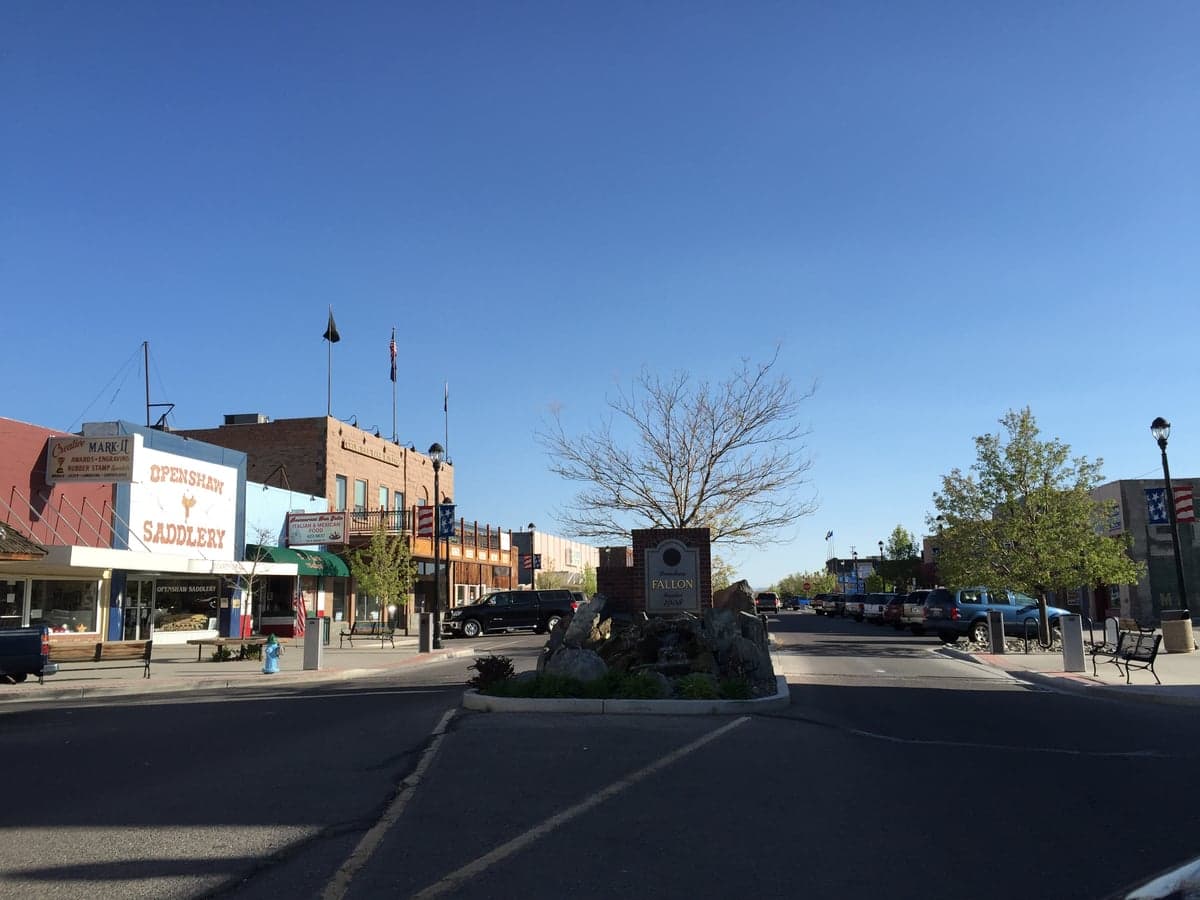
Photo: Wikipedia
Demographics of Fallon, NV
Affluence Level in Fallon, NV
A middle-class area roughly in line with national averages across income, home values, education, and employment.
People of Fallon, NV
The people of Fallon, Nevada, today number 9,371, forming a tight-knit, predominantly white community with a strong agricultural and military heritage. The city’s identity is shaped by its roots as a railroad and farming hub, a role that continues with the nearby Naval Air Station Fallon. With a foreign-born population of just 0.5% and a 72.4% white majority, Fallon remains one of Nevada’s most ethnically homogeneous cities, where a 13.7% Hispanic minority and small Black (3.2%) and East/Southeast Asian (1.8%) communities add modest diversity. The population is notably less college-educated than the national average, at 16.6%, reflecting a workforce centered on agriculture, manufacturing, and military support roles.
How the city was settled and grew
Fallon’s human history begins with the Northern Paiute people, who inhabited the Carson Sink region for centuries before Euro-American settlement. The city itself was founded in 1896, not as a colonial outpost but as a railroad stop on the Nevada–California–Oregon Railway. The original wave of settlers were white homesteaders drawn by the Newlands Reclamation Act of 1902, which brought irrigation to the Lahontan Valley and transformed the arid landscape into productive farmland. These early families—many of German, Irish, and English descent—built the first homes in what is now Oats Park, a historic neighborhood near the downtown core that still contains early 20th-century bungalows and the Oats Park Art Center. A second wave arrived during the Great Depression, when Dust Bowl refugees from Oklahoma and Texas settled in West Fallon, an area west of the railroad tracks that became known for its modest, owner-built homes and strong community ties. By 1950, the population had reached roughly 2,500, almost entirely white and native-born, with a small number of Hispanic laborers working on area ranches.
Modern era (post-1965)
The post-1965 period brought two major demographic shifts. First, the expansion of Naval Air Station Fallon in the 1970s and 1980s drew a small but steady influx of military personnel and their families, many of whom settled in Churchill Estates, a neighborhood of ranch-style homes near the base’s main gate. This military presence introduced a slightly more diverse population, including Black and East/Southeast Asian service members, though their numbers remained small. Second, the growth of the Hispanic community accelerated in the 1990s and 2000s, driven by agricultural labor demand in the region’s alfalfa and dairy operations. These families concentrated in East Fallon, a working-class area along the Stillwater Highway corridor, where a cluster of Hispanic-owned businesses and a Catholic mission church now serve the community. The 2020 Census data shows that while Fallon’s white share has declined from roughly 85% in 1990 to 72.4% today, the city remains far less diverse than Nevada as a whole. The Black population (3.2%) is largely military-affiliated, while the East/Southeast Asian community (1.8%) includes a mix of Navy personnel and a few long-established families in the Downtown Historic District.
The future
Fallon’s population is projected to grow slowly, with the city’s 2024 estimate of 9,371 representing a modest increase from 8,606 in 2010. The Hispanic share is likely to continue rising, potentially reaching 18-20% by 2040, driven by natural increase and continued agricultural labor demand. However, the foreign-born population remains negligible at 0.5%, suggesting that most Hispanic growth comes from U.S.-born families rather than new immigration. The white population is slowly aging and declining in share, but no major influx of other groups is expected. The city is not tribalizing into distinct ethnic enclaves; rather, Hispanic families are gradually integrating into existing neighborhoods like Oats Park and West Fallon, while military families remain transient and concentrated near the base. The biggest wildcard is the potential expansion of the Naval Air Station, which could bring a more diverse, younger population if the base’s role in drone warfare or electronic warfare training grows. For now, Fallon remains a stable, culturally conservative community where newcomers—especially those seeking a quiet, family-oriented lifestyle—will find a welcoming but homogeneous environment.
For a conservative-leaning mover, Fallon offers a predictable, low-crime, and community-oriented setting where the population is largely native-born, English-speaking, and rooted in agricultural and military traditions. The city is not becoming more diverse in a dramatic way, but the Hispanic community is a growing and integrated presence. The key takeaway: Fallon is a place where demographic change is slow and gradual, and where a newcomer can expect to find a population that values self-reliance, neighborliness, and a slower pace of life.

* Values derived from national, state, county, city and local statistics and may differ in a specific area. Last updated: 2026-04-24T14:07:16.000Z
Narrative content on this page is AI-generated and may contain mistakes. Verify any details that matter before acting on them.
ReloMaps may earn a commission from affiliate links at no extra cost to you.

