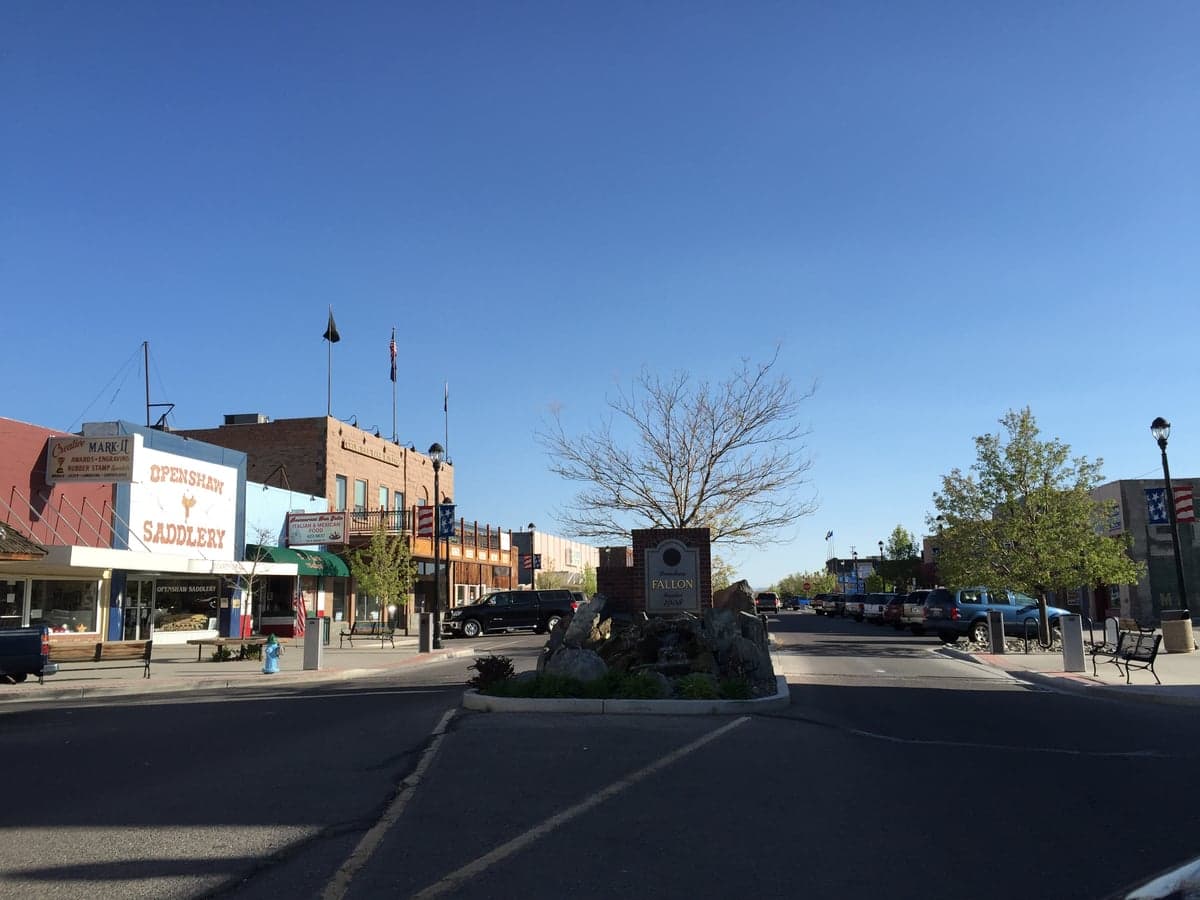
Photo: Wikipedia
Political ClimatePolitical Climate in Fallon, NV
District shown is the primary district for this city’s centroid. Cities may span multiple districts.
Local Political AnalysisPolitical Analysis of Fallon, NV
Fallon, Nevada, has long been a rock-solid conservative community, and that hasn't changed much despite the waves of change hitting the rest of the state. The Cook PVI rating of R+7 tells you the basics, but it doesn't capture the local feel—this is a place where folks still believe in personal responsibility, limited government, and the Second Amendment without apology. The political trajectory here has been steady, not swinging; if anything, the area has hardened its conservative stance as neighboring Reno and Sparks have drifted leftward. You won't find much appetite for progressive experiments in Churchill County, and that's by design.
How it compares
Drive an hour west to Reno, and you're in a different world politically—Washoe County has been trending blue for years, with its urban core pushing policies on housing mandates and environmental regulations that would never fly out here. To the south, Lyon County (Dayton, Fernley) leans conservative too, but it's more purple around the edges as commuters from the Carson City area bring different sensibilities. Fallon, by contrast, remains a bastion of traditional values. The contrast is starkest during election cycles: while Reno ballots are thick with progressive bond measures and zoning overrides, Churchill County voters consistently reject tax hikes and keep local government lean. The surrounding rural areas—like Lovelock to the north—are even more conservative, but Fallon is the economic hub, so its politics set the tone for the whole region.
What this means for residents
For those living here, the political climate translates into a daily life with fewer government intrusions. You won't see the kind of overreach that's become common in bigger Nevada cities—no sweeping mask mandates that drag on for months, no heavy-handed business closure orders, and no local ordinances that treat property owners like tenants. The county commission and school board are filled with folks who genuinely believe in local control, which means decisions stay close to home. That said, there's a quiet concern among long-time residents that the state legislature in Carson City keeps trying to chip away at local autonomy, especially on land use and water rights. The feeling is that as long as Fallon stays engaged and votes its conscience, the community can hold the line against the progressive agenda that's creeping out of the urban corridors.
Culturally, Fallon stands apart in a few key ways that reflect its political DNA. The annual Hearts O' Gold Cantaloupe Festival isn't just a celebration of agriculture—it's a reminder that this is a working community, not a bedroom suburb for tech transplants. Gun rights are exercised openly and without stigma; you'll see pickup trucks with NRA stickers and "Don't Tread on Me" plates, and nobody bats an eye. The local paper, the Lahontan Valley News, still runs editorials that sound like they were written in 1985, which is either refreshing or frustrating depending on your view. Policy-wise, the biggest distinction is the county's approach to federal land management: there's a deep skepticism of BLM overreach, and local leaders have pushed back hard on any proposal that would restrict grazing or mining access. Looking ahead, the concern is that if Reno's growth continues spilling east along I-80, Fallon could eventually face the same kind of demographic pressure that turned places like Douglas County more purple. But for now, this is still a place where a conservative can breathe easy, and the political culture reflects that every day.

State Political ClimatePolitical Climate in Nevada
State Political AnalysisPolitical Environment in the State
Nevada is a classic swing state with a libertarian streak, but it’s been drifting leftward for two decades. The Silver State voted for the Democratic presidential candidate in every election since 2008, and while the margins have tightened—Biden won by just 2.4 points in 2020—the state’s growing urban centers in Clark County (Las Vegas) and Washoe County (Reno) now reliably outweigh the deeply conservative rural counties. The old “live and let live” ethos that once defined Nevada is being tested by progressive policy pushes, and the state’s political identity is more fractured than ever.
Urban vs. rural divide
The political map of Nevada is a tale of two worlds. Clark County, home to nearly three-quarters of the state’s population, is the Democratic engine. Las Vegas, Henderson, and North Las Vegas deliver massive vote margins for Democrats, driven by a diverse, union-heavy workforce (Culinary Union Local 226 is a powerhouse) and a growing Latino population. Washoe County, anchored by Reno and Sparks, has flipped from a traditional swing county to reliably Democratic in recent cycles—Biden carried it by 6 points in 2020. Meanwhile, the rural “cow counties” like Elko, Nye, and White Pine vote Republican by 30-40 point margins. Lyon County, just east of Reno, is a notable exception: it’s ruby red and growing fast with conservative refugees from California. The divide isn’t just urban vs. rural—it’s also suburban vs. exurban. Henderson, once a conservative stronghold, has shifted purple as younger families and Californians move in, while places like Pahrump (Nye County) remain fiercely libertarian and anti-government.
Policy environment
Nevada’s policy landscape is a mixed bag for conservatives. On the plus side, there’s no state income tax, which is a major draw for high-earners and retirees. Property taxes are capped by the “Nevada Plan,” keeping them relatively low compared to California or Oregon. But the regulatory posture is increasingly progressive. The state has a near-total abortion access law (SB 231, 2023), no right-to-work law (union membership is mandatory in many construction and hospitality jobs), and a growing list of green energy mandates—NV Energy, the dominant utility, is required to source 50% of its electricity from renewables by 2030. Education policy is a sore spot: Nevada ranks near the bottom nationally in K-12 outcomes, yet the state legislature has resisted school choice expansion, killing a universal ESA bill in 2023. Election laws are relatively loose—no voter ID requirement, automatic voter registration at DMVs, and universal mail-in ballots (a pandemic-era change made permanent in 2021). For a conservative, the policy environment feels like a slow creep toward California-lite, with the tax advantage being the main remaining draw.
Trajectory & freedom
Nevada’s trajectory on personal freedom is a tale of two trends. On the positive side, gun rights remain strong: Nevada is a shall-issue state for concealed carry, with no permit required for open carry, and a 2023 law (SB 171) actually expanded firearm preemption, preventing local governments from passing their own gun bans. But the state has also moved to restrict personal liberty in other areas. The 2020 “Question 2” vote legalized recreational marijuana, which most conservatives see as a net positive for freedom, but the regulatory framework is heavy—licenses are capped and expensive, creating a cartel-like system. More concerning is the 2021 law (AB 261) that banned “conversion therapy” for minors, which some conservatives view as an infringement on parental rights. The state also passed a “red flag” law (SB 143) in 2023, allowing courts to temporarily seize firearms from individuals deemed a threat—a policy many gun owners see as a slippery slope. On the whole, Nevada is becoming less free in the traditional sense: the state government is expanding its reach into healthcare, education, and family decisions, while the tax advantage remains the lone bulwark against full-blown progressive governance.
Civil unrest & political movements
Nevada has seen its share of political flashpoints. The 2020 election integrity controversy was intense: Clark County’s mail-in ballot processing was plagued by logistical chaos, and the state GOP filed multiple lawsuits over signature verification and observer access. The “Stop the Steal” movement had a strong presence in rural counties, with rallies in Elko and Carson City. On the left, the Culinary Union has been a dominant force, organizing massive protests against the 2023 “room cleaning” bill (AB 129) that required daily hotel room service—a rare instance of labor clashing with environmentalist allies. Immigration politics are a constant undercurrent: Nevada has a “sanctuary” law (SB 223, 2019) that limits local police cooperation with ICE, which has sparked backlash in conservative areas like Mesquite and Boulder City. The “Battle Born” libertarian streak still runs deep—you’ll see “Don’t Tread on Me” flags in Pahrump and “Fight the Mandate” signs in rural gas stations—but the organized conservative movement is fragmented, with the state GOP often feuding with the more moderate “Republican establishment” in Reno and Las Vegas.
Projection
Over the next 5-10 years, Nevada is likely to continue its slow leftward drift, but not without resistance. Demographic trends favor Democrats: the state’s population is growing fastest among Latino and Asian communities, who lean Democratic, while the white working-class base in rural areas is shrinking. In-migration from California—which accounts for about 40% of new residents—tends to bring progressive voters, though many are fiscally conservative refugees fleeing high taxes. The wild card is the “exurban revolt”: places like Lyon County, Douglas County, and the outskirts of Clark County (e.g., the “rural Clark” precincts around Searchlight) are filling with conservatives who may eventually tip the balance in state legislative races. If Republicans can hold the state senate and flip a few assembly seats in 2026, they could block further progressive legislation. But the governor’s mansion is likely to remain blue, and the state’s electoral votes will probably stay in the Democratic column for the foreseeable future. A new resident moving in now should expect a state that remains tax-friendly but increasingly interventionist on social and regulatory issues—a place where the “Silver State” freedom is more about your wallet than your lifestyle.
Bottom line for a conservative moving to Nevada: you’ll love the no-income-tax and the gun-friendly laws, but you’ll need to stay politically engaged to prevent the state from sliding further into California-style governance. The urban-rural divide means your experience will vary wildly depending on where you land—Henderson is a purple suburb with good schools and moderate politics, while Pahrump is a libertarian haven with a “leave me alone” vibe. If you’re a parent, be prepared to fight for school choice at the local level, because the state legislature won’t help you. Nevada is still a freer state than most, but the freedom is eroding, and it’ll take active citizenship to keep it that way.
* Values derived from national, state, county, city and local statistics and may differ in a specific area. Last updated: 2026-04-24T14:07:16.000Z
Narrative content on this page is AI-generated and may contain mistakes. Verify any details that matter before acting on them.
ReloMaps may earn a commission from affiliate links at no extra cost to you.

