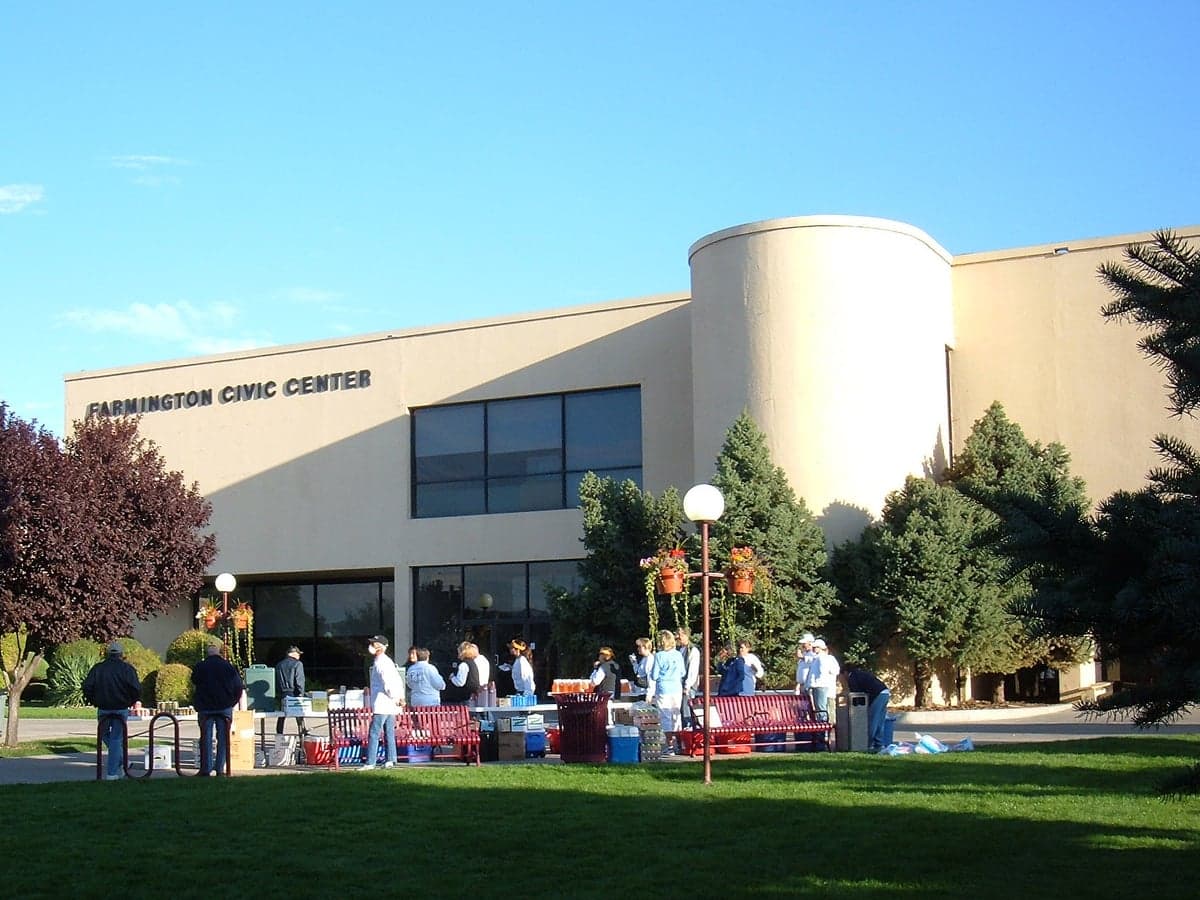
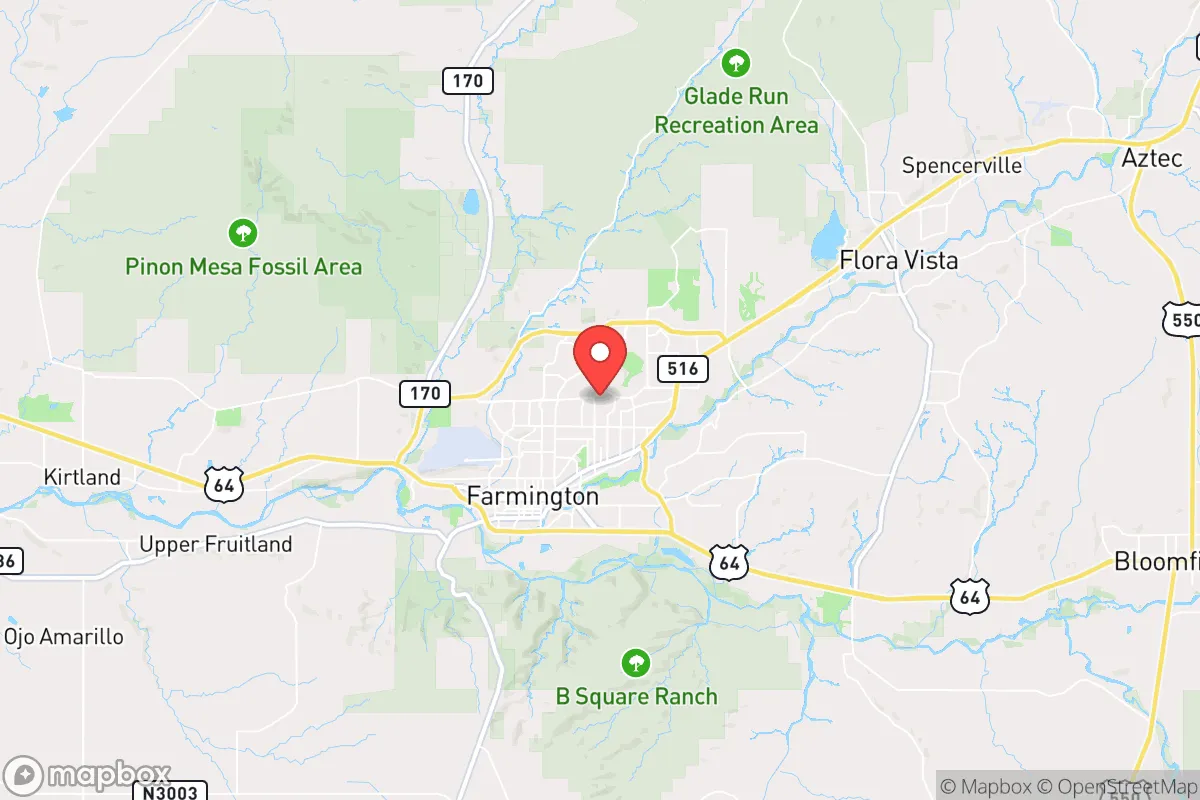
Photo: Wikipedia
Demographics of Farmington, NM
Affluence Level in Farmington, NM
A below-average socioeconomic profile. Incomes, home values, and educational attainment trail the U.S., with higher poverty and unemployment.
People of Farmington, NM
The people of Farmington, New Mexico, today number 46,339 and form a community shaped by a unique blend of Native American, Hispanic, and Anglo heritage, with a notably low foreign-born population of just 1.6%. The city is predominantly White (42.5%) and Hispanic (23.6%), with a small but significant Native American presence tied to the nearby Navajo Nation. Its identity is rooted in energy extraction and trade, and it remains a regional hub for the Four Corners area, characterized by a conservative, family-oriented culture. The college-educated share stands at 22.8%, reflecting a workforce oriented toward skilled trades and energy-sector employment rather than a large professional class.
How the city was settled and grew
Farmington’s population history begins not with Spanish colonization but with the arrival of Anglo-American settlers in the late 19th century, drawn by the promise of irrigated agriculture along the Animas and San Juan Rivers. The town was officially founded in 1901 as a farming and trading outpost, with the first wave of settlers—primarily of Northern European descent—establishing homesteads in what is now the Historic Downtown district. The discovery of oil and natural gas in the 1920s transformed Farmington from a quiet agricultural village into a boomtown, attracting workers from Texas, Oklahoma, and the broader Southwest. These early energy workers settled in neighborhoods like Greenwood and Fairview, which remain predominantly White and middle-class today. The Navajo people, who had long inhabited the surrounding region, began moving into Farmington in larger numbers during the 1930s and 1940s, drawn by employment in the oil fields and later in the coal mines and power plants. They concentrated in the North Farmington area and along the East Main Street corridor, forming a distinct community that remains visible in the city’s demographic map.
Modern era (post-1965)
After the 1965 Immigration and Nationality Act, Farmington did not experience the large-scale immigration seen in many U.S. cities, due to its remote location and energy-based economy. Instead, the post-1965 period saw continued domestic in-migration from other parts of the Southwest, particularly from Texas and Oklahoma, as the energy sector expanded through the 1970s and 1980s. The Hispanic population grew steadily during this era, rising from a small minority to 23.6% today, driven by natural increase and migration from rural New Mexico and northern Mexico. Hispanic families settled primarily in the Southside neighborhood and along Pinon Hills Boulevard, areas that now feature a mix of older homes and newer subdivisions. The East/Southeast Asian community (0.5%) and Indian subcontinent community (0.4%) are very small and largely composed of professionals working in healthcare and engineering at San Juan Regional Medical Center and local energy firms; they are scattered across the city, with no single ethnic enclave. The Black population (0.7%) is similarly tiny and dispersed. The most significant demographic shift since 1965 has been the growth of the Native American population, which now constitutes a substantial share of the city’s residents, many of whom commute from the Navajo Nation or live in the West Farmington area near the tribal border. This group has maintained strong cultural ties while integrating into the local economy, particularly in retail and education.
The future
Farmington’s population is projected to remain stable or grow slowly, with the Hispanic and Native American shares likely increasing as the White population ages and younger families move to larger cities for education and employment. The city is not homogenizing into a single identity but rather tribalizing into distinct enclaves: the White population remains concentrated in Greenwood and Fairview, Hispanic families in Southside and Pinon Hills, and Native American residents in North Farmington and West Farmington. The foreign-born population is expected to remain very low, as the city lacks the economic diversity to attract significant international immigration. The East/Southeast Asian and Indian subcontinent communities are likely to remain small and assimilated, with no signs of forming ethnic neighborhoods. The next 10–20 years will likely see continued outmigration of college-bound youth, keeping the college-educated share below 25%, while the energy sector’s volatility may slow or reverse population growth. The city’s demographic future is one of gradual diversification within a conservative, resource-dependent framework.
For someone moving to Farmington now, the city offers a stable, family-oriented environment with a strong sense of place rooted in its energy and Native American heritage. The population is becoming more Hispanic and Native American, but remains overwhelmingly U.S.-born and culturally conservative. New residents should expect a community where neighborhoods are defined by ethnicity and economic status, and where the pace of change is slow. This is not a melting pot but a mosaic of distinct groups living side by side, with the energy industry as the common thread.

* Values derived from national, state, county, city and local statistics and may differ in a specific area. Last updated: 2026-05-01T06:34:18.000Z
Narrative content on this page is AI-generated and may contain mistakes. Verify any details that matter before acting on them.
ReloMaps may earn a commission from affiliate links at no extra cost to you.

