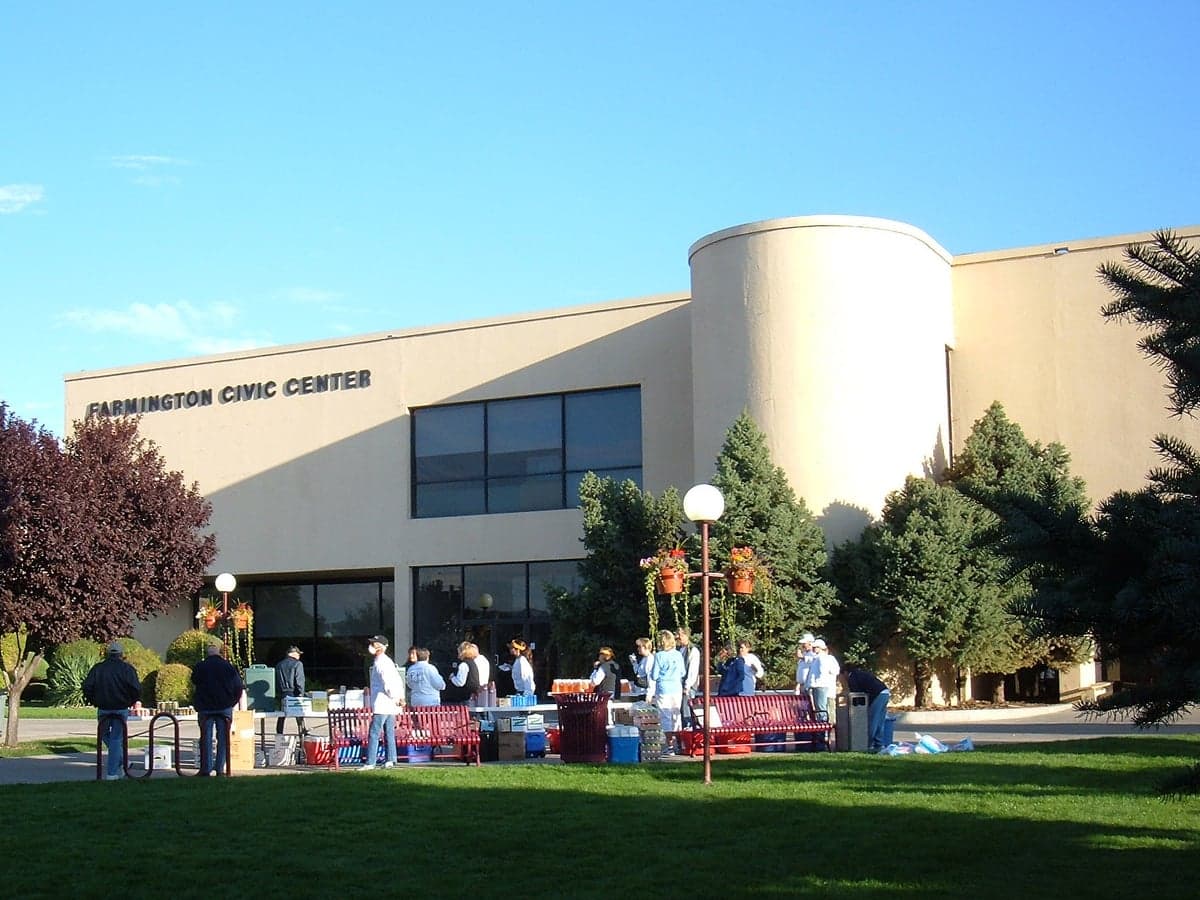
Photo: Wikipedia
Strategic Assessment of Farmington, NM
Workable tactical position. Some exposure to population density or targets, but generally defensible in a crisis.
What does the Strategic Assessment tell us?
Our Strategic Assessment grades tactical survivability of an area. Major population centers, military targets, fallout zones, natural disasters, and border exposure all drive risk — lower exposure means a more defensible position in a crisis.
This is heavily inspired by Joel Skousen's Strategic Relocation book. Highly recommended you checkout the book ($)What does this tell us?
Our Strategic Assessment grades tactical survivability of an area. Major population centers, military targets, fallout zones, natural disasters, and border exposure all drive risk — lower exposure means a more defensible position in a crisis.
This is heavily inspired by Joel Skousen's Strategic Relocation book. Highly recommended you checkout the book ($)Strategic Pillars

Key Distances
Regional Safe Places
Below is our recommended "safe zones" in New Mexico and the surrounding area based on our strategic heuristics. For most people, it's unrealistic to live in a “safe zone” full-time due to work, family or other personal reasons. They tend to be more rural. However, many of these areas are perfect for second homes and retreat properties that double as a vacation home or even a short-term rental.

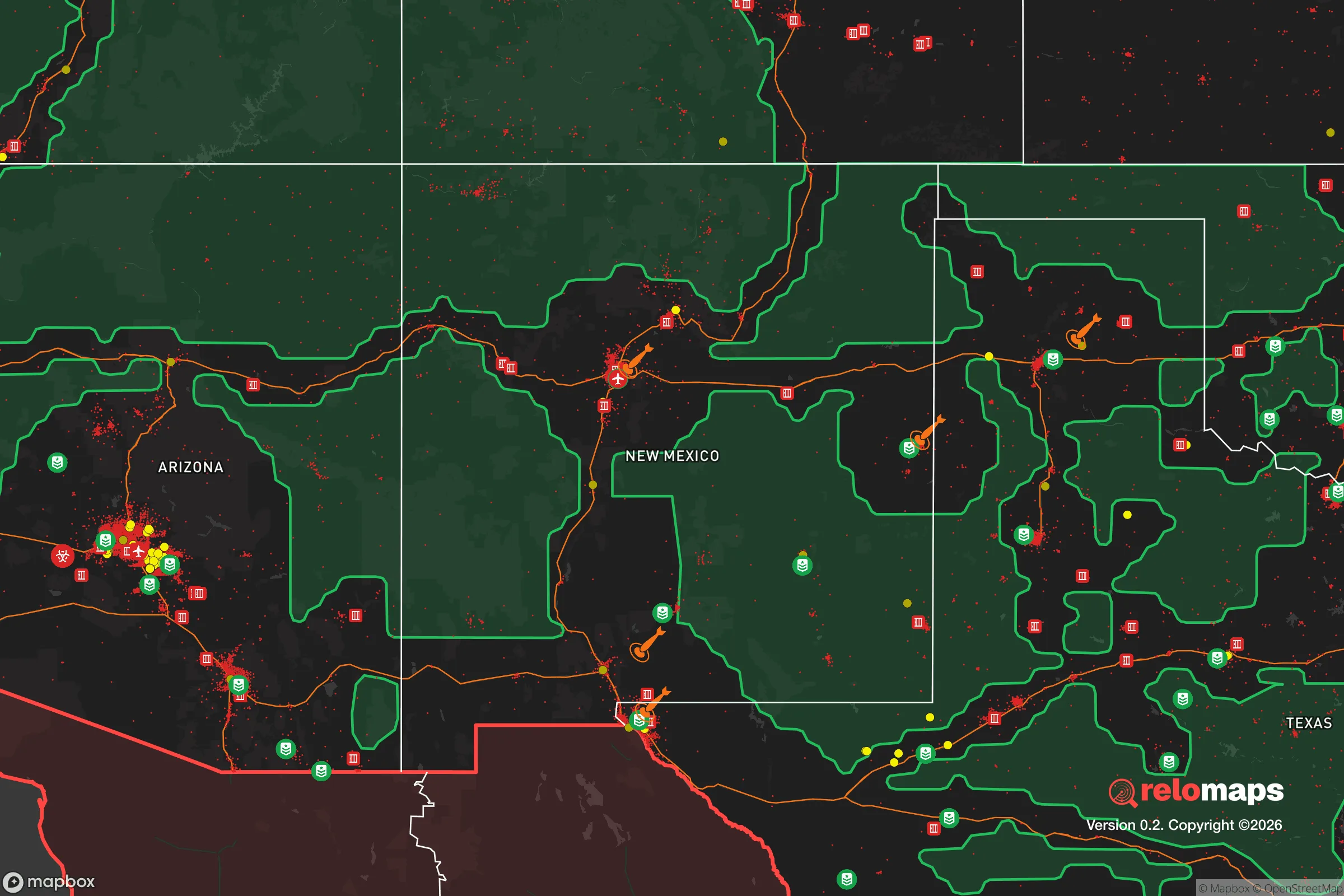


Important Note: For informational purposes only. This does not mean nothing bad ever happens in the green zones. Please use common sense. This is based on public data and modeled with AI. We tried to take a conservative approach but mistakes happen. We update this regularly as new information becomes available.
Solar Generator Recommendations
Backup power matters more here than in safer locations. We've picked three solar generators across budgets and capacity tiers — start with the budget unit if you only need a few essentials, or step up if you want to run a fridge and HVAC for days at a time.

Jackery Portable Power Station Explorer 300
Budget OptionPower on the Go: Weighing only 11 lbs, it's convenient to set up and store with book-sized foldable solar panels

BLUETTI Portable Power Station AC180
Designed for both indoor and outdoor scenarios, AC180 is highly capable as it has a robost capacity and continuous output power.

EF ECOFLOW DELTA Pro Ultra Power Station
Upgraded PickEcoFlow DELTA Pro Ultra is a whole-home energy system designed to grow with your family. Integrated with the Smart Home Panel 2, it scales to meet your evolving energy needs — keeping your home powered, intelligent, and secure through every stage of life.
We earn a commission, at no additional cost to you.
Strategic Assessment Analysis
Farmington, New Mexico, sits in a geographic sweet spot that offers genuine strategic depth for those thinking long-term about resilience, but it comes with trade-offs that demand clear-eyed assessment. Located in the Four Corners region at the junction of Colorado, Arizona, Utah, and New Mexico, this town of roughly 45,000 people is far enough from major population centers to avoid the immediate chaos of a cascading urban collapse, yet close enough to critical infrastructure and natural resources to sustain a self-reliant lifestyle. The area’s historical boom-and-bust cycles—driven by oil, gas, and coal—have forged a population that’s accustomed to hard times and self-sufficiency, which is a cultural asset you can’t buy. For a conservative-leaning relocator worried about civic unrest, supply chain disruptions, or larger national instability, Farmington offers a plausible base of operations, but only if you understand its specific vulnerabilities and plan accordingly.
Geographic position and natural advantages for long-term security
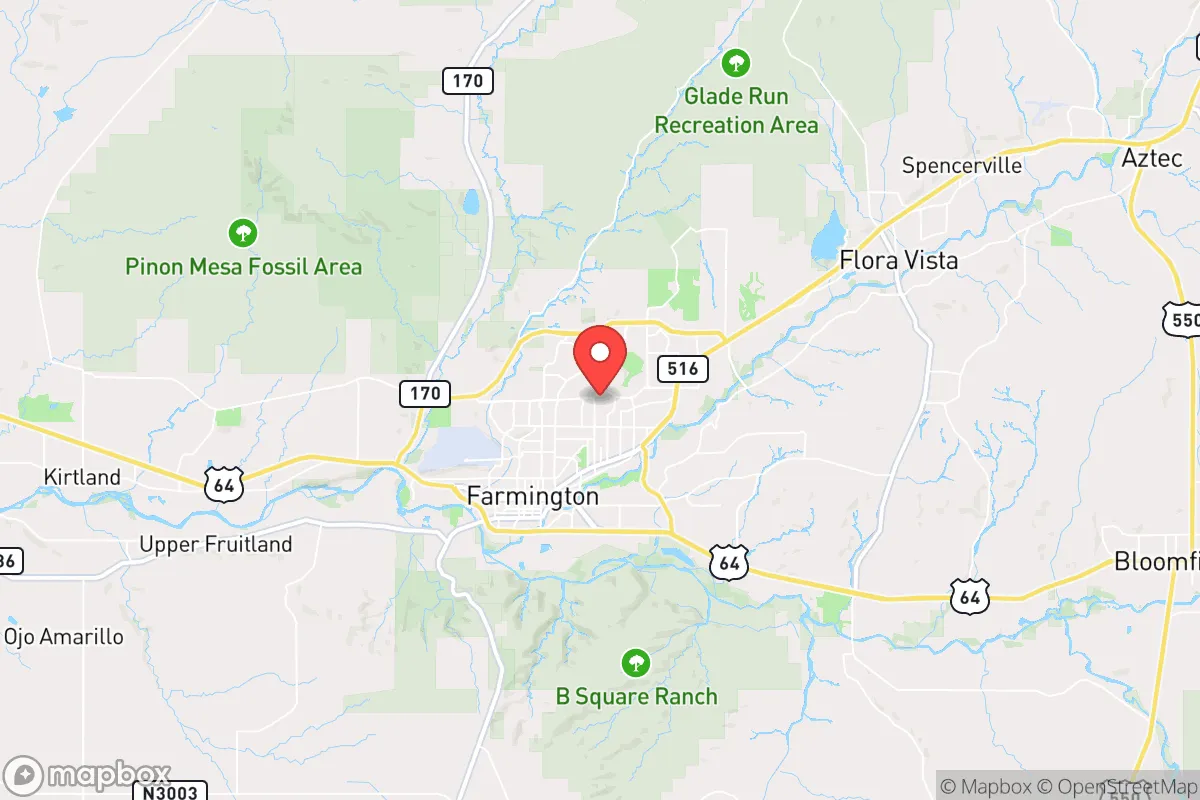
Farmington’s location is its strongest card. It sits in the San Juan River Valley, surrounded by the high desert mesas of the Colorado Plateau, which provides natural barriers to large-scale movement and surveillance. The nearest major metro areas—Albuquerque (180 miles south), Denver (350 miles northeast), and Salt Lake City (400 miles northwest)—are far enough that a sudden evacuation or unrest in those cities won’t spill over quickly. The Four Corners region is sparsely populated, with San Juan County averaging only about 12 people per square mile, giving you breathing room that suburban or coastal areas simply cannot offer. The San Juan River itself is a perennial water source—rare in the arid Southwest—and the area sits atop the San Juan Basin, one of the largest natural gas fields in the country. For someone thinking about energy independence, that’s a serious advantage: natural gas is abundant, and the local infrastructure for extraction and distribution is already in place. The high desert climate also means fewer natural disasters like hurricanes, tornadoes, or earthquakes, though wildfires and drought are recurring concerns. The elevation (roughly 5,500 feet) keeps summers moderate and winters cold but manageable, which is a plus for long-term habitation without the extreme heat stress that plagues lower desert locations.
Risks, exposures, and proximity to fallout-relevant landmarks
No strategic assessment is honest without flagging the liabilities. Farmington’s biggest exposure is its proximity to the San Juan Generating Station, a coal-fired power plant that is now being decommissioned and converted to natural gas and solar. While the plant itself isn’t a nuclear target, the broader Four Corners region has a history of uranium mining and milling, and there are legacy waste sites—like the Shiprock mill site about 30 miles west—that could become secondary hazards in a major disaster. More critically, the area is within 100 miles of the Los Alamos National Laboratory and the Waste Isolation Pilot Plant (WIPP) near Carlsbad, both of which are potential targets in a conflict scenario. Los Alamos, in particular, is a high-value nuclear research facility; a strike or accident there could produce fallout patterns that affect the San Juan Basin depending on wind direction. Farmington is also near the Navajo Nation, which has its own complex infrastructure and governance challenges—during a breakdown, the area could see population movement from the reservation toward town, straining resources. The local economy’s heavy reliance on fossil fuels means that a prolonged economic collapse or energy transition could hit hard, though for a prepper, that same infrastructure (pipelines, storage, local refineries) is a resource, not a liability. The key takeaway: Farmington is not a zero-risk location, but its risks are primarily industrial and economic, not the immediate blast-and-fire dangers of a major city.
Practical resilience for a relocator: food, water, energy, and defensibility
For someone serious about self-reliance, Farmington checks several critical boxes. Water is the non-negotiable, and the San Juan River provides a reliable surface water source that can be treated with basic filtration or boiling. Groundwater in the area is generally good, though some wells in the basin have naturally occurring arsenic or uranium, so testing is mandatory. The growing season is short (about 120 days) but workable for cold-hardy crops like potatoes, beans, squash, and leafy greens, and the local soil, while alkaline, can be amended. There are active farmers’ markets and a handful of local growers, but the area is not a breadbasket—you’ll need to plan for food storage and possibly greenhouse production to extend the season. Energy is where Farmington shines: natural gas is cheap and plentiful, and the region has strong solar potential (over 300 sunny days per year). A combination of solar panels with a natural gas backup generator would give you near-total energy independence. The local topography—mesas, arroyos, and canyonlands—offers natural defensibility; a well-chosen property on a mesa with a single access road can be secured with minimal effort. The population is politically conservative, gun-friendly, and accustomed to outdoor living, which means you’ll find like-minded neighbors and a culture that doesn’t look sideways at stockpiling supplies or owning firearms. The San Juan Regional Medical Center is a capable Level III trauma center, but for serious care, you’re looking at a 3-4 hour drive to Albuquerque or Durango—so medical self-sufficiency (training, supplies, telemedicine capability) is a must. Internet and cellular coverage are decent in town but spotty in the surrounding rural areas, which cuts both ways: it’s a privacy advantage but a communication liability.
The overall strategic picture for Farmington is that of a solid B-tier relocation option for the conservative prepper—not a paradise, but a workable base with real assets and manageable liabilities. It lacks the agricultural depth of the Midwest or the water security of the Pacific Northwest, but it offers a combination of energy abundance, low population density, and cultural alignment that is increasingly rare. The biggest wildcards are the proximity to Los Alamos and the economic fragility of a single-industry town, but those are calculable risks that can be mitigated with proper planning—distance, shielding, and diversified income streams. For a single individual or a family willing to invest in infrastructure (water catchment, solar, greenhouse, security), Farmington provides a defensible, resource-rich position that is far enough from the fray to survive the initial shock of a national crisis, yet connected enough to rebuild afterward. It’s not a bug-out location for the faint of heart—it’s a long-term homestead for those who understand that resilience is built, not found.

* Values derived from national, state, county, city and local statistics and may differ in a specific area. Last updated: 2026-05-01T06:34:18.000Z
Narrative content on this page is AI-generated and may contain mistakes. Verify any details that matter before acting on them.
ReloMaps may earn a commission from affiliate links at no extra cost to you.

