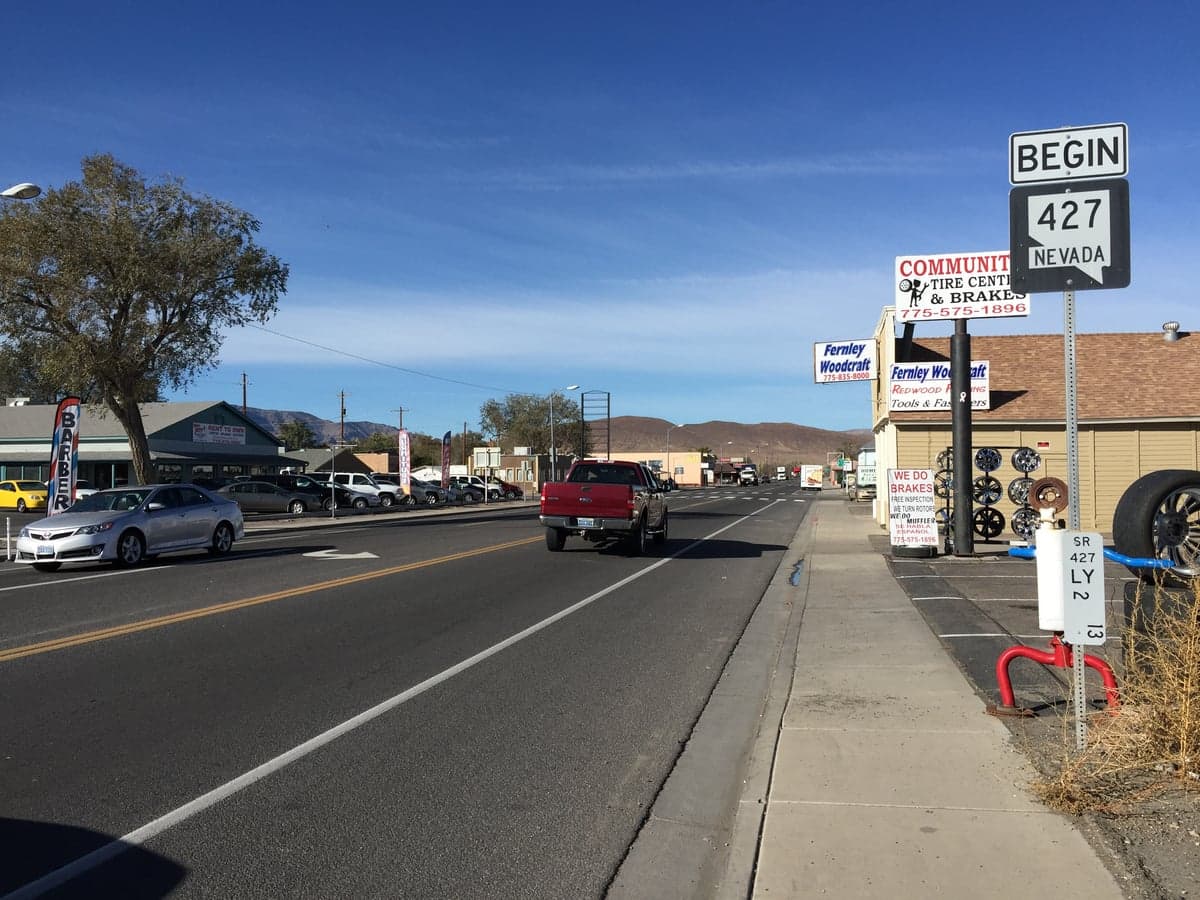
Photo: Wikipedia
Demographics of Fernley, NV
Affluence Level in Fernley, NV
A middle-class area roughly in line with national averages across income, home values, education, and employment.
People of Fernley, NV
The people of Fernley, Nevada today number 23,631, forming a predominantly white (68.8%) and Hispanic (19.1%) community with a notably low foreign-born share of just 3.3%. The city carries a distinct working-class, family-oriented character shaped by its railroad and agricultural roots, with only 15.6% of adults holding a college degree. Residents are concentrated in a mix of older central neighborhoods and newer master-planned subdivisions, giving Fernley a feel of a small town that is rapidly absorbing commuters from the Reno-Sparks metro area 30 miles west.
How the city was settled and grew
Fernley’s human history begins not with a mining rush but with the railroad. The Southern Pacific Railroad established a station and rail yard here in the early 1900s, drawing a first wave of workers—primarily white laborers from the Midwest and Great Plains, along with a small number of Chinese railroad workers who built and maintained the tracks. The town was formally platted in 1904, and the original settlement clustered around what is now the Downtown Fernley district, along Main Street and the rail corridor. These early residents lived in modest wood-frame houses, many of which still stand in the Old Town area near the railroad tracks. The Newlands Reclamation Act of 1902 brought irrigation to the surrounding Truckee River basin, and by the 1910s, farmers—many of them second-generation European immigrants from Germany, Ireland, and Italy—had taken up land in the Fernley Agricultural District south of the rail line, growing alfalfa, hay, and livestock. A small but stable Hispanic population began arriving in the 1920s and 1930s, working as farm laborers and settling in the West Side neighborhood, a historically working-class area west of the railroad underpass. Through the mid-20th century, Fernley remained a quiet railroad-and-farming town of fewer than 2,000 people, with little ethnic diversity beyond the white majority and a modest Hispanic minority.
Modern era (post-1965)
The post-1965 period brought two major shifts. First, the Hart-Cellar Immigration Act of 1965 did not dramatically alter Fernley’s demographics because the city was not a primary destination for new immigrants; the foreign-born share remains very low at 3.3%. Instead, the city’s modern growth has been driven overwhelmingly by domestic in-migration from California and other western states. Beginning in the 1990s and accelerating after 2000, Fernley became a bedroom community for Reno and Sparks, attracting white and Hispanic families seeking cheaper housing and larger lots. This wave settled primarily in the Vista Grande subdivision (north of I-80) and the Fernley Hills master-planned community, both built from the late 1990s onward. These neighborhoods are overwhelmingly white and Hispanic, with very small Black (1.3%) and East/Southeast Asian (1.7%) populations. The Indian-subcontinent community is negligible at 0.1%. The Hispanic population grew from roughly 8% in 1990 to 19.1% today, concentrated in the older West Side and in the newer Vista Grande tracts, where many families work in construction, warehousing, and logistics. The white population, while still the majority, has seen its share decline from over 85% in 1990 to 68.8% today, largely due to Hispanic in-migration rather than white out-migration. The Black and Asian communities remain tiny and scattered, with no distinct ethnic enclaves.
The future
Fernley’s population is heading toward a gradual homogenization around a white-Hispanic axis, with little growth in other racial or ethnic groups. The foreign-born share is unlikely to rise significantly given the city’s lack of immigrant-attracting industries or ethnic networks. The Hispanic population is expected to continue growing, possibly reaching 25-30% by 2040, driven by natural increase and continued domestic migration from California. However, this growth is not producing tribalization into separate enclaves; instead, Hispanic and white residents increasingly share the same subdivisions, schools, and civic life. The Downtown Fernley and Old Town areas are seeing modest reinvestment but remain predominantly white and older. The Fernley Agricultural District is slowly being subdivided for housing, which will likely accelerate the commuter character of the city. The college-educated share, at 15.6%, is well below the national average and is unlikely to rise quickly, as Fernley continues to attract blue-collar and service-sector workers priced out of Reno. No significant immigrant community from East Asia, South Asia, or the Middle East is emerging.
For someone moving in now, Fernley is becoming a more Hispanic-influenced but still overwhelmingly white, working-class commuter town. It is not diversifying in the broad sense—it is becoming a two-group city of white and Hispanic families, with minimal representation from other groups. The neighborhoods to watch are Vista Grande and Fernley Hills, where most new arrivals land, while Old Town and the West Side retain the city’s historic character. The bottom line: Fernley is a stable, family-oriented community where demographic change is slow and incremental, not disruptive.

* Values derived from national, state, county, city and local statistics and may differ in a specific area. Last updated: 2026-04-30T01:27:57.000Z
Narrative content on this page is AI-generated and may contain mistakes. Verify any details that matter before acting on them.
ReloMaps may earn a commission from affiliate links at no extra cost to you.

