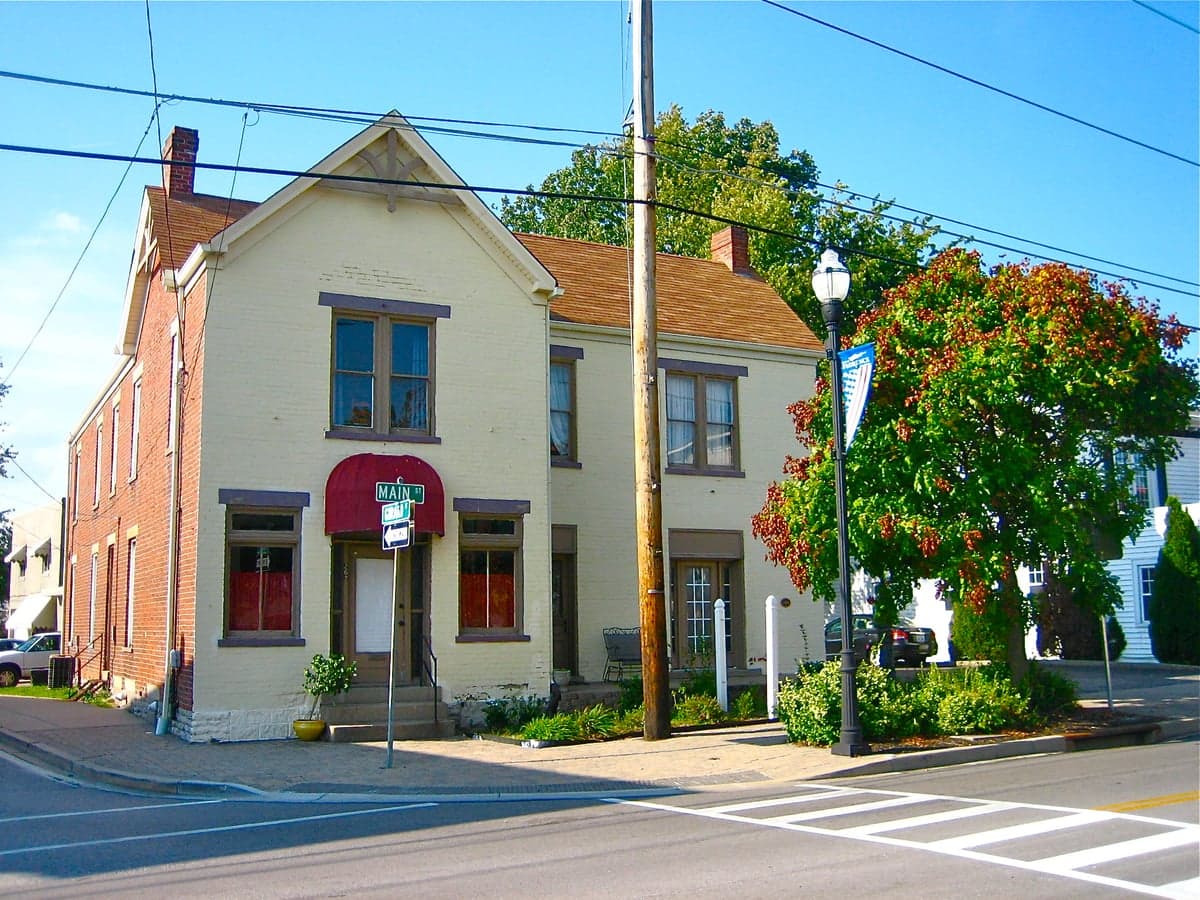
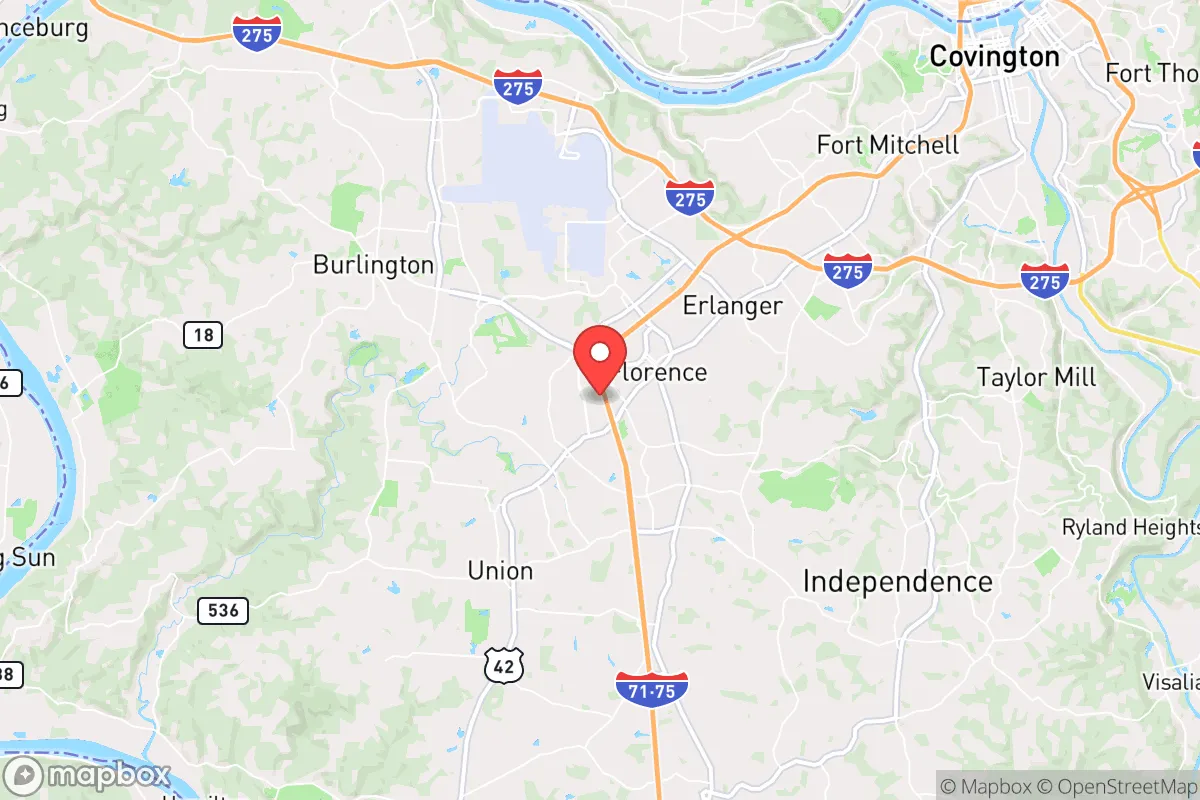
Photo: Wikipedia
Strategic Assessment of Florence, KY
Meaningful friction. Expect exposure to either population pressure, blast zones, or natural disaster risk. Consider buying a retreat property.
What does the Strategic Assessment tell us?
Our Strategic Assessment grades tactical survivability of an area. Major population centers, military targets, fallout zones, natural disasters, and border exposure all drive risk — lower exposure means a more defensible position in a crisis.
This is heavily inspired by Joel Skousen's Strategic Relocation book. Highly recommended you checkout the book ($)What does this tell us?
Our Strategic Assessment grades tactical survivability of an area. Major population centers, military targets, fallout zones, natural disasters, and border exposure all drive risk — lower exposure means a more defensible position in a crisis.
This is heavily inspired by Joel Skousen's Strategic Relocation book. Highly recommended you checkout the book ($)Strategic Pillars

Key Distances
Regional Safe Places
Below is our recommended "safe zones" in Kentucky and the surrounding area based on our strategic heuristics. For most people, it's unrealistic to live in a “safe zone” full-time due to work, family or other personal reasons. They tend to be more rural. However, many of these areas are perfect for second homes and retreat properties that double as a vacation home or even a short-term rental.
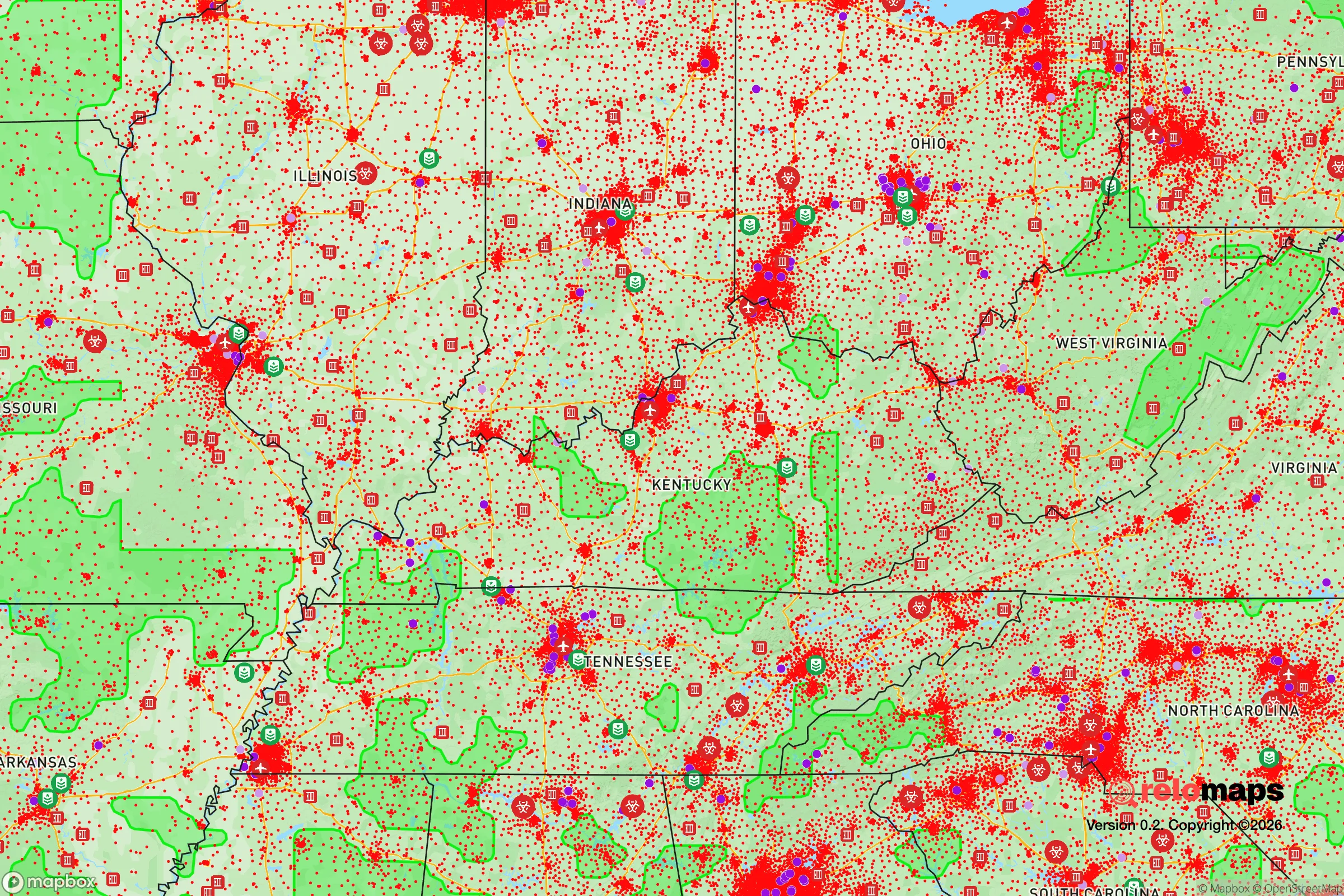
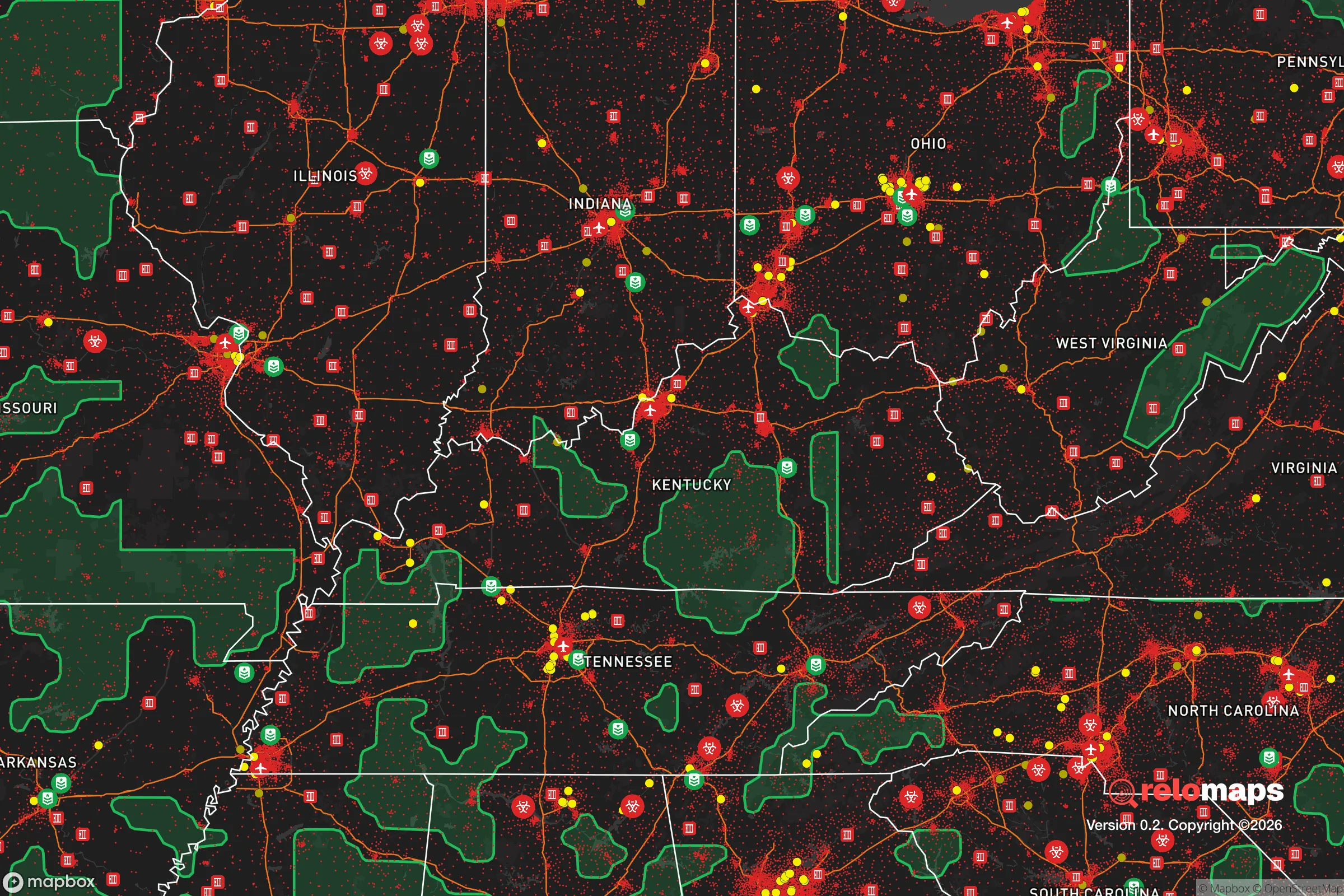


Important Note: For informational purposes only. This does not mean nothing bad ever happens in the green zones. Please use common sense. This is based on public data and modeled with AI. We tried to take a conservative approach but mistakes happen. We update this regularly as new information becomes available.
Solar Generator Recommendations
Backup power matters more here than in safer locations. We've picked three solar generators across budgets and capacity tiers — start with the budget unit if you only need a few essentials, or step up if you want to run a fridge and HVAC for days at a time.

Jackery Portable Power Station Explorer 300
Budget OptionPower on the Go: Weighing only 11 lbs, it's convenient to set up and store with book-sized foldable solar panels

BLUETTI Portable Power Station AC180
Designed for both indoor and outdoor scenarios, AC180 is highly capable as it has a robost capacity and continuous output power.

EF ECOFLOW DELTA Pro Ultra Power Station
Upgraded PickEcoFlow DELTA Pro Ultra is a whole-home energy system designed to grow with your family. Integrated with the Smart Home Panel 2, it scales to meet your evolving energy needs — keeping your home powered, intelligent, and secure through every stage of life.
We earn a commission, at no additional cost to you.
Strategic Assessment Analysis
Florence, Kentucky, sits in a strategic sweet spot that few relocation analysts fully appreciate: close enough to Cincinnati’s economic engine to sustain jobs and infrastructure, yet far enough from the urban core to offer genuine buffer from the cascading failures that follow a major crisis. This Boone County hub benefits from the Ohio River’s water resources, a robust local food supply chain, and a conservative-leaning population that tends to keep to itself. For a relocator thinking in terms of decades, not just next year’s commute, Florence presents a defensible base with real resilience—provided you understand its specific vulnerabilities and plan accordingly.
Geographic position and natural advantages for long-term security
Florence’s location at the intersection of I-71, I-75, and the Kentucky/Ohio border gives it exceptional logistical reach in normal times, but the real value for a prepper is what lies beyond the interstates. The area sits atop the Ohio River Valley aquifer, a deep groundwater system that provides reliable well water even if municipal treatment plants go offline. The surrounding Boone, Kenton, and Grant counties are over 60% agricultural land, meaning local food production isn’t a theoretical exercise—it’s the dominant land use. You’re within a 20-minute drive of dozens of working farms, many of which sell direct to consumers through CSAs and farm stands. The terrain is rolling hills with hardwood forest cover, offering natural concealment and defensible positions for rural properties within 10-15 miles of Florence’s commercial core. Unlike flat, open plains, this landscape gives you options for retreat without leaving your supply network entirely.
The climate is temperate four-season, which avoids the extreme heat stress of the Deep South and the brutal winters of the Upper Midwest. Average annual rainfall is around 44 inches, enough to support rain catchment systems without the flooding risk of coastal zones. The Ohio River itself is a double-edged asset: it provides a massive freshwater source and barge transport corridor, but it also concentrates industrial infrastructure that could become a target. Smart relocators will orient themselves toward the tributary creeks and smaller watersheds north and west of Florence, away from the river’s main industrial banks.
Risks, exposures, and proximity to fallout-relevant landmarks
No honest strategic assessment can ignore Florence’s proximity to high-value targets. Cincinnati’s urban core lies just 12 miles north, and the metro area contains a major international airport (CVG), multiple rail yards, a large inland port complex, and several chemical storage facilities along the Ohio River. In a mass casualty event or civil unrest scenario, these become choke points and potential contamination zones. The I-75 corridor, which runs directly through Florence, would likely be a primary evacuation route and could become impassable during a crisis. Florence itself hosts a large retail and logistics hub—the Florence Mall area and surrounding distribution centers—that could attract looting or become a staging ground for displaced populations.
There are also two nuclear power plants within a 50-mile radius: the William H. Zimmer Generating Station (about 25 miles northeast, now a natural gas plant but with legacy spent fuel storage) and the Clermont County nuclear plant (about 30 miles east, decommissioned but with ongoing waste storage). While neither is an active reactor, the spent fuel pools and dry cask storage represent a persistent radiological risk in the event of a direct attack or major accident. More concerning is the Port of Cincinnati complex, which handles hazardous materials including anhydrous ammonia and chlorine—a single railcar breach could create a toxic plume affecting downwind areas including parts of Boone County. The prevailing winds are from the southwest, which means Florence is generally upwind of the worst industrial hazards, but a shift during a release event would put the entire area at risk.
Practical resilience for a relocator: food, water, energy, and defensibility
For a single individual or family serious about preparedness, Florence offers a workable mix of suburban convenience and rural access. Water is the strongest asset. The Ohio River is a massive, year-round source, and the underlying aquifer means private wells are viable even in subdivisions. Many homes in the outer parts of Boone County already have wells and septic systems, which is a major resilience advantage over city water-dependent suburbs. For those buying property, prioritize lots with existing well permits or at least 2-3 acres for a drilled well installation. Rainwater collection is legal in Kentucky with no state-level restrictions, and the average roof on a 2,000-square-foot home can capture over 1,000 gallons per month during wet seasons.
Food security is above average for a suburban area. Northern Kentucky has a strong network of small-scale livestock operations, and the Boone County Farmers Market operates year-round. Within a 30-minute drive, you can access multiple processors for beef, pork, and poultry, as well as grain mills and bulk food co-ops. The local Amish and Mennonite communities in nearby Grant and Pendleton counties provide a decentralized food production network that operates outside the industrial supply chain. For long-term storage, the climate is dry enough in summer to support root cellaring and cool enough in winter for extended pantry storage without refrigeration.
Energy resilience is a mixed picture. Duke Energy provides grid power with moderate reliability—outages typically last a few hours after storms, not days. But the area has good solar potential, with about 200 sunny days per year, and net metering is available through Duke. For off-grid capability, a 5-10 kW solar array with battery storage can cover a typical home’s critical loads. Natural gas is widely available in the suburban core, which is useful for heating and cooking during grid outages, but propane tanks are the better bet for rural properties since they don’t depend on pipeline pressure. Defensibility is where Florence requires honest assessment. The suburban subdivisions offer little natural cover and are vulnerable to roaming groups. The strategic play is to buy on the periphery—within 5-10 miles of Florence’s commercial resources but on a dead-end road or cul-de-sac with a single access point. Properties with tree lines, creek boundaries, or hilltop positions provide natural observation and chokepoints. The local sheriff’s office is well-funded and generally responsive, but in a widespread crisis, you cannot rely on law enforcement for perimeter security.
The overall strategic picture for Florence is cautiously favorable for a relocator with a prepper mindset. It offers genuine water abundance, local food production capacity, and a conservative population that is unlikely to collapse into chaos at the first sign of trouble. The proximity to Cincinnati is a real liability—any major event at the port, airport, or industrial corridor will send ripple effects southward. But if you choose your property wisely (rural edge, well water, defensible access), Florence can serve as a sustainable base for a decade or more of uncertainty. The key is to treat it as a hub, not a fortress: maintain a retreat property further into the Kentucky countryside (Grant, Pendleton, or Owen counties) for the worst-case scenario, and use Florence for its medical facilities, supply chains, and community networks during the 90% of crises that don’t require full bug-out. That dual-layer strategy is what separates serious preparation from wishful thinking.

* Values derived from national, state, county, city and local statistics and may differ in a specific area. Last updated: 2026-04-21T10:46:15.000Z
Narrative content on this page is AI-generated and may contain mistakes. Verify any details that matter before acting on them.
ReloMaps may earn a commission from affiliate links at no extra cost to you.

