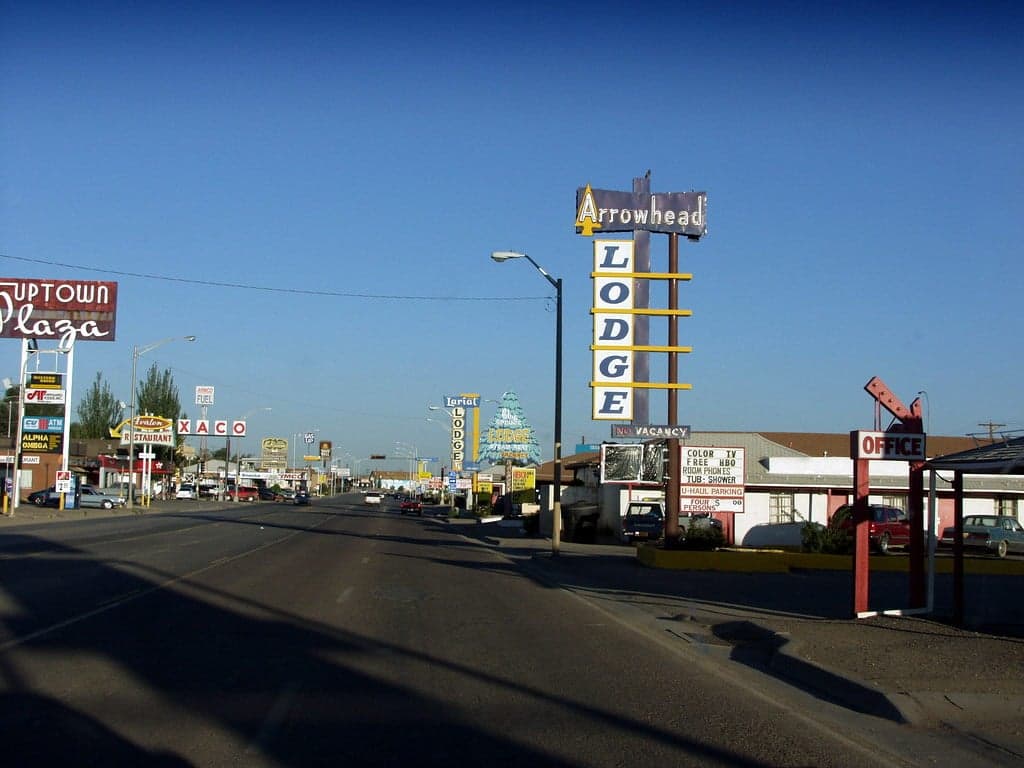
Photo: Wikipedia
Personal Sovereignty in Gallup, NM
Viable for self-reliance. Generally workable, though some barriers may limit total independence.
What does Personal Sovereignty tell us?
Personal Sovereignty measures your capacity for self-reliance and independence with minimal government friction. Higher scores mean fewer barriers between you and the way you want to live... but it assumes you have the space you need and good neighbors.
What does this tell us?
Personal Sovereignty measures your capacity for self-reliance and independence with minimal government friction. Higher scores mean fewer barriers between you and the way you want to live... but it assumes you have the space you need and good neighbors.
State Policy
Energy independence: Net exporter (250% of energy produced in-state)
Personal Liberty
Homesteading

Personal Liberty Analysis
Gallup, New Mexico, offers a mixed but potentially workable environment for personal sovereignty, depending heavily on how aggressively you are willing to navigate state-level overreach and local cultural dynamics. While the city itself leans left politically and is heavily dependent on federal and tribal funding—which creates a soft dependency that can erode self-reliance—the surrounding McKinley County and the broader state present a landscape where a determined individual can carve out significant autonomy, particularly in the realms of property use and self-defense. The key is understanding that New Mexico’s state government is often hostile to personal freedoms in areas like taxation and medical mandates, but the sheer remoteness and economic marginalization of Gallup mean that enforcement is often lax, and the cost of living is low enough to allow for a buffer against systemic pressure.
Tax burden and regulatory posture: How much the state takes and how much it controls
New Mexico’s tax burden is moderate but trending in the wrong direction for anyone seeking to keep more of what they earn. The state has a progressive income tax with rates from 1.7% to 5.9% as of 2026, which is not crushing but is higher than neighboring Texas or Arizona. Property taxes in McKinley County are among the lowest in the state—typically under 0.6% of assessed value—which is a genuine advantage for landowners. However, the state’s gross receipts tax (GRT) is a hidden killer: it applies to nearly all services and goods, including groceries in many municipalities, and Gallup’s combined rate is around 8.4%. This means every transaction is taxed, which penalizes self-reliance and local trade. On the regulatory front, New Mexico is a mixed bag. Occupational licensing is burdensome for trades like plumbing or electrical work, but there are no state-level building codes in unincorporated McKinley County, meaning you can build a cabin or workshop without permits as long as you’re outside city limits. The state also has a Renewable Energy Act that can complicate off-grid solar setups if you try to connect to the grid, but if you stay fully off-grid, the state largely leaves you alone. The regulatory posture is best described as “high intent, low enforcement”—the laws are on the books, but the state lacks the manpower to enforce them in remote areas.
Self-defense and gun law specifics: What you can carry, where, and how fast
New Mexico is a shall-issue state for concealed carry, meaning if you pass a background check and complete a 16-hour training course, you get a permit. As of 2026, the state also allows permitless (constitutional) carry for anyone 21 or older who can legally possess a firearm. This is a solid baseline for personal defense. However, there are significant caveats. The state has a red flag law (Extreme Risk Firearm Protection Order) that allows law enforcement or family members to petition a court to seize your firearms if they deem you a risk—no conviction required. This is a direct threat to sovereignty, as it bypasses due process. Additionally, New Mexico has a background check requirement for private firearm sales, which complicates private transfers between individuals. On the positive side, Gallup itself is in a high-crime area (violent crime rates are roughly 2.5x the national average), which means local law enforcement is generally supportive of armed self-defense. The McKinley County Sheriff’s Office has a reputation for being pro-Second Amendment, and there are no local ordinances banning open carry. For a prepper, the key takeaway is: you can carry, but you must be prepared for the possibility of a red flag order being used against you if you have a dispute with a neighbor or family member. Store your firearms in a secure, non-obvious location, and consider keeping a low profile about your inventory.
Self-reliance and homesteading viability: Lot sizes, zoning, and off-grid feasibility
This is where Gallup and its surroundings shine for the self-reliant individual. McKinley County has vast tracts of unzoned land, particularly in the rural areas east and south of Gallup. Lot sizes for raw land start at 1 acre and go up to 40 acres or more, with prices as low as $1,000–$3,000 per acre for desert scrubland. There are no county-level building codes for owner-built structures on unincorporated land, meaning you can erect a shipping container home, a yurt, or a traditional cabin without permits. Water is the critical constraint: the region is arid, receiving only 10–12 inches of rain annually. Drilling a well can cost $10,000–$20,000 and may hit brackish water, so rainwater catchment and hauling water are common. Off-grid solar is highly feasible—Gallup averages 280 sunny days per year—and the state’s net metering laws are favorable if you connect to the grid, but again, staying fully off-grid avoids the regulatory hassle. Zoning within Gallup city limits is more restrictive (minimum lot sizes of 6,000 sq ft, building permits required), but the city is small enough that you can live just outside the boundary and still commute in for supplies. For a homesteader, the formula is simple: buy 5–10 acres outside city limits, drill a well or set up rainwater collection, install solar panels, and build a simple structure—no permits, no inspectors, no interference. The main challenge is the harsh climate (hot summers, cold winters, wind) and the distance to major suppliers (Albuquerque is 2.5 hours east).
Personal liberties: Parental rights, medical autonomy, speech, and property
New Mexico’s record on personal liberties is a study in contradictions. On parental rights, the state is generally permissive: there is no state-level mandate for school curriculum transparency, but there is also no law that explicitly overrides parental authority in medical decisions for children. However, the state has a compulsory vaccination law for school attendance (all standard childhood vaccines required), which is a direct infringement on parental sovereignty. Medical autonomy for adults is better: New Mexico has no state-level vaccine mandate for employment (though private employers can impose them), and there are no laws restricting the use of alternative or holistic medicine. The state also has a Right to Try law for terminally ill patients, allowing access to experimental treatments. On speech, New Mexico has no notable prior restraint laws, but the state does have a hate crimes statute that can enhance penalties for speech deemed threatening—a potential chill on political expression. Property rights are strong in rural areas: there is no state-level property tax on personal vehicles, and the state has a homestead exemption of up to $60,000 on property taxes for primary residences. However, the state’s use of eminent domain for infrastructure projects (e.g., the proposed Gallup-McKinley County water pipeline) is a concern. The biggest liberty threat is the state’s willingness to use health orders and emergency powers—during COVID, New Mexico had some of the strictest lockdowns in the nation, including a ban on out-of-state travel for non-essential purposes. This pattern suggests that in a future crisis, the state will not hesitate to restrict movement and commerce.
Overall, Gallup offers a high degree of personal sovereignty for those willing to live with the trade-offs: low property taxes, lax rural zoning, and strong self-defense laws are genuine assets, but they come with a state government that is philosophically opposed to individual autonomy in areas like medical choice and emergency powers. Compared to states like Idaho or Montana, New Mexico is weaker on sovereignty; compared to California or New York, it is a haven. For a survivalist or prepper, the best strategy is to establish a self-sufficient homestead in the county, keep a low profile, and maintain a legal and physical buffer against state overreach. Gallup is not a fortress of liberty, but it is a place where a determined individual can build one.

* Values derived from national, state, county, city and local statistics and may differ in a specific area. Last updated: 2026-05-04T02:06:52.000Z
Narrative content on this page is AI-generated and may contain mistakes. Verify any details that matter before acting on them.
ReloMaps may earn a commission from affiliate links at no extra cost to you.

