 Popular
Photo: Wikipedia
Demographics of Garden City, KS
Affluence Level in Garden City, KS
A middle-class area roughly in line with national averages across income, home values, education, and employment.
People of Garden City, KS
Garden City, Kansas, is a community of 27,781 residents defined by its Hispanic-majority population (54.6%) and a significant East/Southeast Asian minority (4.4%), creating a distinctive cultural landscape in southwest Kansas. The city’s character is shaped by its role as a regional meatpacking and agricultural hub, with a foreign-born population of 15.2% and a relatively low college attainment rate of 18.7%. This is a working-class city where immigrant communities have transformed the demographic makeup over the past half-century, resulting in a place where Spanish is commonly heard alongside English and where Vietnamese and Lao languages are present in pockets of the east side.
How the city was settled and grew
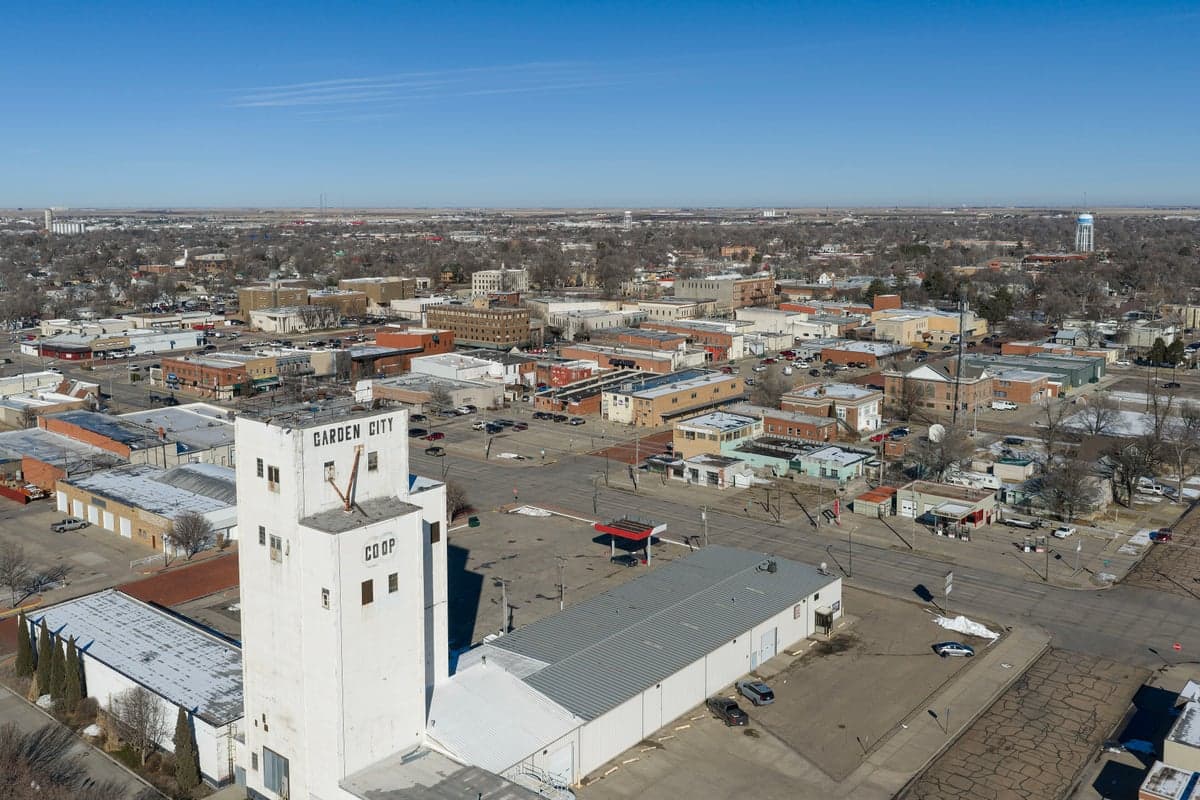
Garden City was founded in 1879 as a railroad stop on the Atchison, Topeka and Santa Fe line, drawing Anglo-American settlers from the Midwest and East Coast who were lured by the promise of irrigated farming on the High Plains. The original population was overwhelmingly white, with a small number of Black families who arrived as domestic workers and railroad laborers in the early 1900s. These early residents built the Downtown Historic District around Main Street and the North Side neighborhoods near the railroad tracks, where many of the city’s original frame houses still stand. The city grew slowly through the Dust Bowl era and World War II, remaining a predominantly white, agricultural community of about 10,000 by 1950. The South Side neighborhoods, developed in the 1940s and 1950s, housed the families of local farmers and small business owners who formed the city’s Anglo core.
Modern era (post-1965)
The Immigration and Nationality Act of 1965, combined with the expansion of the meatpacking industry in the 1970s and 1980s, fundamentally reshaped Garden City’s population. The opening of the IBP (now Tyson Foods) beef plant in 1980 and the subsequent arrival of Cargill and National Beef packing plants created a massive demand for low-skilled labor that drew immigrants from Mexico and Central America. Hispanic residents, who made up less than 5% of the population in 1970, now constitute 54.6% of the city. These families concentrated in the East Garden City neighborhoods along Mary Street and the West Side near the packing plants, where affordable housing and proximity to work created dense Hispanic enclaves. The East Side also became home to a smaller but significant East/Southeast Asian community (4.4%), primarily Vietnamese and Lao refugees who arrived in the 1980s and 1990s through secondary migration from other states. The white population, which was nearly 90% in 1970, has fallen to 34.0% as many Anglo families moved to newer subdivisions in the Northwest Heights area or left the city entirely. The Black population (5.6%) includes both long-standing families and newer arrivals from other states drawn by packing plant jobs.
The future
Garden City’s population is trending toward an even higher Hispanic share, driven by continued immigration and higher birth rates among Hispanic families. The white population is aging and declining, while the East/Southeast Asian community appears stable but not growing rapidly. The city is not homogenizing into a single culture; rather, it is tribalizing into distinct enclaves, with the Northwest Heights area remaining predominantly white and affluent, the East Side becoming more uniformly Hispanic, and the South Side retaining a mixed character. The foreign-born share of 15.2% is likely to hold steady or increase slightly as packing plants continue to recruit immigrant labor. The low college attainment rate (18.7%) suggests that upward mobility through education remains limited, and the city’s economic future is tied to the meatpacking industry, which shows no signs of relocating. For a newcomer, this means moving into a city where Spanish-language fluency is increasingly useful, where the public schools are majority-Hispanic, and where the Anglo cultural norms of the past are giving way to a more diverse, working-class identity.
Garden City is becoming a Hispanic-majority, immigrant-driven community where the packing plants anchor both the economy and the demographic future. For a conservative-leaning mover, this means a place with strong family values, a robust work ethic, and a clear sense of community, but also one where English is no longer the sole language of daily life and where the cultural landscape is shifting rapidly. The city offers affordable housing and steady employment, but the social fabric is increasingly defined by ethnic enclaves rather than a single, unified identity.

* Values derived from national, state, county, city and local statistics and may differ in a specific area. Last updated: 2026-04-30T04:39:56.000Z
Narrative content on this page is AI-generated and may contain mistakes. Verify any details that matter before acting on them.
ReloMaps may earn a commission from affiliate links at no extra cost to you.

