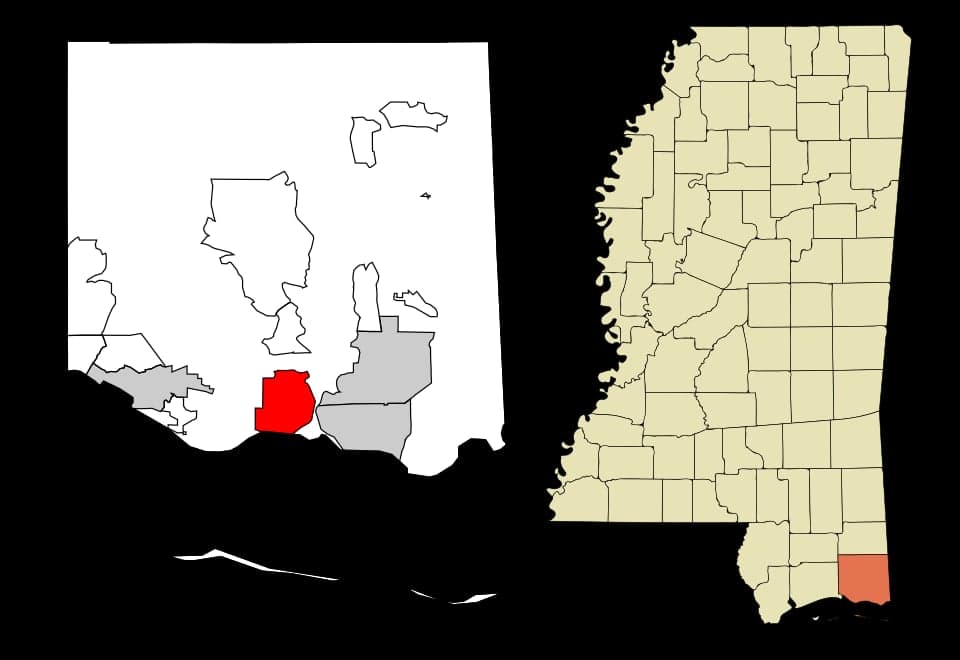
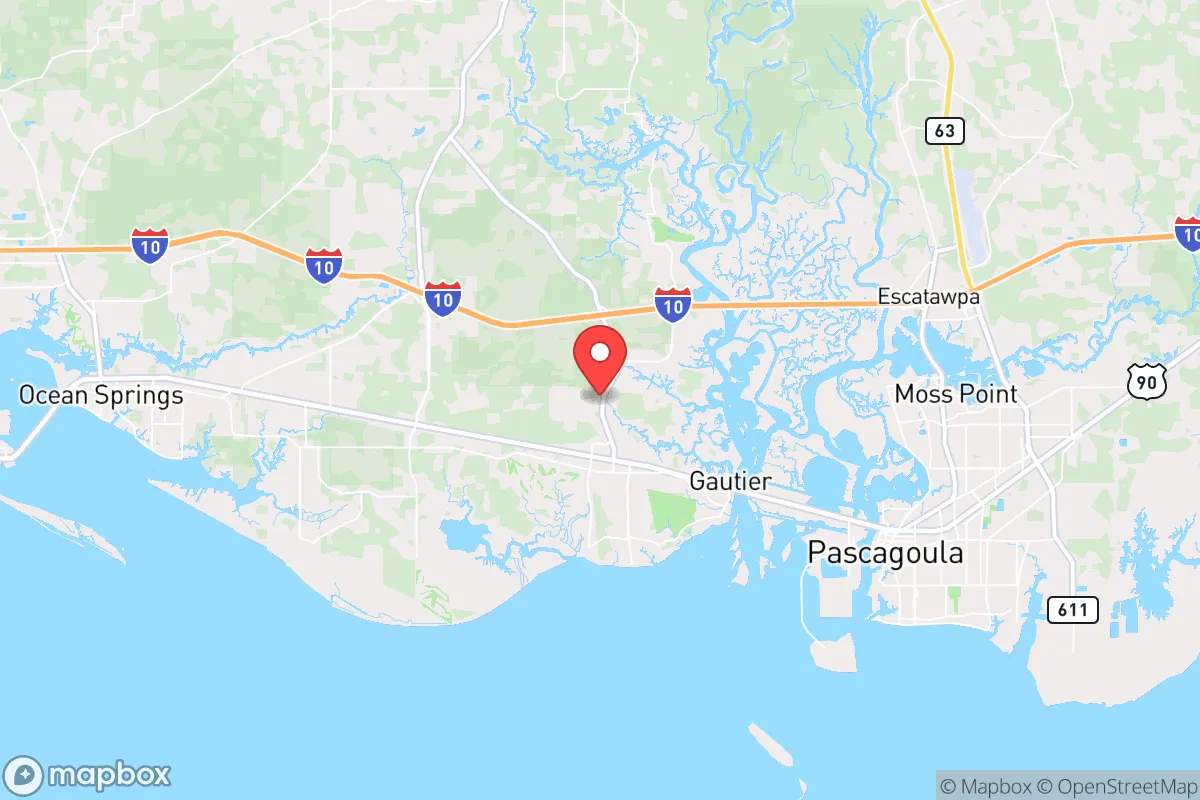
Photo: Wikipedia
Demographics of Gautier, MS
Affluence Level in Gautier, MS
A middle-class area roughly in line with national averages across income, home values, education, and employment.
People of Gautier, MS
The people of Gautier, Mississippi, today number 19,026, forming a community defined by its deep-rooted working-class character and a demographic profile that is majority-minority. The city is notably less diverse than the national average in foreign-born residents (just 1.8%), yet it hosts a significant Black population (32.1%) and a growing Hispanic community (12.0%), alongside a White plurality (51.8%). This is a place where family ties to the land and local industry run deep, and where the population is slowly shifting from a historically biracial Black-White dynamic toward a more tri-ethnic composition.
How the city was settled and grew
Gautier’s human history begins not with colonial settlement but with the timber and shipbuilding booms of the late 19th and early 20th centuries. The city is named after the Gautier family, French-Canadian settlers who established a sawmill and shipyard along the West Pascagoula River in the 1860s. The original population was overwhelmingly White and of European descent, drawn by jobs in the lumber mills and the emerging seafood industry. The earliest residential core formed around what is now Old Gautier Village, a historic district along the river where the mill workers and their families lived in modest cottages. By the early 1900s, a small Black population had settled in the Martin Bluff area, working as laborers in the mills and as domestic help for the White families. The city remained a small, rural hamlet through the Great Depression, with its population barely exceeding 1,000. The post-World War II era brought the first major growth wave, driven by the expansion of the nearby Ingalls Shipbuilding yard in Pascagoula. This drew White workers from across the Deep South, who settled in new subdivisions like Gautier Estates and Pine Ridge, while Black workers from rural Mississippi and Alabama concentrated in the Gulf Hills neighborhood.
Modern era (post-1965)
The 1965 Immigration and Nationality Act had a negligible direct effect on Gautier, as the city’s foreign-born population remains tiny. Instead, the major demographic shift after 1965 was domestic: the steady suburbanization of Black families from Pascagoula and Moss Point, and the arrival of White retirees and military-affiliated families drawn to the Gulf Coast’s low cost of living. The 1970s and 1980s saw the construction of Singing River Estates, a predominantly White subdivision that attracted professionals from the shipyard and the nearby Keesler Air Force Base. Meanwhile, the Black population grew in Gulf Hills and began moving into previously White areas like Gautier Estates as white flight from Pascagoula pushed families north. The Hispanic population, now 12.0%, began arriving in the 1990s, primarily from Mexico and Central America, to work in construction, landscaping, and the seafood processing plants. They initially clustered in the Martin Bluff area and along Highway 90, forming a small but visible enclave. The Asian population (1.1%) is almost entirely of Vietnamese and Filipino descent, many of whom came after the Vietnam War and work in the fishing and healthcare sectors; they are scattered across the city with no single dominant neighborhood.
The future
Gautier’s population is trending toward greater ethnic diversity, but the pace is slow. The White share has declined from roughly 60% in 2000 to 51.8% today, while the Hispanic share has more than doubled from 5% to 12.0%. The Black population has remained stable at around 32%, suggesting that the city is not experiencing rapid resegregation but rather a gradual tri-ethnic blending. The foreign-born share (1.8%) is unlikely to rise sharply, as Gautier lacks the job base or immigrant networks of larger Gulf Coast cities. The most likely scenario for the next 10-20 years is a continued slow decline in the White share, a plateau in the Black share, and steady growth in the Hispanic share to perhaps 15-18%. The city is not tribalizing into distinct ethnic enclaves; instead, neighborhoods like Gautier Estates and Singing River Estates are becoming more mixed, while Martin Bluff remains the most Hispanic area. The college-educated share (20.4%) is low, reflecting the city’s blue-collar character, and this is unlikely to change without a major new employer.
For someone moving in now, Gautier is becoming a more diverse, working-class suburb of Pascagoula, where the population is stable and rooted. The city offers a low-cost, family-oriented environment with a strong sense of local identity, but limited economic mobility and little new in-migration from outside the region. It is a place where the past—timber, shipbuilding, and family land—still shapes the present, and where the future looks much like today, only slightly more Hispanic and slightly less White.

* Values derived from national, state, county, city and local statistics and may differ in a specific area. Last updated: 2026-04-30T05:52:41.000Z
Narrative content on this page is AI-generated and may contain mistakes. Verify any details that matter before acting on them.
ReloMaps may earn a commission from affiliate links at no extra cost to you.

