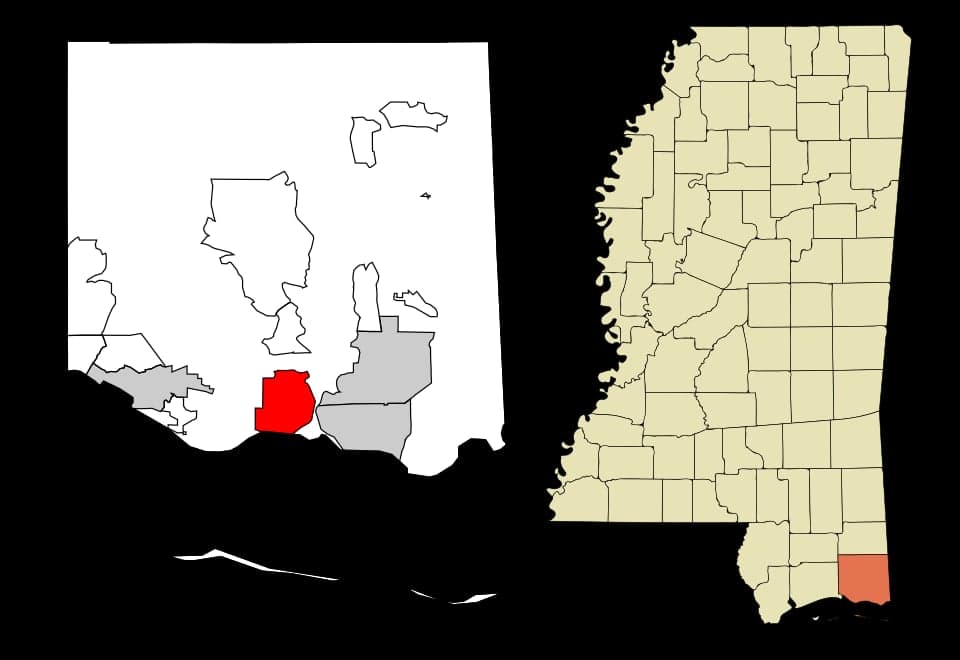


Photo: Wikipedia
Political ClimatePolitical Climate in Gautier, MS
District shown is the primary district for this city’s centroid. Cities may span multiple districts.
Local Political AnalysisPolitical Analysis of Gautier, MS
Gautier, Mississippi, sits deep in reliably conservative territory, and that’s not changing anytime soon. The area’s Cook Partisan Voting Index (PVI) of R+21 tells you everything you need to know about the baseline — this is a place where Republican candidates routinely win by double digits, and the local culture reflects that. If you’re looking at Gautier, you’re looking at a community that has historically valued limited government, personal responsibility, and a “live and let live” approach, as long as that doesn’t mean government overreach into your backyard or your paycheck. The political trajectory here has been steady, not swinging; if anything, the surrounding Jackson County has only gotten more conservative as coastal Mississippi pushes back against federal overreach on energy, land use, and Second Amendment rights.
How it compares
Gautier isn’t an island politically — it’s part of a broader conservative corridor along the Gulf Coast. Drive west to Biloxi or Gulfport, and you’ll find a slightly more moderate, tourism-driven vibe, with more union influence from the casinos and a bit more tolerance for progressive social policies. Head east to Pascagoula, and you’re in a blue-collar, shipbuilding town that leans even harder into conservative populism. But Gautier sits in a sweet spot: it’s suburban enough to avoid the rougher edges of Pascagoula’s industrial politics, yet far enough from Biloxi’s tourist economy to keep the culture grounded in family, church, and local business. The real contrast is north toward Moss Point, which has seen more economic struggle and a more mixed political outlook — but Gautier’s stability keeps it firmly in the R+21 lane.
What this means for residents
For folks living here, the conservative tilt means lower taxes relative to the state average, fewer zoning headaches, and a general hands-off attitude from local government when it comes to personal choices — whether that’s homeschooling, carrying a firearm, or running a small business out of your garage. You won’t see the kind of progressive overreach that’s creeping into bigger cities, like heavy-handed mask mandates or property tax hikes for social programs. The local school board and city council tend to focus on infrastructure and public safety rather than social engineering. That said, there’s a quiet concern among long-time residents that as Gautier grows — and it is growing, slowly — outside influences could start pushing for more regulation. The Ingalls Shipbuilding expansion and new housing developments are bringing in folks from other states, and some worry that could shift the political needle over the next decade. For now, though, the culture holds.
One cultural distinction that sets Gautier apart is its strong sense of local identity without the tourist-trap feel of the coast. You won’t find a lot of political activism or protests here — people mostly just want to be left alone to work, fish, and raise their kids. The biggest policy debates tend to revolve around hurricane preparedness, flood insurance rates, and keeping the local economy humming without inviting federal strings. If you’re looking for a place where the government stays out of your business and the neighbors share your values, Gautier fits the bill. Just keep an eye on the newcomers — the political winds can shift if enough people from blue states decide the Gulf Coast looks like a good escape.

State Political ClimatePolitical Climate in Mississippi
State Political AnalysisPolitical Environment in the State
Mississippi is one of the most reliably conservative states in the nation, with a Republican lean that has only deepened over the past two decades. The state hasn’t voted for a Democratic presidential candidate since 1976, and in 2024, Donald Trump carried it by roughly 17 points. The dominant coalition is a mix of rural and suburban voters, evangelical Christians, and a growing number of conservative-leaning transplants from other Southern states. Over the last 10-20 years, the shift has been dramatic: Democrats once held a majority in the state legislature as recently as 2010, but today Republicans hold supermajorities in both chambers. This trajectory is driven by white voters moving rightward and the slow but steady depopulation of historically Democratic strongholds in the Delta.
Urban vs. rural divide
The political map of Mississippi is a textbook study in the urban-rural split. The state’s largest metro, the Jackson metropolitan area, is the only real Democratic stronghold. Hinds County, which includes Jackson, voted for Joe Biden by a 2-to-1 margin in 2020, driven by a majority-Black population and a concentration of government workers and university faculty. But even Jackson is shrinking—its population has declined by roughly 20% since 2000—which weakens its statewide influence. The Gulf Coast cities of Biloxi and Gulfport lean Republican but are more moderate, often splitting tickets in local races. The real engine of conservative power is the suburban and exurban ring around Jackson—places like Madison and Rankin counties, which vote 70-80% Republican. Madison, in particular, is a fast-growing, affluent suburb where you’ll see Trump signs year-round and where school board races are dominated by parental rights debates. The rural Delta counties, like Bolivar and Washington, are heavily Democratic but depopulating fast, while the northeastern hill country—Tupelo, Corinth, Oxford—is reliably red, with the notable exception of Oxford itself, where the University of Mississippi creates a small blue bubble.
Policy environment
Mississippi’s policy environment is among the most conservative in the country, and it’s been getting more so. The state has no income tax on Social Security benefits and a flat 4% income tax that is scheduled to phase down to zero by 2028 under legislation passed in 2022. Sales tax is around 7%, but groceries are exempt. The regulatory posture is light-touch: there’s no state-level occupational licensing for many trades, and the state has a right-to-work law. On education, Mississippi has leaned into school choice, with a robust charter school law and a new Education Scholarship Account program passed in 2024 that lets parents use state funds for private school tuition. Healthcare is a mixed bag: the state has not expanded Medicaid under the Affordable Care Act, leaving roughly 75,000 working poor in a coverage gap, but the private insurance market is stable and relatively affordable. Election laws are strict: voter ID is required, absentee voting is limited to those with a valid excuse, and early voting was only introduced in 2024. The state also passed a law in 2023 banning ballot drop boxes, which was sold as an election integrity measure.
Trajectory & freedom
On the freedom front, Mississippi is moving in a decidedly libertarian-conservative direction. The most significant recent expansion of personal liberty came in 2023 with the passage of a constitutional carry law, allowing any adult who can legally possess a firearm to carry it openly or concealed without a permit. That same year, the legislature passed a Parents’ Bill of Rights, which requires schools to notify parents of any changes to a student’s mental, emotional, or physical health and prohibits schools from withholding information about a child’s gender identity. On medical freedom, the state banned COVID-19 vaccine mandates for both public and private employers in 2022, and in 2024 it passed a law prohibiting the enforcement of any federal gun control measure that doesn’t have a state-level equivalent—a direct nullification play. Property rights are strong: Mississippi is a “stand your ground” state, and it has some of the weakest eminent domain protections for private property in the South, though a 2023 law tightened the definition of “public use.” The only area where freedom has contracted is on abortion: the state’s trigger law went into effect in 2022, banning nearly all abortions with no exceptions for rape or incest, which some conservatives see as a necessary protection of life but others view as government overreach.
Civil unrest & political movements
Mississippi has seen relatively little civil unrest compared to other states, but there have been flashpoints. The most visible in recent years was the 2020 protests in Jackson following the murder of George Floyd, which included some property damage and a heavy police presence. The state’s immigration politics are quiet—Mississippi has a very small foreign-born population (about 2.5%), and there are no sanctuary cities. The most organized political movements are on the right: the Mississippi Republican Party is dominated by the Mississippi Freedom Caucus, a hardline conservative group that has pushed for school choice, gun rights, and anti-ESG legislation. On the left, the Mississippi Poor People’s Campaign and the NAACP chapters in Jackson and the Delta organize around voting rights and economic justice, but they have little legislative influence. Election integrity has been a hot topic: after the 2020 election, the state legislature created a special committee to investigate voting irregularities, though none were found. The most visible flashpoint for a new resident would likely be the ongoing debate over the state flag—the old Confederate-themed flag was replaced in 2020 with a new design featuring a magnolia, a change that still rankles some older residents.
Projection
Over the next 5-10 years, Mississippi is likely to become even more conservative, but with a slightly different flavor. The in-migration pattern is small but notable: retirees and remote workers from higher-tax states like California and Illinois are trickling into the Gulf Coast (Ocean Springs, Bay St. Louis) and the Oxford area, drawn by low housing costs and no income tax. These newcomers tend to be fiscally conservative but socially moderate, which could create tension with the existing evangelical base. The biggest demographic shift is the continued depopulation of the Delta and the growth of the Jackson suburbs, which will further dilute Democratic influence. The state’s population is projected to be flat or slightly declining, meaning the political balance will be determined by who stays and who leaves. Expect more school choice expansion, further tax cuts, and continued battles over election laws. The wild card is the state’s healthcare system: if the coverage gap becomes a political liability, you might see a push for a limited Medicaid expansion, but it would have to come with work requirements to pass the legislature.
For a new resident, the bottom line is this: Mississippi offers a high degree of personal freedom in the areas that matter most to conservatives—gun rights, parental control over education, low taxes, and light regulation. You won’t feel the heavy hand of the state in your daily life, and your neighbors will generally share your values. The trade-offs are a weak social safety net, limited healthcare options in rural areas, and a political culture that can feel insular. If you’re moving here, expect to find a place where your vote actually counts in local primaries, where the school board meetings are lively, and where the biggest political fights are about how much further right to go, not whether to turn left.
* Values derived from national, state, county, city and local statistics and may differ in a specific area. Last updated: 2026-04-30T05:52:41.000Z
Narrative content on this page is AI-generated and may contain mistakes. Verify any details that matter before acting on them.
ReloMaps may earn a commission from affiliate links at no extra cost to you.

