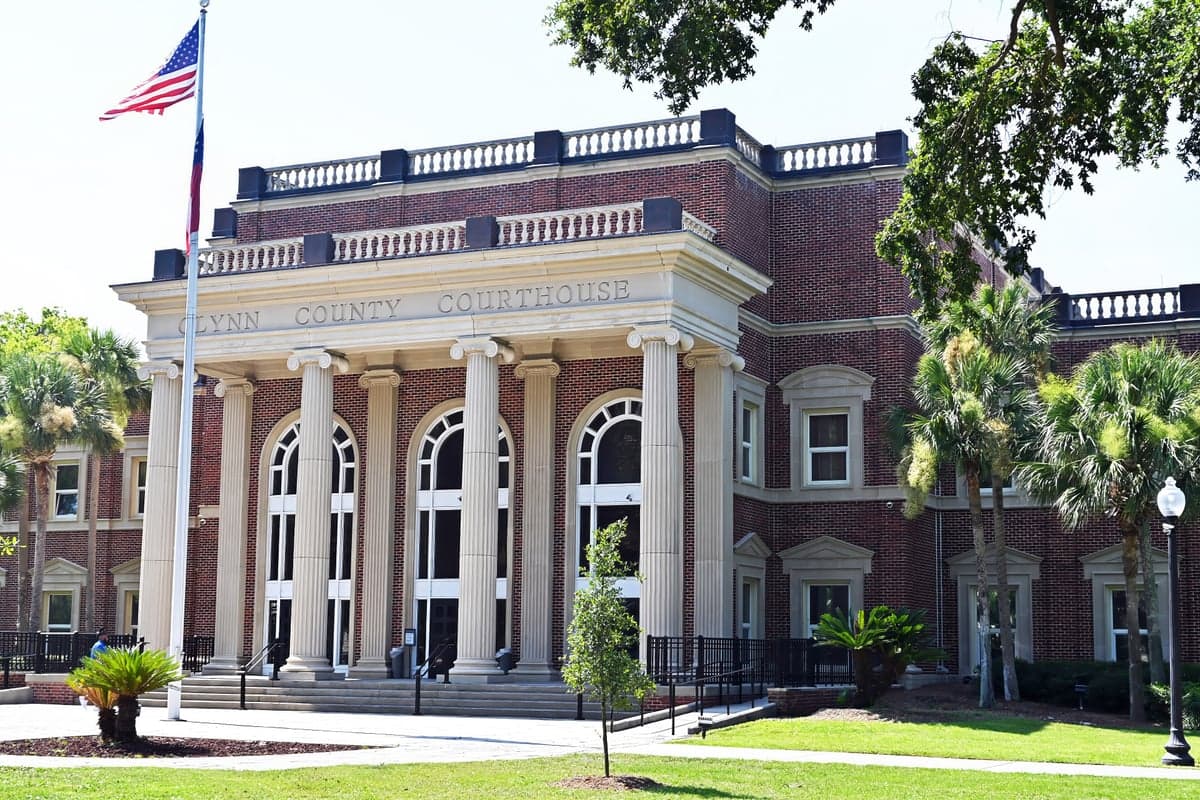

Photo: Wikipedia
Demographics of Glynn County
Affluence Level in Glynn County
A middle-class area roughly in line with national averages across income, home values, education, and employment.
People of Glynn County
Glynn County, Georgia, is home to 84,987 residents, a population shaped by centuries of coastal settlement, industrial booms, and deep-rooted cultural traditions. The county’s identity is defined by its historic port city of Brunswick, the barrier island resort of St. Simons Island, and a demographic makeup that is 62.1% White, 24.5% Black, 7.5% Hispanic, and 1.1% East/Southeast Asian, with a foreign-born share of just 2.9%. This is a place where a strong Southern heritage, a working waterfront economy, and a growing tourism sector coexist, creating a community that is both traditional and slowly diversifying.
Settlement & growth (pre-1960)
Long before European arrival, the area now known as Glynn County was inhabited by the Guale people, a Mississippian culture group who lived along the coast and barrier islands. Spanish explorers and missionaries established a presence in the 16th century, but permanent European settlement did not take hold until the British founded the Georgia Colony in 1733. The county itself was created in 1777, named after John Glynn, a British MP sympathetic to the American cause. The earliest English-speaking settlers were primarily of English and Scots-Irish stock, drawn by land grants and the promise of coastal agriculture.
Throughout the 19th century, Glynn County’s economy revolved around cotton, timber, and the port of Brunswick. The plantation system relied heavily on enslaved African labor, and by 1860, enslaved people made up a majority of the county’s population. After the Civil War and emancipation, many freedmen remained in the area, working as sharecroppers, dockworkers, and domestic laborers. The city of Brunswick became a hub for the region’s Black community, with neighborhoods like Dartown and Gould’s Crossing forming as distinct enclaves. The post-Reconstruction era also saw the arrival of small numbers of German and Irish immigrants, who worked in the timber mills and on the railroads, settling primarily in Brunswick’s Downtown and Old Town districts.
The early 20th century brought the rise of the seafood industry, particularly shrimp and oyster processing, which attracted a wave of Greek and Italian immigrants to Brunswick. These families established themselves in the Glynn Haven and Arco neighborhoods, founding churches and social clubs that remain active today. The Great Depression and World War II slowed growth, but the post-war era saw a significant shift: the construction of the Torras Causeway in the 1920s and later the Sidney Lanier Bridge opened St. Simons Island and Sea Island to tourism and residential development. By the 1950s, middle-class white families were moving to the island’s East Beach and Ocean Forest areas, while Brunswick’s industrial core continued to attract Black and immigrant workers to neighborhoods like Risley and Lincoln Park.
Modern era (post-1965)
The 1965 Hart-Cellar Act had a limited direct impact on Glynn County, as the area’s foreign-born population remains low at 2.9%. However, the broader national trends of suburbanization and Sun Belt migration reshaped the county significantly. The 1970s and 1980s saw an influx of domestic migrants from the Rust Belt—particularly Ohio, Michigan, and Pennsylvania—drawn by the region’s lower cost of living, warmer climate, and growing retirement appeal. These newcomers settled heavily on St. Simons Island, in the planned community of Sea Palms, and in the mainland suburb of Dock Junction.
The Hispanic population, now 7.5% of the county, began growing in the 1990s and 2000s, driven by labor demand in the poultry processing plants, construction, and the hospitality industry. Most Hispanic residents are of Mexican and Central American origin, and they have concentrated in Brunswick’s Downtown and Arco neighborhoods, as well as in the unincorporated area of Sterling. The East/Southeast Asian community, at 1.1%, is small but established, with families of Filipino and Vietnamese descent working in healthcare, the military (via the nearby Kings Bay Naval Submarine Base in Camden County), and the seafood industry. They are scattered across Brunswick and St. Simons Island, with no single dominant enclave.
The Black population, 24.5%, remains concentrated in historic neighborhoods like Risley, Lincoln Park, and Dartown in Brunswick, as well as in the rural community of Pennick. However, suburbanization has led to some movement into previously white areas like Dock Junction and Country Club Estates. The county’s college-educated share is 30.4%, reflecting the presence of the College of Coastal Georgia in Brunswick and the professional workforce tied to the port, tourism, and healthcare sectors. The Indian subcontinent population is negligible at 0.1%, with no visible enclave.
The future
Glynn County’s population is projected to grow modestly over the next decade, driven by continued domestic migration from the Northeast and Midwest, as well as natural increase among the Hispanic and Black communities. The county is not homogenizing; rather, it is slowly tribalizing into distinct geographic and cultural zones. St. Simons Island and Sea Island are becoming increasingly affluent and white, with a high concentration of retirees and second-home owners. Brunswick’s historic Black and Hispanic neighborhoods remain economically diverse but face pressure from gentrification and rising property taxes. The Hispanic population is likely to grow steadily, as younger families settle in and birth rates remain above the county average, but assimilation into the broader Southern culture is already evident in language use and civic participation.
The East/Southeast Asian community is expected to remain small, with growth tied to specific industries like healthcare and the military. The foreign-born share may rise slightly but will stay well below the national average, as Glynn County lacks the large urban job markets and ethnic networks that drive immigration to Atlanta or Houston. The biggest demographic wildcard is the climate-driven migration of retirees from Florida and the Gulf Coast, which could accelerate if sea-level rise and hurricane risks push people inland. For now, the county’s cultural identity remains rooted in its Southern, coastal heritage, with new arrivals largely absorbed into that framework rather than transforming it.
For someone moving in now, Glynn County offers a stable, traditional community with a slow pace of change. The population is older and less diverse than the national average, but the growing Hispanic presence and the continued influx of out-of-state retirees are gradually reshaping the social fabric. The key decision for a new resident is whether to settle on the island, where the culture is resort-oriented and transient, or on the mainland, where the economy is more industrial and the community more deeply rooted. Either way, the county’s history as a working port and a coastal retreat means that its people value both hard work and leisure, and newcomers who respect that balance will find a welcoming, if not rapidly changing, home.

* Values derived from national, state, county, city and local statistics and may differ in a specific area. Last updated: 2026-06-06T07:39:50.000Z
Narrative content on this page is AI-generated and may contain mistakes. Verify any details that matter before acting on them.
ReloMaps may earn a commission from affiliate links at no extra cost to you.

