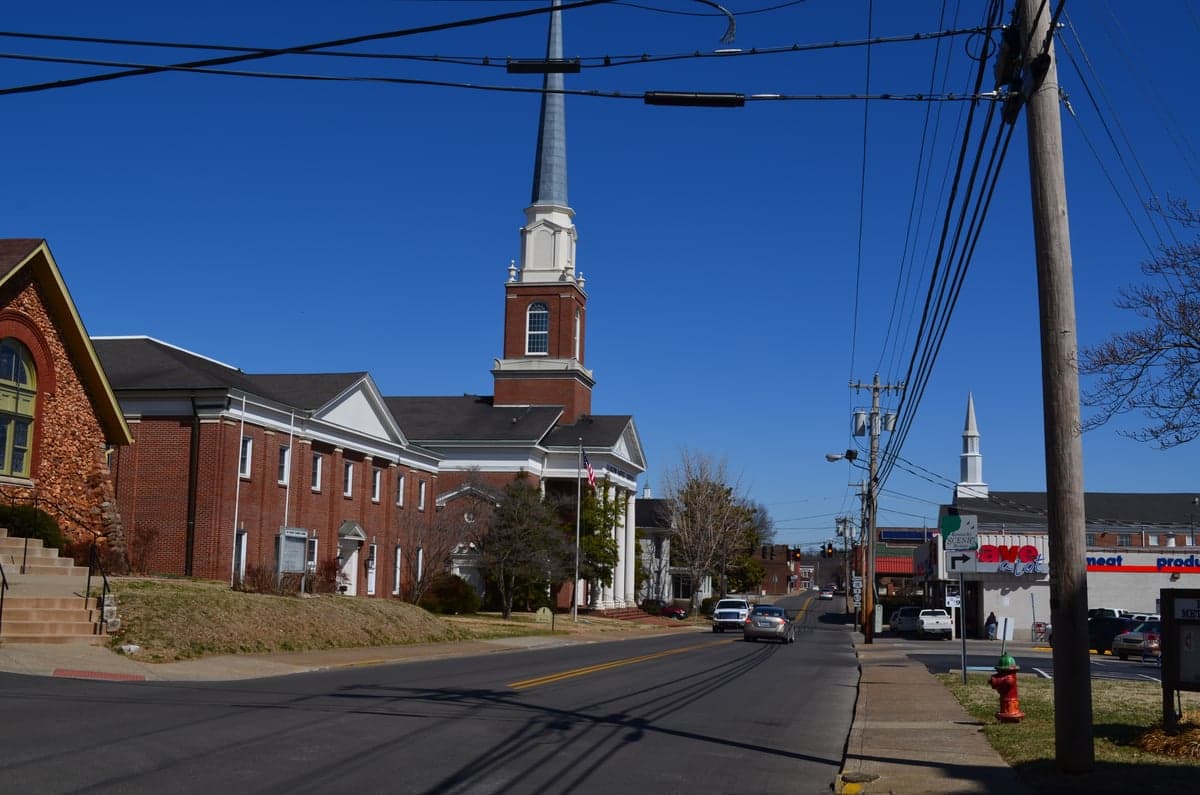
Photo: Wikipedia
Demographics of Glasgow, KY
Affluence Level in Glasgow, KY
A low-income area with significant economic hardship. Household wealth and educational attainment are well below national averages.
People of Glasgow, KY
The people of Glasgow, Kentucky today form a predominantly White (77.9%) and native-born community of 15,141, with a small but growing Hispanic population (7.7%) and a stable Black population (8.3%). The city’s identity is rooted in its role as a regional trade and healthcare hub for Barren County, with a workforce that skews toward manufacturing, retail, and medical services. College attainment sits at 23.0%, below the national average, reflecting a community where many residents hold skilled trades or production jobs rather than four-year degrees. The foreign-born share is just 2.9%, making Glasgow a place where most residents have deep generational ties to the area, though recent Hispanic in-migration is slowly diversifying the social fabric.
How the city was settled and grew
Glasgow was founded in 1799 as the seat of Barren County, drawing its earliest settlers from Virginia, North Carolina, and Tennessee via the Cumberland Gap. These were largely Scots-Irish and English farmers who took up land grants in the fertile limestone valleys surrounding the city. The arrival of the Louisville and Nashville Railroad in 1859 turned Glasgow into a shipping point for tobacco, livestock, and timber, attracting a small wave of German and Irish laborers who settled in the South Green Street district near the rail depot. By the early 1900s, a modest African American community had formed in the Westwood neighborhood, working as domestic servants, farmhands, and railroad workers. The post-World War II era brought a manufacturing boom, with companies like R.R. Donnelley and later Fruit of the Loom opening plants, drawing rural white families from surrounding counties into subdivisions like Hickory Hills and Briarwood.
Modern era (post-1965)
The 1965 Hart-Cellar Act had minimal direct impact on Glasgow, as the city’s foreign-born population remains low at 2.9%. Instead, the major demographic shift since the 1970s has been domestic: the decline of tobacco farming pushed younger white families into town for manufacturing and service jobs, while the expansion of T.J. Samson Community Hospital and Western Kentucky University’s Glasgow campus drew a small professional class. The Hispanic population, now 7.7%, began growing in the 1990s as Mexican and Central American laborers arrived to work in poultry processing at the nearby Tyson Foods plant in Scottsville and in construction. These families have concentrated in the East Main Street corridor and the Park City area, where affordable rental housing and Spanish-language churches have formed. The Black population, at 8.3%, remains largely in the Westwood and Happy Valley neighborhoods, though younger Black residents have begun moving into newer subdivisions like Lakewood. The East/Southeast Asian share (1.1%) is tiny and consists mostly of Filipino healthcare workers at the hospital, living scattered across the city rather than in a single enclave. The Indian-subcontinent population is effectively zero.
The future
Glasgow’s population is slowly homogenizing in its white share (77.9%) while the Hispanic segment (7.7%) continues to grow, driven by family reunification and steady demand for low-skill labor in manufacturing and agriculture. The Black population has been stable for decades and is unlikely to rise significantly without a major employer shift. The foreign-born share (2.9%) will likely climb to 4-5% by 2035, almost entirely from Hispanic immigration, as the city’s relatively low cost of living and available factory jobs attract new arrivals. There is no sign of tribalization into distinct ethnic enclaves; instead, Hispanic families are dispersing across the East Main Street corridor and into older subdivisions like Briarwood, while white and Black residents remain in their traditional neighborhoods but with increasing overlap in newer developments. The college-educated share (23.0%) may rise slowly as the hospital and regional university campus attract more professionals, but Glasgow is not poised to become a knowledge-economy hub. The next decade will likely see a slightly more diverse, slightly more Hispanic city that retains its core character as a working-class regional center.
For someone moving in now, Glasgow offers a stable, affordable community where most residents share a common cultural background and where newcomers—especially Hispanic families—are integrating into existing neighborhoods rather than forming separate enclaves. The city is not rapidly changing in its overall character, but the slow diversification of the East Main Street area means that a new resident will encounter a slightly more multicultural environment than existed a generation ago. The bottom line: Glasgow is a quietly diversifying, still predominantly white, working-class town where the biggest demographic story is the gradual growth of a Hispanic minority, not a wholesale transformation.

* Values derived from national, state, county, city and local statistics and may differ in a specific area. Last updated: 2026-04-21T10:45:13.000Z
Narrative content on this page is AI-generated and may contain mistakes. Verify any details that matter before acting on them.
ReloMaps may earn a commission from affiliate links at no extra cost to you.

