
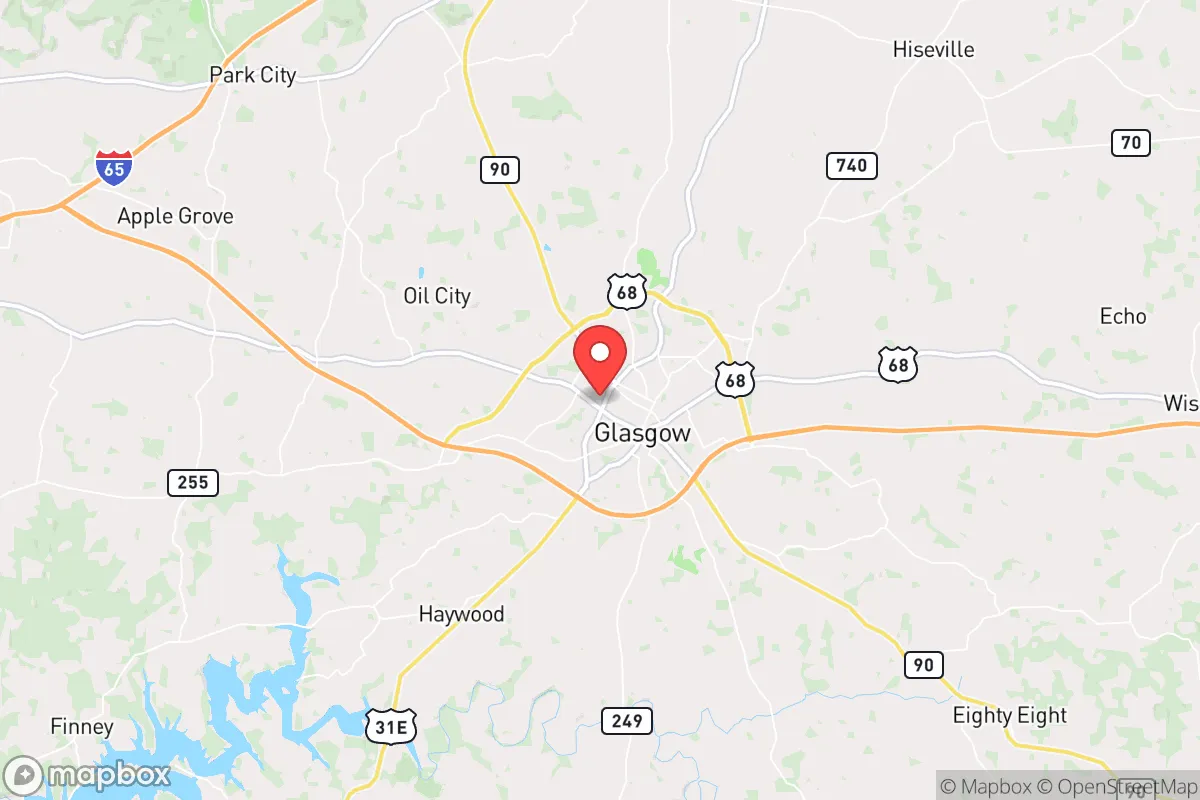

Photo: Wikipedia
Political ClimatePolitical Climate in Glasgow, KY
District shown is the primary district for this city’s centroid. Cities may span multiple districts.
Local Political AnalysisPolitical Analysis of Glasgow, KY
Glasgow, Kentucky, sits solidly in the red, with a Cook PVI of R+20 that reflects a deep-rooted conservative tradition. This isn't a recent shift; it's the way things have been for generations, and for the most part, it's still the way things are. The local political climate leans heavily Republican, and you'll find that most folks around here value personal responsibility, limited government, and the right to live your life without a bunch of bureaucratic red tape. While the national trends might be pulling some places left, Glasgow has held its ground, though you can see the occasional ripple from the progressive waves hitting bigger cities like Louisville or Lexington.
How it compares
When you look at the surrounding area, Glasgow is actually a bit of a moderate anchor compared to some of the smaller, more rural towns nearby. Places like Cave City or Horse Cave are even more staunchly conservative, with a stronger "leave us alone" vibe. Drive an hour north to Bowling Green, and you'll find a more mixed bag, thanks to the university and a growing manufacturing base that brings in folks from all over. But Glasgow? It's a steady, predictable conservative stronghold. The contrast is sharpest when you compare it to Louisville, which is a blue island in a red state. Here, you don't see the same push for progressive social policies or the kind of government overreach that makes you feel like you need permission to run your own life. The local elections are usually decided on who can best keep taxes low and maintain basic services, not on grand ideological experiments.
What this means for residents
For the people who live here, the political climate translates into a pretty straightforward daily life. You're not going to see a lot of heavy-handed local ordinances telling you what you can and can't do with your property, your business, or your family. The local government tends to stay out of the way, which is exactly how most folks want it. There's a strong sense of community self-reliance, where neighbors help neighbors rather than expecting a government program to step in. That said, you do have to keep an eye on things. As the state government in Frankfort occasionally flirts with more progressive ideas—like expanding Medicaid or pushing certain environmental regulations—it's a reminder that the fight to keep government small and local is never truly over. The concern is always that a few bad elections could bring in policies that feel like they're from a different planet, not a different county.
Culturally, Glasgow is a place where the Second Amendment is still a given, not a debate. You'll see "We Support Our Troops" signs and a general respect for traditional values that feels like a throwback to a simpler time. The biggest policy distinction you'll notice is the local resistance to any kind of zoning or land-use overreach. People here value their right to do what they want with their own land, and any hint of a county-wide master plan or restrictive housing code gets met with serious skepticism. Looking ahead, the long-term trend is a bit of a worry. As more people move in from out of state, looking for cheaper land and a slower pace, there's a risk they'll bring their big-city ideas with them. The hope is that they come here for the freedom, not to change it. For now, Glasgow remains a place where you can still breathe easy, but you've got to stay vigilant to keep it that way.

State Political ClimatePolitical Climate in Kentucky
State Political AnalysisPolitical Environment in the State
Kentucky has long been a reliably red state in federal elections, but its political climate is far more nuanced than a simple partisan label suggests. The state has voted for the Republican presidential candidate in every election since 2000, often by double-digit margins, yet it maintains a strong Democratic presence at the local and state level, particularly in the Louisville and Lexington metros. Over the past 10-20 years, the dominant coalition has shifted decisively from a moderate, blue-dog Democratic establishment to a solidly conservative Republican majority, driven by a rural realignment and the collapse of the old coal-dependent Democratic machine. This trajectory has accelerated since 2015, with the GOP now holding supermajorities in both chambers of the General Assembly and every statewide office.
Urban vs. rural divide
The political map of Kentucky is a textbook study in the urban-rural divide. The two major population centers, Louisville (Jefferson County) and Lexington (Fayette County), are the state's Democratic strongholds, consistently voting blue by 15-20 points in presidential elections. Louisville, home to the state's largest university and a more diverse economy, leans left on social issues and has a vocal progressive activist scene. Lexington, anchored by the University of Kentucky, is similarly liberal, though its suburban fringe in counties like Jessamine and Woodford is increasingly competitive. Outside these two islands, the state is overwhelmingly Republican. The eastern coalfields, once a Democratic bastion under the old "Yellow Dog" tradition, have flipped hard red, with counties like Pike and Perry now voting Republican by 40-50 points. The western part of the state, including the Purchase area around Paducah and the Pennyrile region, is reliably conservative, with Bowling Green and Owensboro serving as conservative-leaning but not deeply red hubs. The northern Kentucky suburbs of Cincinnati, including Boone, Kenton, and Campbell counties, are a key battleground—historically Republican but now showing signs of suburban drift, though they remain solidly red in state races. The rural-urban split is stark: the 80 or so rural counties that are losing population are the engine of the GOP's dominance, while the growing urban centers are the only places Democrats can compete.
Policy environment
Kentucky's policy environment is a mixed bag for a conservative audience. On the positive side, the state has a flat income tax rate of 4.5%, which is being phased down from 5% under a 2022 law that triggers automatic cuts when revenue targets are met—a clear win for fiscal conservatives. There is no state property tax, and sales tax is capped at 6%. The regulatory posture is generally business-friendly, with a right-to-work law (passed in 2017) and a tort reform package that capped non-economic damages in medical malpractice cases. However, the state's education policy is a flashpoint. The 2022 passage of a limited school choice program, the "Education Opportunity Account Act," was a major victory for parental rights, but it was immediately challenged in court and remains tied up in litigation. The state also passed a 2023 law banning transgender athletes from girls' sports and prohibiting gender-affirming care for minors, which aligns with conservative social values. On election integrity, Kentucky has a voter ID law (passed in 2020) and no-excuse absentee voting was eliminated after the pandemic, which is a positive for those concerned about ballot security. The state's healthcare landscape is dominated by a Medicaid expansion under the Affordable Care Act, which was implemented by former Governor Matt Bevin's predecessor and has been kept in place, though with work requirements that were blocked by courts. This is a point of tension for conservatives who prefer a more limited government role in healthcare.
Trajectory & freedom
The trajectory of personal freedom in Kentucky is a mixed picture, but the trend is clearly toward more liberty in several key areas. The most significant recent expansion of freedom was the constitutional carry law (SB 150) passed in 2019, which allows law-abiding citizens to carry a concealed firearm without a permit. This was a major win for Second Amendment advocates. On parental rights, the 2023 "Parents' Bill of Rights" (HB 153) requires schools to notify parents of any changes to a student's mental or physical health and prohibits instruction on sexual orientation or gender identity in elementary school. This is a clear expansion of parental authority. However, the state has also seen concerning encroachments on freedom. The 2020 COVID-19 lockdowns were among the most aggressive in the nation, with Governor Andy Beshear's executive orders shutting down churches and businesses, leading to a Supreme Court case (Roman Catholic Diocese of Brooklyn v. Cuomo) that ultimately limited such powers. The state's emergency powers law was reformed in 2021 to limit a governor's ability to issue extended emergency orders without legislative approval, a direct response to the overreach. On property rights, Kentucky has a relatively weak eminent domain framework, and the state's tax assessment system has been criticized for lacking transparency. The overall trend is toward more freedom in the areas of guns, education, and parental rights, but the state's history of strong executive power during emergencies remains a concern.
Civil unrest & political movements
Kentucky has seen its share of political flashpoints. The most visible was the Breonna Taylor protests in Louisville in 2020, which resulted in widespread property damage, looting, and the deployment of the National Guard. This event radicalized many suburban voters in the state, pushing them further into the Republican camp. The state also has a strong, organized conservative movement, particularly through the Kentucky Family Foundation and the Kentucky Right to Life, which have been effective in pushing legislation on abortion and parental rights. On the left, the Louisville chapter of the Democratic Socialists of America has been active, but its influence is largely confined to the city. Immigration politics are less of a flashpoint than in border states, but there have been local controversies over sanctuary city policies, with Louisville's "Louisville Metro Police Department's policy of not inquiring about immigration status" drawing criticism from conservatives. The state has no sanctuary cities, and a 2023 law (HB 5) requires local law enforcement to cooperate with federal immigration authorities. Election integrity has been a major topic since 2020, with the state's Republican-controlled legislature passing a series of laws to tighten voting procedures, including the elimination of ballot drop boxes and stricter signature verification. There is no serious secession or nullification movement in Kentucky, though some rural counties have passed symbolic "Second Amendment sanctuary" resolutions.
Projection
Over the next 5-10 years, Kentucky is likely to become more Republican and more conservative, driven by two demographic trends. First, the continued population loss in rural eastern and western Kentucky will shrink the Democratic base in those areas, while the growth of the Louisville and Lexington suburbs will be offset by the fact that those suburbs are themselves trending red. Second, in-migration from states like California, Illinois, and Ohio is bringing a mix of people, but the data suggests that many of these newcomers are conservative-leaning retirees or remote workers seeking lower taxes and less regulation. The state's Republican supermajority is unlikely to be seriously challenged, and further policy moves are expected: a continued phase-down of the income tax, expansion of school choice, and additional restrictions on abortion (the state already has a near-total ban). The wildcard is the 2027 gubernatorial election, where a strong Democratic candidate could win a single term, as Andy Beshear did in 2019, but the legislature will remain firmly in GOP hands. A new resident moving in now should expect a state that is increasingly aligned with traditional conservative values on guns, taxes, and education, but with a persistent urban-liberal enclave in Louisville that will continue to be a source of political friction.
Bottom line for a new resident: If you are a conservative looking for a state that respects gun rights, parental authority, and low taxes, Kentucky is a solid choice. You will find a government that is generally on your side, but you need to be aware of the urban-liberal pockets in Louisville and Lexington, and the lingering legacy of COVID-era overreach. The state is trending in the right direction, but it is not a libertarian paradise—it is a deeply red state with a strong sense of community and a government that, while imperfect, is far more aligned with your values than most of the country.
* Values derived from national, state, county, city and local statistics and may differ in a specific area. Last updated: 2026-04-21T10:45:13.000Z
Narrative content on this page is AI-generated and may contain mistakes. Verify any details that matter before acting on them.
ReloMaps may earn a commission from affiliate links at no extra cost to you.

