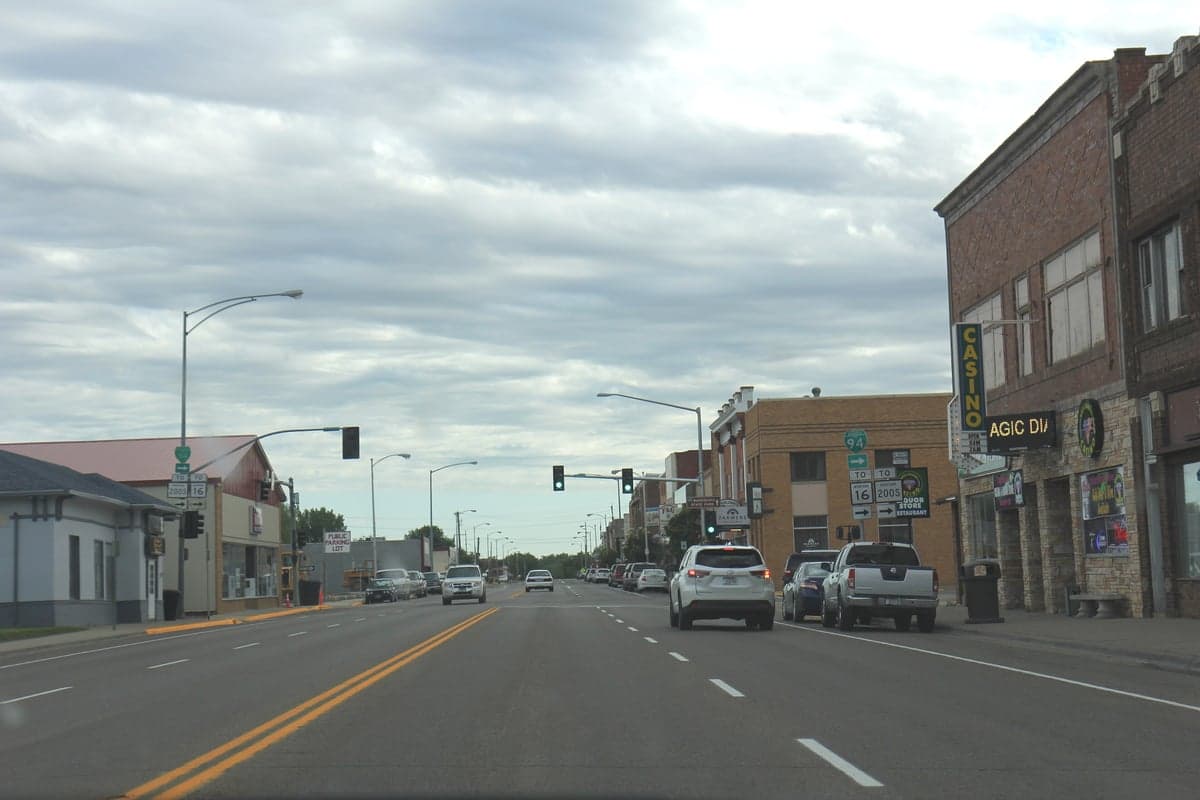
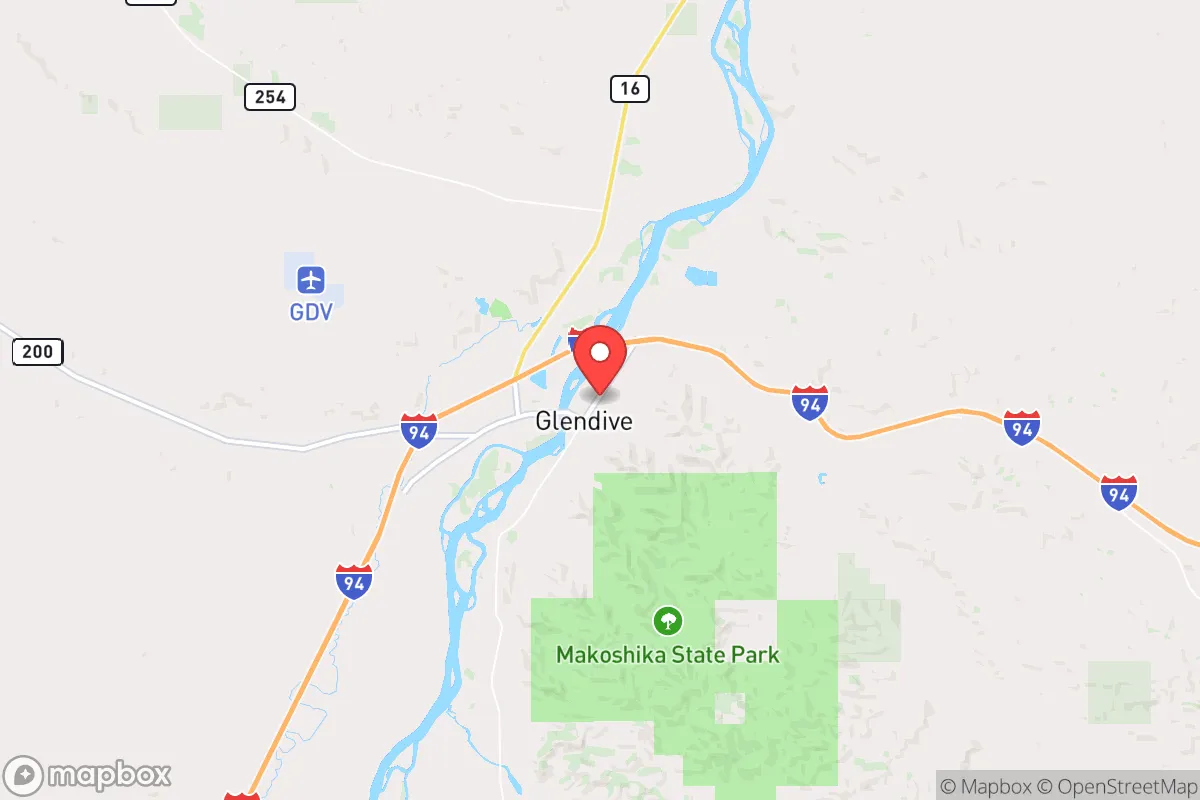
Photo: Wikipedia
Demographics of Glendive, MT
Affluence Level in Glendive, MT
A middle-class area roughly in line with national averages across income, home values, education, and employment.
People of Glendive, MT
Glendive, Montana, is a small, predominantly white community of 4,831 residents where 90.2% of the population identifies as white alone, and the foreign-born share is a negligible 0.2%. The city’s character is shaped by its role as a regional trade and energy hub in eastern Montana, with a blue-collar, family-oriented identity and a notably low college attainment rate of 25.8%. Hispanic residents make up 5.2% of the population, while Black (0.1%) and East/Southeast Asian (0.0%) communities are virtually absent, reflecting the area’s limited historical and contemporary immigration. This is a place where generational roots run deep, and new arrivals are overwhelmingly domestic, often drawn by energy, agriculture, or healthcare jobs.
How the city was settled and grew
Glendive’s founding and early growth were driven entirely by the railroad. The Northern Pacific Railway arrived in 1881, establishing a division point and repair shops that became the town’s economic backbone. The original settlers were a mix of Northern European immigrants—primarily German, Norwegian, and Irish—along with Anglo-American homesteaders drawn by the promise of land under the Homestead Act of 1862. These groups built the earliest residential core, now known as Old Town Glendive, clustered along Merrill Avenue and near the railroad yards. By the early 1900s, a second wave of homesteaders, many from the Upper Midwest, filled out the West Glendive neighborhood, which grew as the town expanded westward along the Yellowstone River. The discovery of oil in the nearby Cedar Creek field in the 1910s brought a smaller wave of workers, but the population remained overwhelmingly white and native-born through the mid-20th century. The city’s growth plateaued after the railroad’s decline in the 1950s, stabilizing at roughly 5,000 residents—a number it has held with little change for decades.
Modern era (post-1965)
After the 1965 Hart-Cellar Act, Glendive saw virtually no new immigration. The foreign-born population today is 0.2%, and the city’s racial composition has remained static: white share has stayed above 90% since records began. Domestic in-migration has been modest and selective. The energy boom of the 1970s and 1980s, centered on coal mining and power generation at the nearby Lewis & Clark Station, drew a small number of workers from other parts of Montana and the Dakotas. These newcomers settled primarily in North Glendive, a postwar subdivision of ranch-style homes built near the hospital and school complex. The 1990s and 2000s saw a slight uptick in Hispanic residents, rising from under 1% to 5.2% by 2020, largely driven by seasonal agricultural work in the surrounding sugar beet and wheat fields. These families have concentrated in the Southside area, a lower-density zone near the interstate, though the community remains small and integrated. No distinct ethnic enclaves exist; Glendive’s neighborhoods are defined more by housing age and income than by race.
The future
Glendive’s population is aging and slowly shrinking. The median age is 42.3, above the national average, and the city lost roughly 200 residents between 2010 and 2020. Projections from the Montana Department of Commerce suggest a continued gradual decline, with the population potentially falling below 4,500 by 2035. The Hispanic share may grow modestly as agricultural labor demand persists, but it is unlikely to exceed 8-10% given the limited economic draw for new arrivals. The white population will remain dominant, but the city is not homogenizing in a tribal sense—it is simply aging in place. Younger residents often leave for college or jobs in Billings or the oil fields of North Dakota, and few return. The East End, a newer subdivision of single-family homes built in the 2010s near the hospital, has attracted a handful of young families, but it remains a small pocket. For a newcomer, Glendive offers a stable, low-diversity community where social life revolves around churches, schools, and outdoor recreation on the Yellowstone River.
Glendive is becoming a quieter, older version of itself—a place where the population is more likely to shrink than diversify. For a conservative-leaning individual or family seeking a safe, slow-paced, and culturally homogeneous environment, this stability is a feature, not a bug. The city’s future is not one of rapid change but of gradual consolidation around its core identity as a white, working-class, and deeply rooted community.

* Values derived from national, state, county, city and local statistics and may differ in a specific area. Last updated: 2026-04-30T01:39:28.000Z
Narrative content on this page is AI-generated and may contain mistakes. Verify any details that matter before acting on them.
ReloMaps may earn a commission from affiliate links at no extra cost to you.

