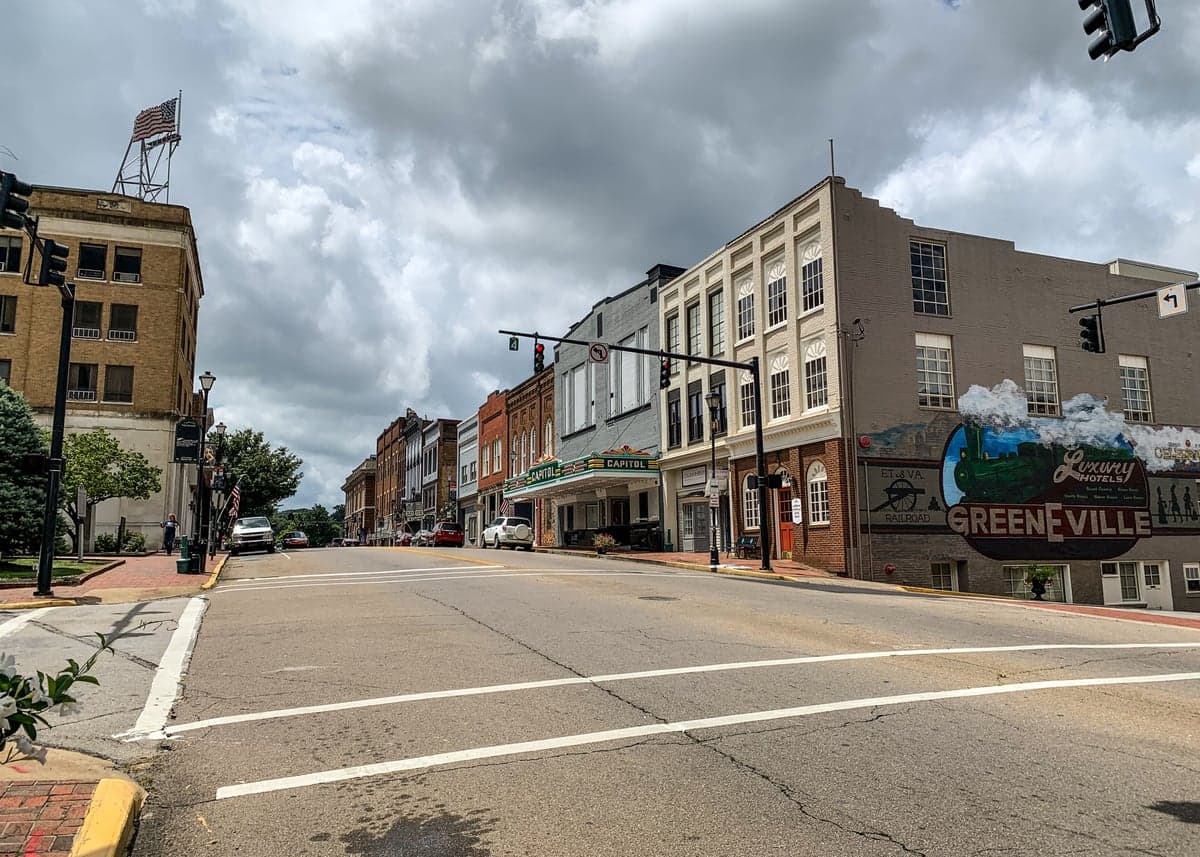
Photo: Wikipedia
Political ClimatePolitical Climate in Greeneville, TN
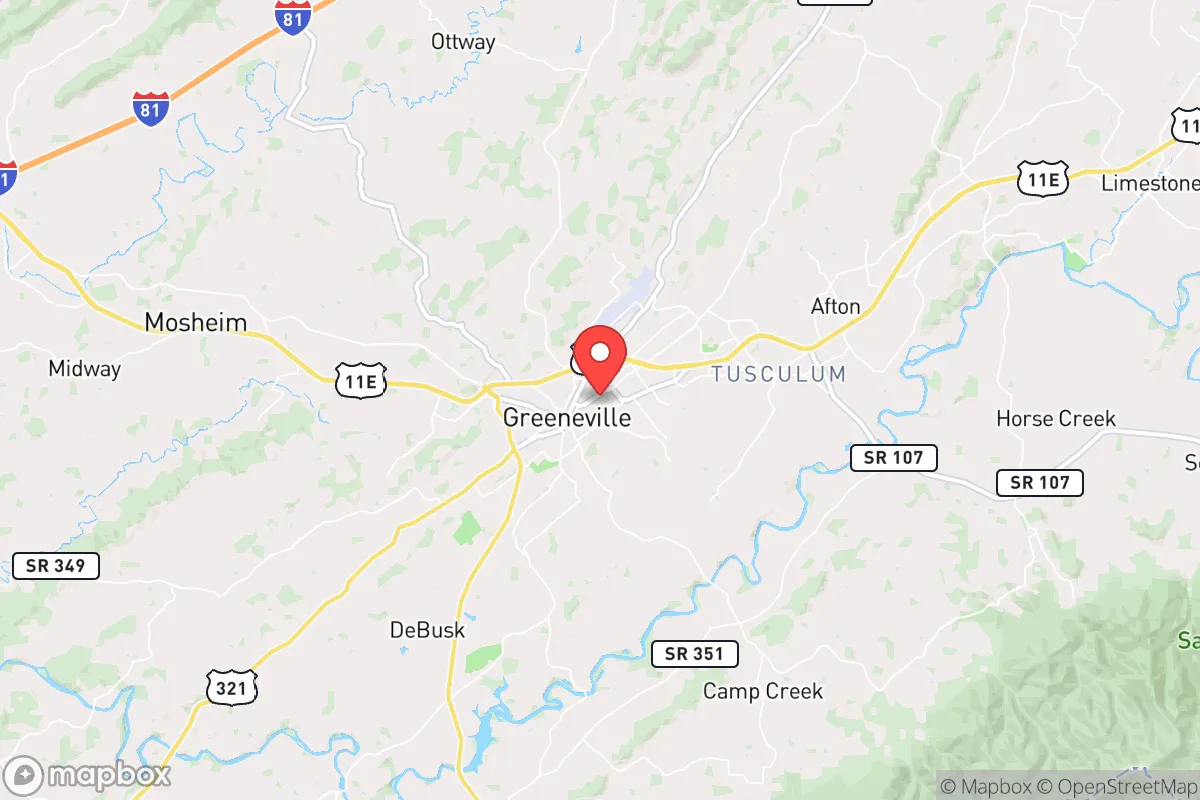
District shown is the primary district for this city’s centroid. Cities may span multiple districts.
Local Political AnalysisPolitical Analysis of Greeneville, TN
Greeneville is about as solidly conservative as it gets in Tennessee, and that’s not changing anytime soon. The Cook PVI here is R+29, meaning the district votes nearly 30 points more Republican than the national average—a number that puts it among the reddest areas in the entire country. If you’ve lived here a while, you remember when the county went even harder for Reagan than it did for Trump, and that streak hasn’t broken. The trajectory is steady: Greeneville stays conservative because the people here genuinely believe in limited government, local control, and keeping Washington out of their business. You don’t see the kind of flip-flopping you get in places like Nashville or Knoxville, where the suburbs are starting to drift left.
How it compares
Drive thirty minutes west to Morristown, and you’ll find a similar red-leaning vibe, but it’s not as deep—Hamblen County sits around R+20. Head north toward Johnson City, and you’ll hit a college town that’s noticeably more purple, with East Tennessee State University pulling the needle toward the center. But Greeneville? It’s surrounded by small towns like Mosheim and Tusculum that vote the same way, so there’s no real political contrast within the county. The biggest difference you’ll notice is when you go south to Newport or east toward the North Carolina line—those areas are still conservative, but they’re more libertarian-leaning, less tied to the old-school GOP machine. Greeneville’s politics are rooted in a deep sense of tradition, not just party loyalty.
What this means for residents
For folks living here, the political climate means you don’t have to worry about your local government pushing progressive social experiments. There’s no talk of defunding the police, no county-wide mask mandates that drag on forever, and no school board trying to sneak critical race theory into the curriculum. The tax burden stays low because the county commission isn’t interested in expanding government programs. What that translates to in daily life is simple: you keep more of your paycheck, your kids aren’t being indoctrinated, and your Second Amendment rights aren’t under constant attack from the local courthouse. The downside is that some people feel the area can be insular—if you’re not a churchgoer or a longtime family, you might feel like an outsider for a while. But for anyone who values personal freedom and hates government overreach, this is about as close to a safe haven as you’ll find in the eastern part of the state.
One thing that sets Greeneville apart culturally is how the local Republican Party here is still the old-school, Reagan-style kind—not the populist firebrands you see in some other parts of Tennessee. You won’t find a lot of Trump flags on every corner, but you will find a deep respect for the Constitution and a wariness of any politician who talks about “transforming” the community. The county has resisted efforts to bring in big-box development that would change the small-town character, and that same cautious attitude applies to politics. Looking ahead, the concern among longtime residents is that as retirees and remote workers move in from blue states, they’ll bring their voting habits with them. So far, that hasn’t happened in Greeneville the way it has in Franklin or Chattanooga, but it’s something people keep an eye on. For now, the political climate here is stable, conservative, and unlikely to shift unless the federal government starts forcing mandates that override local control—and that’s exactly the kind of overreach that would get people here fired up to push back even harder.

State Political ClimatePolitical Climate in Tennessee
State Political AnalysisPolitical Environment in the State
Tennessee has long been a reliably red state, with a strong Republican trifecta controlling the governorship and both legislative chambers. Over the last 10-20 years, the state has shifted decisively rightward, driven by a combination of suburban growth in the Nashville and Knoxville exurbs, a deep rural conservative base, and a steady influx of domestic migrants from blue states. The dominant coalition is a mix of fiscal conservatives, social conservatives, and Second Amendment advocates, with the state’s partisan lean now hovering around +15 to +20 points Republican in presidential elections. This trajectory shows no signs of reversing, though the fast-growing Nashville metro is introducing some political friction.
Urban vs. rural divide
The political map of Tennessee is a textbook study in the urban-rural split. The major metros—Nashville (Davidson County), Memphis (Shelby County), and Knoxville (Knox County)—are the state’s blue or purple anchors. Nashville has become increasingly Democratic, with Davidson County voting +25 for Biden in 2020, driven by a booming tech and healthcare economy and a younger, more diverse population. Memphis remains solidly Democratic, with Shelby County voting +35 for Biden, though its population is stagnant. Knoxville is more moderate, often tipping Republican in statewide races but with a Democratic-leaning city core. The real engine of Tennessee’s red lean is the vast rural and exurban expanse. Counties like Williamson (south of Nashville), Rutherford, and Wilson have flipped from purple to deep red as suburban families and retirees from California and Illinois pour in. Williamson County, for example, voted +22 for Trump in 2020, up from +16 in 2016. The state’s eastern third, including the Tri-Cities (Johnson City, Kingsport, Bristol) and Chattanooga, is reliably conservative, with Hamilton County (Chattanooga) trending redder as the city’s growth attracts conservative-leaning professionals. The divide is stark: the three major metros account for about 40% of the population but produce nearly all the Democratic votes, while the rest of the state’s 95 counties deliver overwhelming Republican margins.
Policy environment
Tennessee’s policy environment is aggressively conservative, with a focus on low taxes, limited regulation, and cultural conservatism. The state has no income tax on wages, relying instead on a 7% sales tax and a 1% tax on dividends and interest (the Hall Tax), which is being phased out and will be fully eliminated by 2029. Property taxes are low, with a median effective rate of 0.67%, among the lowest in the nation. The regulatory posture is business-friendly, with a right-to-work law and no state-level minimum wage above the federal $7.25. Education policy has been a flashpoint: the state passed a universal school voucher program in 2025 (the Tennessee Education Freedom Act), allowing any family to use public funds for private or homeschool expenses. This was a major win for school choice advocates. Healthcare is a mixed bag—Tennessee did not expand Medicaid under the ACA, leaving a coverage gap, but the state has a robust network of rural hospitals and a growing telehealth sector. Election laws are strict: voter ID is required, early voting is limited to 14 days, and the state purges inactive voters regularly. In 2023, the legislature passed a law banning ranked-choice voting and limiting ballot drop boxes. The overall posture is one of limited government intervention, though critics note that the state’s heavy reliance on sales tax is regressive.
Trajectory & freedom
Tennessee is becoming more free in several key areas, particularly gun rights, parental rights, and tax policy. In 2021, the state passed permitless carry (constitutional carry), allowing any law-abiding adult to carry a handgun without a permit. This was a major expansion of Second Amendment rights. In 2023, the legislature passed the “Tennessee Freedom Act,” which prohibits the enforcement of federal gun laws that violate state law—a direct challenge to federal overreach. Parental rights have been strengthened: the “Parental Bill of Rights” (2022) requires schools to notify parents of any medical or mental health services offered to their child and prohibits instruction on sexual orientation or gender identity in K-3 classrooms. The “Tennessee Promise” scholarship program has expanded educational freedom by offering two years of tuition-free community college. On the downside, the state has seen some concerning trends. In 2023, the legislature passed a law banning gender-affirming care for minors, which has drawn legal challenges and national attention. Medical autonomy has been curtailed in other ways: the state’s abortion ban, triggered in 2022, prohibits nearly all abortions with narrow exceptions. Property rights are generally strong, with no statewide zoning mandates, but local governments in Nashville and Memphis have imposed rent control and inclusionary zoning, which some conservatives see as government overreach. The trajectory is toward more personal liberty in the traditional conservative sense—gun rights, school choice, low taxes—but with significant restrictions on medical and social issues.
Civil unrest & political movements
Tennessee has seen its share of political flashpoints, but they are relatively contained compared to states like Oregon or Washington. The most visible unrest occurred in 2020, when protests in Nashville and Memphis over the death of George Floyd turned into clashes with police, resulting in property damage and arrests. The state’s response was swift: the legislature passed a law in 2021 increasing penalties for rioting and blocking highways. Immigration politics are a growing issue, particularly in the Nashville metro, where the Hispanic population has grown by 50% since 2010. The state has no sanctuary city policies—in fact, a 2023 law requires local law enforcement to cooperate with ICE and prohibits “sanctuary” ordinances. There have been no serious secession or nullification movements, though the “Tennessee Freedom Act” mentioned earlier is a form of nullification against federal gun laws. Election integrity controversies have been minimal, though the state’s voter ID law and purge practices have drawn criticism from the left. The most visible political movement is the rise of the “Moms for Liberty” chapter in Williamson County, which has been active in school board meetings and book bans. On the left, the “Tennessee Justice Center” and “Indivisible” groups organize around healthcare and voting rights, but they are a distinct minority. A new resident would notice the political climate is generally calm, with occasional flare-ups around school curriculum and gun rights.
Projection
Over the next 5-10 years, Tennessee will likely become more conservative, not less. The primary driver is in-migration: the state is adding about 80,000 new residents per year, mostly from California, Illinois, and New York. These migrants are disproportionately conservative-leaning families and retirees seeking lower taxes and a more traditional culture. The Nashville metro will continue to grow, but the exurbs—Murfreesboro, Franklin, Spring Hill—are where the political energy is. These areas are voting increasingly Republican, offsetting any blue shift in the urban core. The state’s rural counties are aging but remain deeply red, and the legislature is likely to continue passing conservative legislation on school choice, gun rights, and tax cuts. The biggest wild card is the federal courts: the state’s abortion ban and gender-affirming care ban are being challenged, and a Democratic administration in Washington could force compliance. But at the state level, the trajectory is clear: Tennessee will remain a red state, with the Republican supermajority in the legislature likely to grow. A new resident moving in now should expect to find a state that is increasingly aligned with traditional conservative values, with a government that is actively pushing back against federal overreach.
For a new resident, the bottom line is this: Tennessee offers a high degree of personal freedom in the areas that matter most to conservatives—low taxes, strong gun rights, school choice, and limited government regulation. The political climate is stable and predictable, with a government that is responsive to conservative voters. The trade-offs are a regressive tax system, limited healthcare access for low-income residents, and a cultural environment that can feel insular in the rural areas. If you value low taxes, a business-friendly environment, and a government that respects your rights as a parent and gun owner, Tennessee is a strong choice. Just be prepared for the summer heat and the fact that Nashville’s growth is bringing some of the same traffic and housing cost issues you might be trying to escape.
* Values derived from national, state, county, city and local statistics and may differ in a specific area. Last updated: 2026-05-01T05:25:28.000Z
Narrative content on this page is AI-generated and may contain mistakes. Verify any details that matter before acting on them.
ReloMaps may earn a commission from affiliate links at no extra cost to you.

