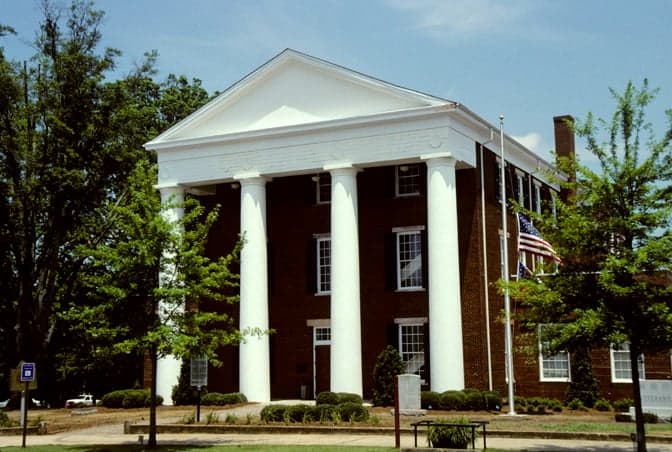
Photo: Wikipedia
Demographics of Greensboro, GA
Affluence Level in Greensboro, GA
A below-average socioeconomic profile. Incomes, home values, and educational attainment trail the U.S., with higher poverty and unemployment.
People of Greensboro, GA
The people of Greensboro, Georgia today form a predominantly Black community (55.8%) with a significant White minority (35.3%) and a small but growing Hispanic population (5.4%), creating a demographic profile distinct from many other small Georgia towns. With a population of 3,603, the city maintains a tight-knit, historically rooted character where family ties and church communities remain central to daily life. The foreign-born share sits at just 3.7%, and the college-educated rate of 25.2% is below the national average, reflecting a working-class identity shaped by agriculture, manufacturing, and local services. This is a place where old families still anchor neighborhoods, and newcomers—whether retirees, remote workers, or Hispanic laborers—are still a distinct minority.
How the city was settled and grew
Greensboro was founded in 1803 as the seat of Greene County, named for Revolutionary War General Nathanael Greene. The original White settlers were primarily yeoman farmers and planters from Virginia and the Carolinas, drawn by the fertile Piedmont soil and the promise of cotton cultivation. These early families built their homes around the courthouse square, establishing what is now Downtown Greensboro as the commercial and civic core. By the 1830s, the forced removal of the Creek Nation opened additional land, and the plantation economy expanded rapidly, bringing enslaved Black laborers who formed the majority of the county's population by 1860. After the Civil War, freedmen established their own communities, most notably East Greensboro and the area around Springfield Baptist Church, where Black churches, schools, and small businesses anchored a self-sufficient neighborhood. The arrival of the Georgia Railroad in the 1850s and later the Central of Georgia Railway made Greensboro a shipping hub for cotton and timber, drawing a small wave of Irish and German immigrants who settled near the rail depot in what is now Depot District. By 1900, the population was roughly evenly split between Black and White residents, with rigid segregation shaping every aspect of life.
Modern era (post-1965)
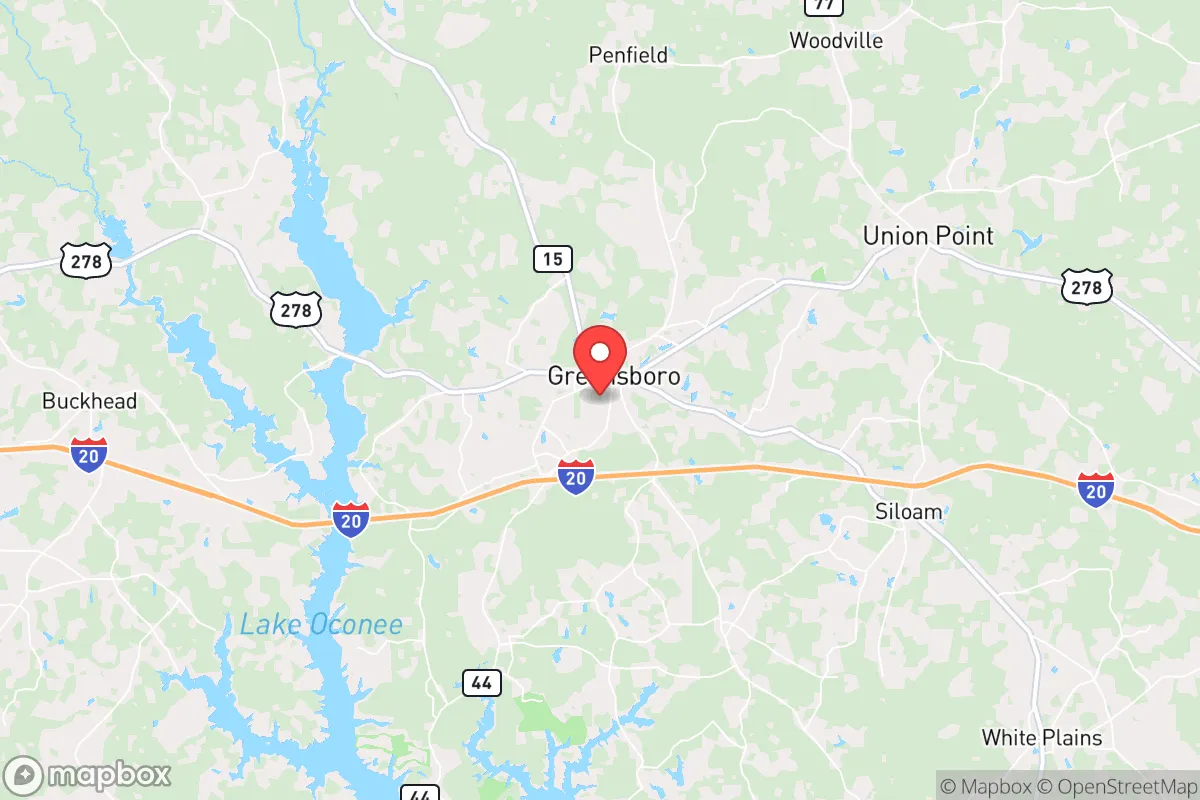
The post-1965 period brought significant demographic change, driven by the twin forces of civil rights gains and agricultural mechanization. The Black population, which had been the backbone of the cotton and sharecropping economy, began to shift from rural farm labor into town-based jobs in manufacturing, education, and local government. East Greensboro solidified as the city's primary Black residential area, while West Greensboro remained predominantly White, a pattern that persists today. The 1970s and 1980s saw a modest influx of White retirees and second-home buyers drawn to Lake Oconee, created by Georgia Power in 1979. This lakefront development spurred new subdivisions like Reynolds Plantation (now part of the Ritz-Carlton Reynolds community), which attracted affluent, largely White newcomers from Atlanta and the Southeast. Meanwhile, the Hispanic population began to grow in the 1990s and 2000s, as Latino laborers moved into the area for construction, landscaping, and poultry processing jobs. These families have concentrated in south Greensboro near the industrial parks and along Highway 44, where rental housing and mobile home parks offer affordable entry points. The Asian and Indian populations remain negligible at 0.0% each, reflecting the area's limited draw for professional immigrants compared to metro Atlanta. The overall population has been relatively stable since 2000, hovering around 3,500–3,600, with the Black share declining slightly from over 60% in 1990 as White and Hispanic shares have edged upward.
The future
The population of Greensboro is likely to become slightly more diverse over the next 10–20 years, but the pace of change will be slow. The Hispanic share, currently 5.4%, is expected to grow as families settle and birth rates remain above the national average, with new arrivals likely concentrating in south Greensboro and along the Highway 44 corridor. The White population, buoyed by lakefront retirement and second-home development around Reynolds Plantation and Lake Oconee, may increase modestly, particularly among affluent retirees and remote workers seeking a lower cost of living. The Black population, while still the majority, may continue a gradual decline as younger Black residents leave for educational and job opportunities in Atlanta, Athens, and beyond. The foreign-born share is unlikely to rise dramatically given the area's limited economic base and lack of major immigrant gateway infrastructure. The college-educated rate may tick up as lakefront communities attract more professionals, but the overall character of Greensboro will remain working-class and family-oriented, with a strong church and community center presence. New residential development is likely to be concentrated in lakefront subdivisions and along the Highway 44 corridor, while the historic core of East Greensboro and Downtown will see slower reinvestment.
For someone moving in now, Greensboro offers a stable, slow-changing community where racial lines are still visible but daily life is neighborly and unhurried. The city is becoming a slightly more diverse, slightly more affluent place, but the core identity—Black-majority, working-class, deeply rooted in church and family—will remain the dominant reality for the foreseeable future. Newcomers should expect a warm but cautious welcome, where fitting in means respecting established traditions and building relationships over time.

* Values derived from national, state, county, city and local statistics and may differ in a specific area. Last updated: 2026-08-17T20:13:03.000Z
Narrative content on this page is AI-generated and may contain mistakes. Verify any details that matter before acting on them.
ReloMaps may earn a commission from affiliate links at no extra cost to you.

