

Photo: Wikipedia
Political ClimatePolitical Climate in Greensboro, GA
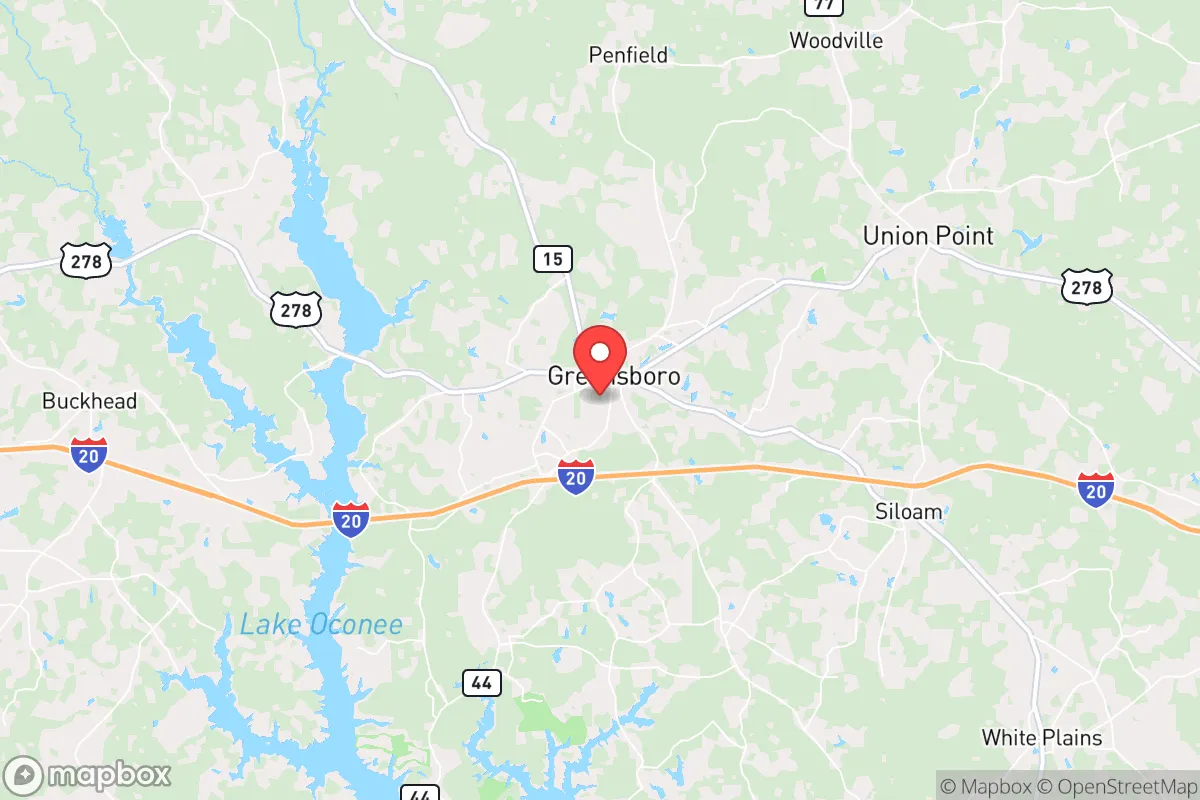
District shown is the primary district for this city’s centroid. Cities may span multiple districts.
Local Political AnalysisPolitical Analysis of Greensboro, GA
Greensboro, Georgia, sits in a deeply conservative corner of the state, with a Cook Partisan Voting Index of R+11, meaning the area reliably votes about 11 points more Republican than the national average. That’s a solid red lean, and it’s been that way for a while, though the flavor of that conservatism has shifted a bit over the past decade. You’ll find a mix of old-school Southern Democrats who’ve long since switched parties, newer retirees from metro Atlanta looking for lower taxes and slower living, and a growing number of folks who work remotely but want to keep their politics local. The trajectory is steady red, but not without some interesting undercurrents—especially as the lakefront development around Lake Oconee brings in more moderate and even a few liberal-leaning seasonal residents.
How it compares
Compared to the rest of Georgia, Greensboro is noticeably more conservative than the state as a whole, which has a Cook PVI of R+3. That means the county—Greene County—is about eight points redder than the statewide average. Drive 30 minutes west to Madison or 45 minutes south to Eatonton, and you’ll find similar politics, though Madison has a slightly more moderate streak thanks to its historic district and a small but vocal arts community. Head an hour north to Athens, and the contrast is stark: that’s a deep blue college town, a world away in both culture and voting patterns. The real difference, though, is in the intensity of the conservatism. In Greensboro, you’re less likely to hear heated debates about national politics at the coffee shop; it’s more of a quiet, lived-in Republicanism. The state as a whole, especially around Atlanta, is more polarized and competitive. Here, the primary is often the real election.
What this means for residents
For conservative residents, this is a comfortable place to live. Local government tends to lean pro-business, taxes are kept low, and there’s little appetite for progressive policy experiments. You’ll find plenty of churches, gun-friendly attitudes, and a general sense that government should stay out of daily life. For liberal residents, it’s a different story. You won’t face open hostility—most folks are polite—but you’ll likely feel like a minority voice. Progressive candidates rarely run for local office, and when they do, they don’t win. That said, the lake community brings in some diversity of thought, especially among second-home owners from Atlanta or out of state. They tend to keep their politics quiet, but they do influence local debates around development and environmental rules. The practical effect is that if you’re liberal, you’ll probably find your social circle among other lake folks or in nearby Athens for cultural events. If you’re conservative, you’ll feel right at home at the local diner or the county commission meeting.
Culturally, Greensboro stands apart from the rest of Georgia in a few ways. The Lake Oconee area has a distinct resort-town vibe that softens some of the hard edges you might find in deeper rural counties. You’ll see more out-of-state license plates, more golf carts, and a slightly more polished version of Southern living. Policy-wise, the county has been cautious about growth—zoning is stricter than in neighboring counties, partly to protect lakefront property values. That’s a conservative impulse (property rights, low taxes) but it also means less sprawl and more intentional development. In the long term, I see the area staying red, but with a growing libertarian streak—people who want small government but also don’t want to be told what to do with their land. It’s a good place to live if you value predictability and a slower pace, no matter which box you check on your ballot.

State Political ClimatePolitical Climate in Georgia
State Political AnalysisPolitical Environment in the State
Georgia has transformed from a reliably Republican stronghold into the nation’s premier swing state, with a partisan lean that now sits at roughly R+3 after decades of GOP dominance. The state’s political trajectory over the past 20 years is a story of rapid suburbanization and demographic change: in 2004, George W. Bush won Georgia by 17 points; by 2024, Donald Trump carried it by just 2.4 points, while Democrats have swept every statewide federal race since 2020 (two Senate seats and the presidential contest). The dominant coalitions are a rural, white, and older Republican base concentrated in the interior versus a multiracial, college-educated, and increasingly liberal metro Atlanta coalition that now drives statewide outcomes. For a relocator, this means you’re moving into a state where your vote genuinely matters—and where the political culture is split between deep-red small towns and purple-to-blue suburbs.
Urban vs. rural divide
The political map of Georgia is defined by the sharp contrast between metro Atlanta and the rest of the state. Atlanta proper and its inner-ring suburbs like Decatur and Brookhaven are solidly Democratic, delivering margins of 70-85% for the party. The real story, though, is the suburban crescent—counties like Cobb, Gwinnett, and Henry that were reliably Republican as recently as 2012 but have flipped blue due to an influx of college-educated professionals and diverse populations. Gwinnett County, for example, went from voting for Mitt Romney by 12 points in 2012 to supporting Joe Biden by 18 points in 2020. Meanwhile, rural south Georgia—places like Valdosta and Thomasville—and the northern mountain counties remain deeply Republican, often voting 70-80% for the GOP. The exurban fringe, including fast-growing Buford and Dawsonville, is where the GOP is holding its ground, but these areas are seeing demographic shifts too. The practical takeaway: if you live inside I-285, you’re in a blue bubble; if you’re in a small town, you’re in a red one; and if you’re in the outer suburbs, you’re in the battleground.
Policy environment
Georgia’s policy environment is a mix of conservative governance with pragmatic moderation on economic issues. The state has a flat income tax rate of 5.49% (down from 5.75% in 2024, with a scheduled drop to 4.99% by 2029), no estate tax, and a relatively low property tax burden thanks to the homestead exemption and assessment caps that limit annual increases to 3% for owner-occupied homes. Sales tax rates vary by county, typically 7-8%. On education, Georgia has a robust school choice ecosystem: the Georgia Promise Scholarship Act (2024) provides up to $6,500 per year for private school tuition or homeschooling expenses, and there are over 100 charter schools statewide. Healthcare policy is more mixed—the state did not expand Medicaid under the Affordable Care Act, leaving roughly 300,000 low-income adults in the coverage gap, but it has a strong Certificate of Need law that limits hospital competition. Election laws have been a flashpoint: the Election Integrity Act of 2021 (SB 202) added voter ID requirements for absentee ballots, limited drop box locations, and restricted third-party ballot collection, while also expanding early voting hours in most counties. For a conservative relocator, the tax and school choice policies are clear wins; for a liberal one, the healthcare gap and voting restrictions are notable downsides.
Recent policy direction
Georgia’s recent legislative sessions have pushed the state further right on cultural and regulatory issues while maintaining a business-friendly posture. On gun and self-defense law, Georgia is a constitutional carry state (permitless carry for adults 21 and over, passed in 2022 via SB 319), and has a strong Stand Your Ground law. Parental and education rights saw a major win with the Parents’ Bill of Rights (SB 449, 2022), which requires schools to notify parents of any changes to a child’s mental, emotional, or physical health—effectively limiting transgender student privacy policies. Speech and privacy are generally protected, though the state passed a foreign ownership ban on agricultural land (SB 420, 2024) that restricts purchases by entities from China, Russia, and other listed countries. On medical and bodily autonomy, Georgia’s Living Infants Fairness and Equality (LIFE) Act (HB 481, 2019) bans abortion after a fetal heartbeat is detected (around six weeks), with exceptions for rape, incest, and life of the mother—a law that was blocked by courts for two years but reinstated in 2022 after Dobbs. Property rights are strong: Georgia is a right-to-farm state, limiting nuisance lawsuits against agricultural operations, and has no statewide rent control. Taxation is trending downward: the 2024 tax cut package accelerated the income tax rate reduction and doubled the standard deduction. Ballot access remains a point of contention: while voter registration is easy (online, same-day registration during early voting), the 2021 law shortened the runoff election period from nine weeks to four, which critics say suppresses turnout. For a relocator, the direction is clear: Georgia is becoming more conservative on social issues and more libertarian on economic ones.
Civil unrest & political movements
Georgia has seen its share of political flashpoints, but the state is not a hotbed of ongoing civil unrest. The 2020 election aftermath was the biggest recent event: the state was ground zero for Trump’s efforts to overturn the results, leading to the now-famous phone call to Secretary of State Brad Raffensperger and a subsequent Fulton County grand jury investigation that resulted in a 2023 indictment of Trump and 18 allies. That case has polarized the state, with Trump supporters viewing it as a political prosecution and opponents seeing it as accountability. Protest activity has been concentrated in Atlanta: the Cop City protests (2021-2023) against a proposed police training facility in DeKalb County turned violent, with one activist killed by law enforcement and dozens arrested. On the right, the Georgia Republican Party has seen internal battles between establishment figures (like Governor Brian Kemp) and Trump-aligned challengers, with Kemp winning his 2022 primary by a wide margin—indicating that the state GOP is not fully MAGA-dominated. Immigration politics are a live issue: Georgia passed a strict E-Verify mandate for all employers (HB 87, 2011) and has no sanctuary cities, though Atlanta’s Welcoming City policy limits cooperation with ICE. Election integrity remains a rallying cry for the right, with ongoing audits and lawsuits over ballot drop boxes and absentee ballot processing. A new resident will notice the political tension mostly in the form of yard signs, bumper stickers, and heated local news coverage—but not in daily safety or social friction.
Projection
Over the next 5-10 years, Georgia is likely to become even more competitive, with a slight Democratic lean in statewide races driven by continued suburbanization and in-migration from blue states. The 2020-2024 pattern suggests that Democrats have a structural advantage in metro Atlanta that is growing faster than the GOP’s rural base can offset. However, the state’s electoral map is not static: fast-growing exurban counties like Forsyth and Paulding are trending redder as they fill with conservative-leaning transplants from California and the Northeast. The 2026 governor’s race will be a key test: if a Democrat can win, Georgia will be considered a true swing state; if the GOP holds, it will remain a lean-red state with occasional blue upsets. Demographically, the state is becoming more diverse (the 2020 census showed the white population share dropping below 50% for the first time), and younger voters are more liberal. Policy-wise, expect continued tax cuts, further school choice expansion, and likely a push for a constitutional amendment on school vouchers. Abortion and voting laws will remain battlegrounds, but the state’s business-friendly posture—home to Fortune 500 companies like Coca-Cola, Delta, and Home Depot—will likely prevent any extreme swings. For a relocator, the takeaway is that Georgia in 2035 will look much like it does today: a purple state where your vote counts, your taxes are low, and your lifestyle choices are largely your own—but the political temperature will stay high.
For a new resident, the bottom line is that Georgia offers a low-tax, high-opportunity environment with a political culture that is genuinely contested. If you’re conservative, you’ll find a state government that reflects your values on guns, abortion, and school choice, but you’ll need to accept that your neighbors in the suburbs may not share them. If you’re liberal, you’ll find a vibrant urban core and growing suburban coalition that can win statewide, but you’ll face a legislature that is often hostile to your priorities. The practical reality is that Georgia is a place where politics is a spectator sport—but it rarely disrupts daily life. The economy is strong, the cost of living is moderate, and the weather is warm. Just be prepared for your vote to matter, and for the conversation at the dinner table to get lively.
* Values derived from national, state, county, city and local statistics and may differ in a specific area. Last updated: 2026-08-17T20:13:03.000Z
Narrative content on this page is AI-generated and may contain mistakes. Verify any details that matter before acting on them.
ReloMaps may earn a commission from affiliate links at no extra cost to you.

