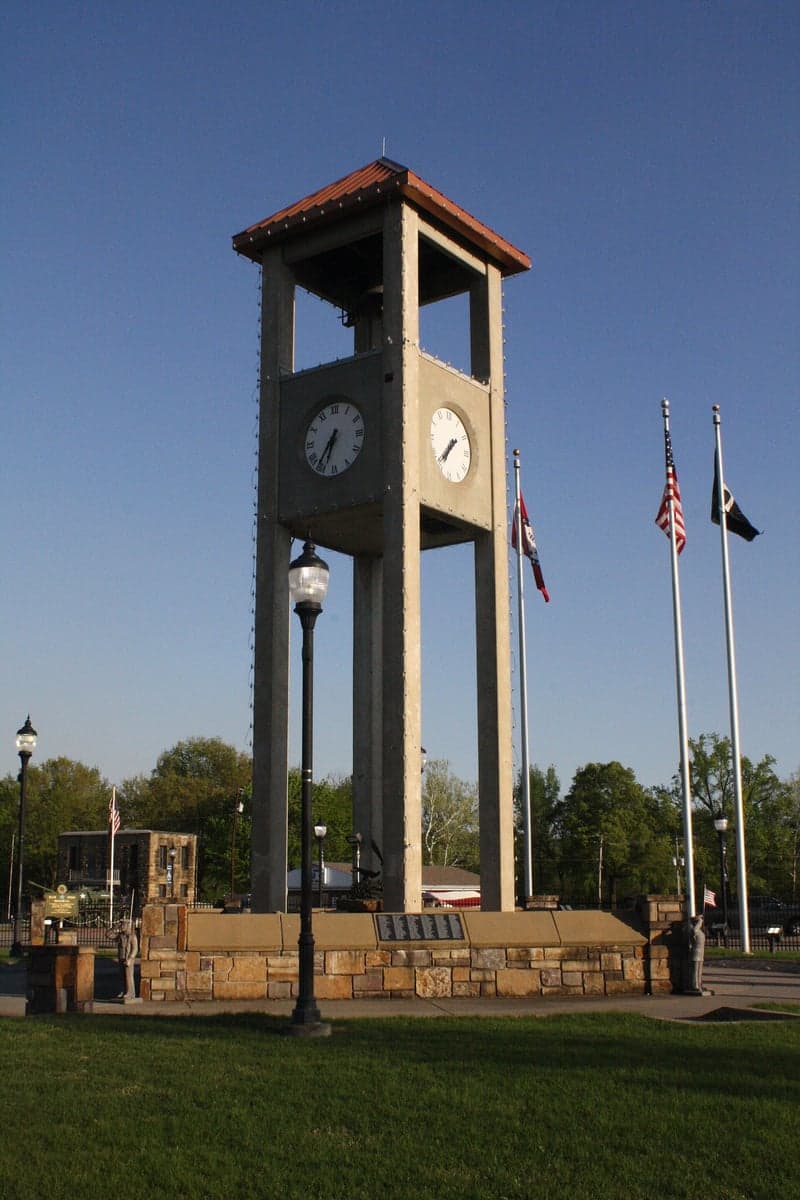
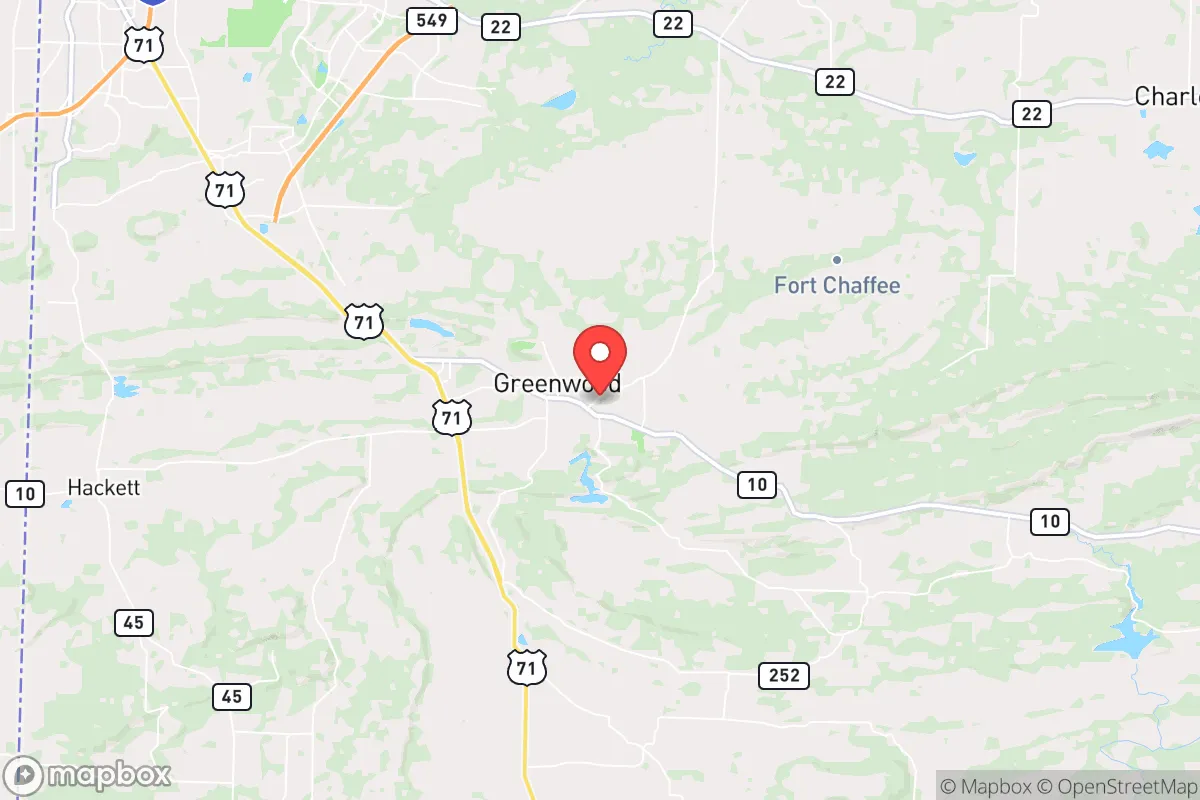
Photo: Wikipedia
Demographics of Greenwood, AR
Affluence Level in Greenwood, AR
A middle-class area roughly in line with national averages across income, home values, education, and employment.
People of Greenwood, AR
The people of Greenwood, Arkansas, today form a predominantly white, family-oriented community of 9,570 residents, characterized by a strong sense of local identity and a notably low rate of demographic change. With a foreign-born population of 0.0% and a Hispanic share of 8.3%, the city is overwhelmingly native-born and English-speaking, creating a social environment where newcomers are expected to integrate into established local norms. The population is less college-educated than the national average at 28.3%, reflecting a workforce rooted in trades, local services, and commuting to nearby Fort Smith, giving the city a practical, blue-collar character.
How the city was settled and grew
Greenwood was founded in the 1850s as a farming and trading post along the Arkansas River Valley, with the original settlers being Anglo-American families moving west from Tennessee, Kentucky, and Missouri. These early arrivals were drawn by the fertile bottomlands and the promise of cotton and livestock agriculture, and they established the core of what is now Old Town Greenwood, centered around the original courthouse square. The arrival of the St. Louis–San Francisco Railway in the 1880s spurred a second wave of settlement, bringing merchants and craftsmen who built homes in the Railroad Addition district, just south of the tracks. The city remained a small, homogeneous agricultural hub through the early 20th century, with virtually no immigration from outside the United States, a pattern that set the foundation for its current demographic makeup.
Modern era (post-1965)
After the 1965 Hart-Cellar Act, Greenwood saw no significant influx of foreign-born residents, as the city lacked the industrial or service-sector jobs that attracted immigrants to larger urban centers. Instead, the post-1965 period was defined by domestic in-migration from within Arkansas and neighboring states, driven by the expansion of the Fort Smith metropolitan area. The construction of Interstate 540 in the 1990s made Greenwood a viable commuter suburb, and new subdivisions like Woodland Hills and Pheasant Run absorbed families moving out of Fort Smith for lower taxes and larger lots. The Hispanic population, now 8.3%, grew modestly during this period, primarily through families working in poultry processing and construction, and they concentrated in the South Greenwood area near Highway 96. The Black population remained negligible at 0.4%, and both East/Southeast Asian and Indian-subcontinent communities registered at 0.0%, reinforcing the city's status as one of the least ethnically diverse municipalities in the region.
The future
Looking ahead, Greenwood is likely to remain demographically stable, with no major forces driving rapid diversification. The foreign-born population is projected to stay near zero, as the city lacks the rental housing stock, public transit, and entry-level job networks that attract immigrant communities. The Hispanic share may grow slowly through natural increase and continued migration from within Arkansas, but it is unlikely to exceed 12-15% in the next decade, and these families are expected to assimilate into existing neighborhoods rather than forming distinct ethnic enclaves. The Greenwood Highlands and Stonebridge subdivisions, both built since 2010, are attracting young white families from within the region, reinforcing the city's homogeneous character. The population is aging slightly, with the median age rising as younger adults move to Fort Smith or larger cities, but Greenwood's reputation for low crime and strong schools will continue to draw conservative-leaning families seeking a stable, predictable community.
For someone moving in now, Greenwood offers a community where the population is not just stable but static in its ethnic and cultural composition. The city is becoming a more affluent bedroom suburb, but it is not becoming more diverse, more urban, or more cosmopolitan. New residents should expect a place where the social fabric is woven from long-standing local ties, and where being an outsider is a temporary status that fades with participation in church, school, and civic life. This is a community that values continuity over change, and it delivers exactly that to those who choose to call it home.

* Values derived from national, state, county, city and local statistics and may differ in a specific area. Last updated: 2026-04-29T21:42:37.000Z
Narrative content on this page is AI-generated and may contain mistakes. Verify any details that matter before acting on them.
ReloMaps may earn a commission from affiliate links at no extra cost to you.

