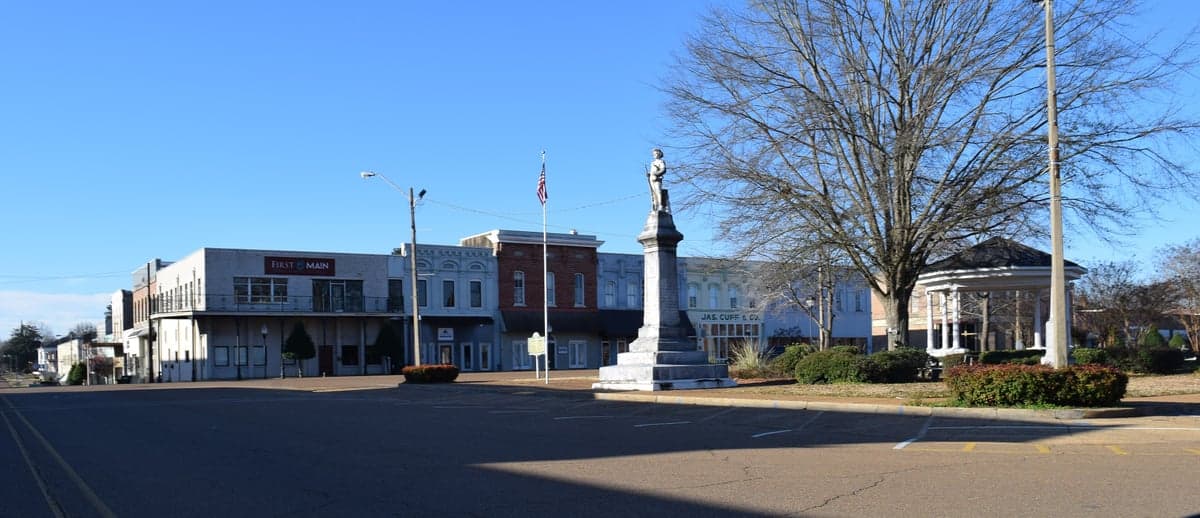
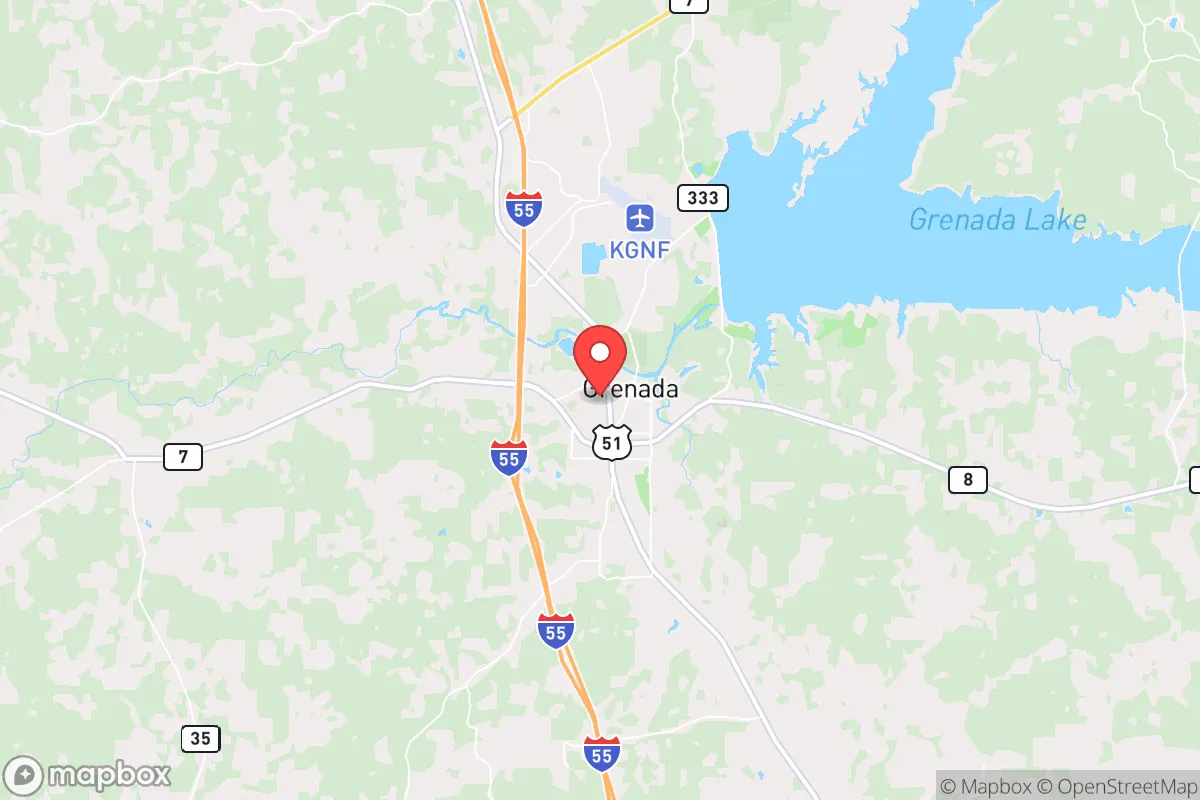
Photo: Wikipedia
Demographics of Grenada, MS
Affluence Level in Grenada, MS
A below-average socioeconomic profile. Incomes, home values, and educational attainment trail the U.S., with higher poverty and unemployment.
People of Grenada, MS
The people of Grenada, Mississippi, today number 12,484, forming a majority-Black city (56.4%) with a substantial White minority (40.4%) and a very small foreign-born population of just 1.4%. The city’s character is distinctly Southern and working-class, with a college attainment rate of 26.8% that trails the national average, reflecting its roots in agriculture and manufacturing. Grenada’s identity is shaped by a deep history of racial division and economic transition, with its population concentrated in historic neighborhoods that still echo the settlement patterns of the 19th and 20th centuries.
How the city was settled and grew
Grenada was founded in 1836 as a railroad and river town at the crossroads of the Yalobusha River and the Mississippi Central Railroad. The original population was drawn by land grants and the promise of cotton wealth, with White planters and their enslaved Black laborers arriving from the older states of Virginia, the Carolinas, and Georgia. By the 1850s, the city had a thriving cotton economy, and the enslaved population formed the majority of the labor force. After the Civil War, freedmen established their own communities, most notably in the Depot District near the railroad tracks, where Black-owned businesses and churches anchored a self-sufficient neighborhood. The White planter class concentrated in the Hill District (around present-day Hill Street), where larger homes and a separate social infrastructure developed. A second wave of settlement came in the early 1900s with the expansion of the lumber industry, drawing White and Black workers from the surrounding countryside into neighborhoods like the North Grenada Addition, a working-class area that grew as sawmills and cotton gins expanded. By 1950, the population had reached roughly 7,000, with the city’s racial composition already tilting Black, though official segregation kept neighborhoods sharply divided.
Modern era (post-1965)
The post-1965 era brought significant demographic shifts, driven by the end of legal segregation and the decline of the cotton and lumber industries. The Immigration and Nationality Act of 1965 had minimal direct impact on Grenada—the city’s foreign-born population remains tiny at 1.4%—but domestic migration reshaped the city. White flight accelerated in the 1970s and 1980s as Black families moved into previously all-White neighborhoods, particularly the Grenada Lake area (around the U.S. Army Corps of Engineers reservoir), which saw an influx of Black middle-class families seeking newer housing. Meanwhile, many White residents relocated to the southern outskirts (along Highway 51 and Interstate 55) or to the unincorporated communities of Gore Springs and Elliott. The city’s Black population share rose from roughly 45% in 1970 to 56.4% today, while the White share fell from over 50% to 40.4%. The Asian population—East and Southeast Asian groups only—remains negligible at 0.2%, with no Indian-subcontinent community recorded. The Hispanic population is listed at 0.0%, indicating no measurable presence. The college-educated share of 26.8% reflects the city’s limited white-collar job base, with many residents commuting to Grenada Lake’s tourism sector or to manufacturing plants in nearby towns like Winona and Greenwood.
The future
Grenada’s population is likely to continue its slow decline—the city lost roughly 1,000 residents between 2010 and 2020—as younger, educated residents leave for larger job markets in Jackson, Tupelo, or Memphis. The city is not homogenizing into a single identity; rather, it is tribalizing along racial and economic lines. The Black majority is concentrated in the older central neighborhoods (the Depot District and North Grenada Addition), while the White minority is increasingly clustered in the southern and lake-area subdivisions. The foreign-born population is too small to drive any significant change, and no immigrant community is growing or plateauing. The next 10–20 years will likely see further population loss, with the city becoming older and more economically stratified. The college-educated share may rise slightly if remote work allows some professionals to stay, but the overall trend is toward a smaller, poorer, and more racially divided city.
For someone moving in now, Grenada offers a low cost of living and a quiet, small-town atmosphere, but the demographic trajectory points to continued contraction and limited diversity. The city is becoming a predominantly Black, working-class community with a shrinking White minority, and newcomers should expect a place where racial and economic lines remain clearly drawn. The lack of immigrant growth means the city will not see the cultural or economic revitalization that has reshaped other Southern towns, making it a stable but static choice for relocation.

* Values derived from national, state, county, city and local statistics and may differ in a specific area. Last updated: 2026-04-30T19:59:28.000Z
Narrative content on this page is AI-generated and may contain mistakes. Verify any details that matter before acting on them.
ReloMaps may earn a commission from affiliate links at no extra cost to you.

